Resume and cover letter resources
Cybersecurity Engineer Resume Example 2026
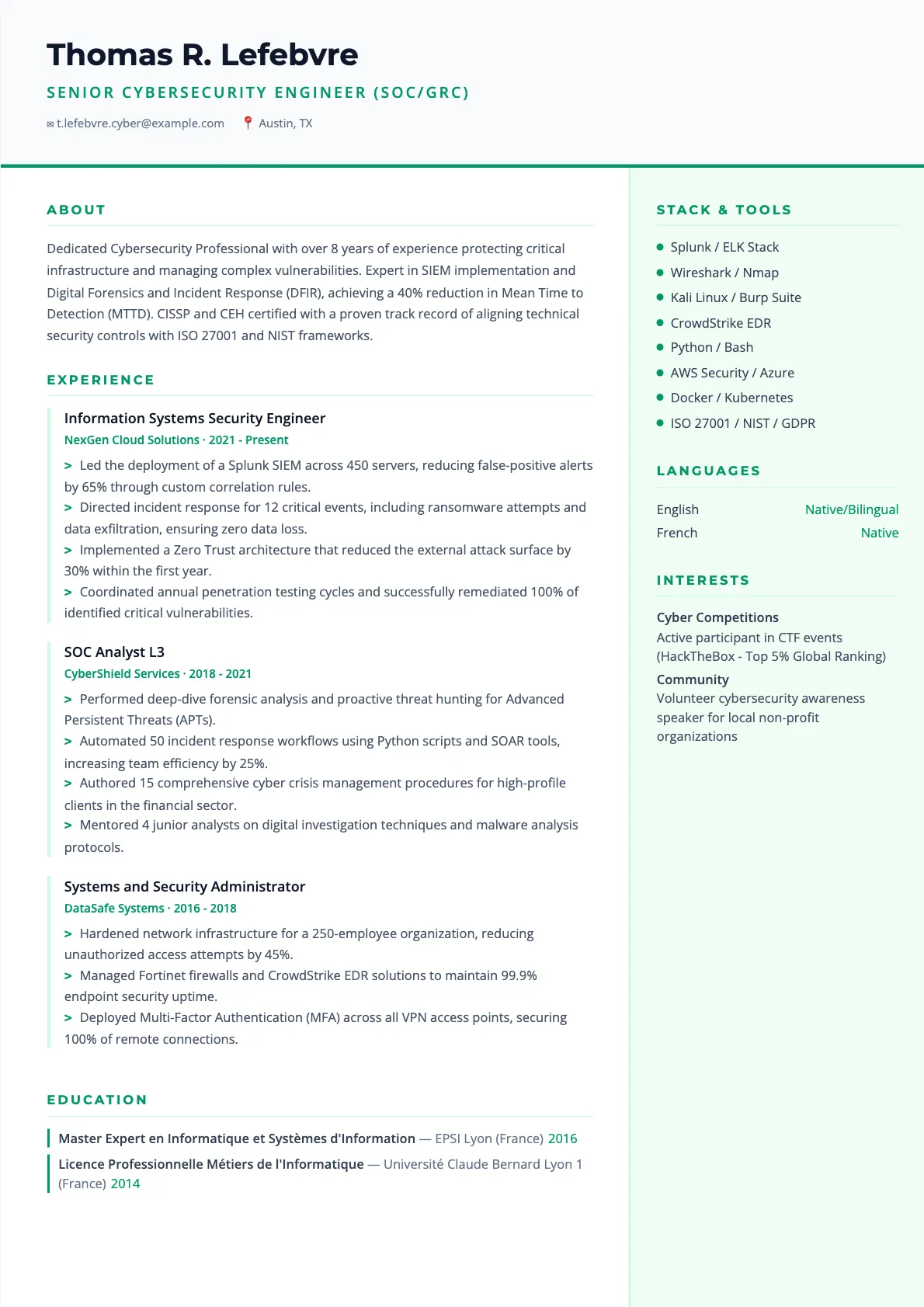
A Cybersecurity Engineer resume must demonstrate both technical proficiency and strategic risk management. In the US market, recruiters prioritize hands-on experience with SIEM tools, incident response, and industry-standard certifications like CISSP or CEH. This guide provides a fictional sample and expert strategies to showcase your ability to defend critical infrastructure and mitigate modern digital threats effectively.
Updated
How should you structure a Cybersecurity Engineer resume?
A Cybersecurity Engineer resume should follow a reverse-chronological format that highlights technical certifications and measurable security outcomes. Start with a strong professional summary that mentions your years of experience and core specialties like SOC operations or GRC. Ensure your contact information is clear and professional, omitting personal details like age or marital status to comply with US standards.
Use a clean, single-column layout to ensure Applicant Tracking Systems (ATS) can easily parse your technical skills and job titles.
The professional experience section must focus on impact rather than just listing daily tasks. Instead of saying you monitored logs, explain how you reduced detection time or prevented specific threats. Use action verbs such as 'Remediated,' 'Hardened,' and 'Orchestrated' to demonstrate leadership and technical initiative.
If you have international experience, list the original institution and degree name exactly as awarded. You may provide a brief parenthetical note on the scope of the degree, but avoid claiming automatic equivalence to US licenses or degrees.
Which technical skills and certifications are most valuable?
Recruiters prioritize industry-recognized certifications like CISSP, CISM, or OSCP to validate your technical expertise and commitment to the field. List these prominently in your summary or a dedicated certifications section. For technical roles, emphasize your proficiency with SIEM tools like Splunk, cloud security environments such as AWS or Azure, and scripting languages like Python or PowerShell.
Mentioning specific frameworks like NIST, ISO 27001, or SOC2 shows you understand the regulatory landscape.
Balance your hard skills with soft skills like crisis communication and analytical problem-solving. Cybersecurity is often a high-pressure environment where you must explain complex risks to non-technical stakeholders. Highlighting your ability to write incident reports or lead cross-functional security audits adds significant value.
Avoid listing obsolete technologies; focus on modern EDR, SOAR, and DevSecOps tools that reflect the current state of the industry in 2026.
How do you quantify cybersecurity achievements?
Use specific metrics such as percentage reductions in attack surface or time-based improvements in incident response to prove your effectiveness. Numbers provide concrete evidence of your value to a potential employer. For example, mention how many critical vulnerabilities you patched or the percentage of the workforce you successfully trained in phishing awareness.
These figures help a hiring manager visualize the scale of the environments you have protected.
Frame your achievements around the 'Situation-Action-Result' (SAR) method. Describe a specific security challenge you faced, the technical steps you took to address it, and the final outcome for the business. This approach is particularly effective for describing incident response or infrastructure hardening projects.
By showing that you saved the company money or prevented downtime, you position yourself as a strategic asset rather than just a technical cost center.
What are common mistakes to avoid on a cyber resume?
Avoid including a photo or personal demographic information, as these are not standard in the United States and can lead to immediate rejection. Focus entirely on your professional qualifications and technical merit. Another common error is failing to tailor the resume to the specific job description.
If a role emphasizes GRC, your resume should highlight compliance and risk assessment rather than just penetration testing skills.
Do not neglect the importance of keywords for ATS optimization. Many large tech firms use automated filters to scan for specific tools and methodologies. However, avoid 'keyword stuffing' without context; every skill listed should be backed up by your work history.
Finally, ensure your resume is concise, ideally two pages for senior roles and one page for entry-level positions. A cluttered resume can obscure your most impressive certifications and achievements.
| Weak Description | Strong Achievement |
|---|---|
| Responsible for monitoring network security logs. | Reduced Mean Time to Detection (MTTD) by 40% through custom SIEM correlation rules. |
| Helped with incident response during data breaches. | Led the remediation of 12 critical ransomware incidents, preventing data loss for 5,000+ users. |
| Knowledge of security frameworks and compliance. | Aligned corporate infrastructure with NIST 800-53 standards, passing 100% of external audits. |
Frequently asked questions
Should I include my GitHub or HackTheBox profile?
Yes, for technical cybersecurity roles, providing links to your GitHub, personal security blog, or platforms like HackTheBox is highly recommended. It demonstrates a passion for continuous learning and provides tangible proof of your technical skills and problem-solving abilities outside of a formal work environment.
How do I handle foreign degrees on a US resume?
List the degree as it was awarded by the original institution. You should check with the employer or a credential evaluation service to see if they require a formal evaluation. Do not claim a US license or certification you do not hold, and avoid asserting automatic equivalence between foreign and domestic qualifications.
Is a cover letter necessary for cybersecurity roles?
While the resume is the primary document, a cover letter allows you to explain your specific interest in the company's security challenges. It is an excellent place to discuss your philosophy on risk management or a specific complex incident you resolved that might be too detailed for a resume bullet point.