CV and cover letter resources
Staff Nurse CV Example: Registered Nurse CV for NHS Roles
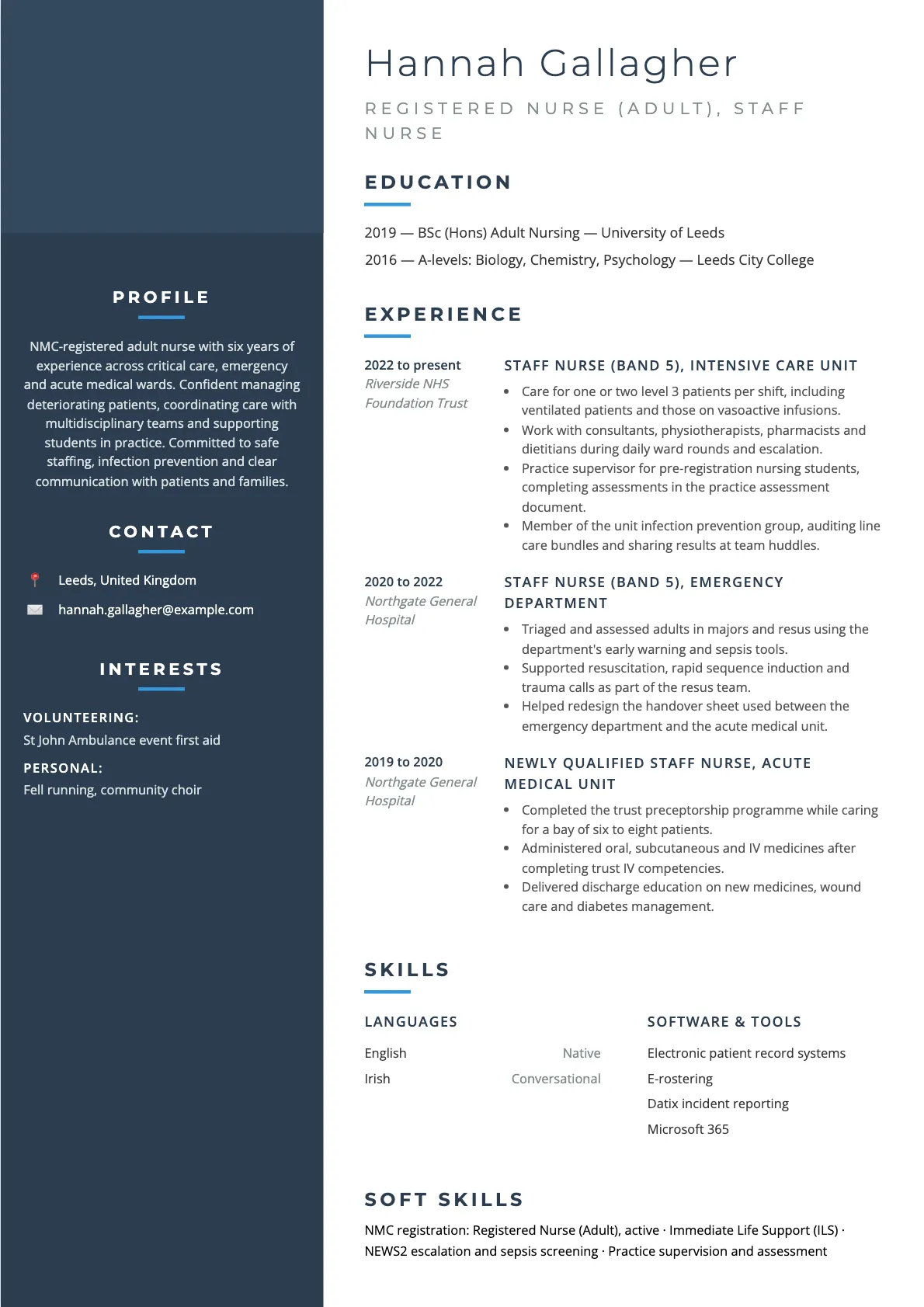
A strong Staff Nurse CV shows your NMC registration status, the clinical areas you have worked in and the responsibilities you held on each shift. Recruiters in NHS trusts and private hospitals read it alongside your application form, so it must be accurate and easy to scan. Below is a fictional band 5 example, followed by practical advice for experienced and newly qualified nurses.
Updated
How should you lay out a Staff Nurse CV?
Use a reverse-chronological layout on two pages, with your NMC registration near the top. Recruiters want to see your current registration, your field of nursing and your most recent clinical area before anything else. Put your name, a professional email address and your town at the top, then a short profile of three or four lines.
Each job entry should give your title, band, ward or department, employer and dates. Underneath, list what you did on a typical shift and what you improved, using concrete details such as patient acuity, bay size, the systems you used and any link nurse or supervision roles. Avoid copying your job description word for word, because every applicant for that post has the same one.
Leave out your photo, date of birth, marital status and National Insurance or PPS number. UK and Irish employers do not need them on a CV, and they take up space that should describe your practice. Save the file as a PDF unless the advert asks for Word, and give it a clear name such as your full name followed by the words Staff Nurse CV.
Should you include your NMC PIN and registration details?
State that you are on the NMC register, your field of practice and whether your registration is active. Many nurses also add their PIN, because employers check it against the online register during pre-employment checks. If you would rather not publish it on a document that may be shared, write that it is available on request and give it on the application form.
If you trained in Ireland and are registered with the Nursing and Midwifery Board of Ireland, name that board accurately rather than implying NMC registration you do not hold. The same applies to nurses who trained outside the UK and are part way through the NMC application process. Describe the stage you have reached honestly, for example application submitted or test of competence booked.
Add your revalidation date only if it helps. It can reassure a recruiter that your registration will not lapse soon after you start, but it is not compulsory. Keep mandatory training such as manual handling and safeguarding in a single line, and give more space to clinical courses like ILS, ALS or a critical care module.
Which clinical skills matter most to NHS recruiters?
Match your skills to the person specification in the job advert, because shortlisting is scored against it. NHS adverts list essential and desirable criteria, and panels look for evidence of each one in your CV and supporting statement. If the post asks for IV competence, tracheostomy care or experience with NEWS2, name those skills plainly.
Group technical skills by area rather than listing dozens of tasks. Acute care, medicines management, wound care, end of life care and safeguarding are useful headings that a recruiter can scan in seconds. Mention the electronic record and rostering systems you have used, without assuming that a system name alone proves competence.
Show professional behaviours through examples, not adjectives. Instead of saying you are a good communicator, describe the handover tool you helped improve or the family meetings you supported. The NHS values of compassion, respect and working together for patients can guide which examples you choose.
What should a newly qualified nurse put on a CV?
Treat your clinical placements as your main experience and describe each one like a short job. Give the ward or service, the setting, the length of the placement and what you were trusted to do by the end of it. A final placement where you managed a small group of patients under supervision is particularly worth detailing.
If you worked as a healthcare assistant before or during your degree, include it, but keep the job title accurate so nobody confuses it with registered practice. That experience shows you understand ward routines, personal care and teamwork. Add your expected registration date if you are applying before your PIN is issued, and mention the preceptorship programme you hope to join.
Keep the education section clear and complete. List your nursing degree with the university and year, then A-levels or an Access to Higher Education Diploma. Dissertation topics, academic prizes and extra placements can go here if they relate to the post you want.
| Vague wording | Concrete evidence |
|---|---|
| Looked after patients in ICU. | Cared for one or two level 3 patients per shift, including ventilated patients on vasoactive infusions. |
| Helped with students. | Practice supervisor for pre-registration students, completing assessments in the practice assessment document. |
| Good at spotting deterioration. | Used NEWS2 and the sepsis screening tool to escalate deteriorating patients to the outreach team. |
| Did paperwork. | Kept accurate care plans and fluid balance records in the electronic patient record. |
Frequently asked questions
How long should a nursing CV be in the UK?
Two pages is the usual length for an experienced nurse. A newly qualified nurse can often fit everything on one or two pages. Put the most relevant clinical experience first and shorten older roles.
Do I need a CV if the NHS uses an online application form?
Many NHS posts are applied for through an online form with a supporting statement, so the CV is not always requested. Keeping one up to date still helps for agency work, private hospitals and direct approaches, and it makes the form quicker to complete.
Should I list my band on my CV?
Yes, adding your band next to your job title helps NHS recruiters understand your level of responsibility. For private sector roles, describe your responsibilities as well, since banding may not be familiar to every employer.
Can I apply for UK nursing jobs before NMC registration?
Some employers recruit students and international nurses before registration is complete, usually into a preceptorship or a pre-registration role. State your registration status accurately and check the employer's requirements in the advert.