Resume and cover letter resources
Registered Nurse Resume Example and Writing Guide 2026
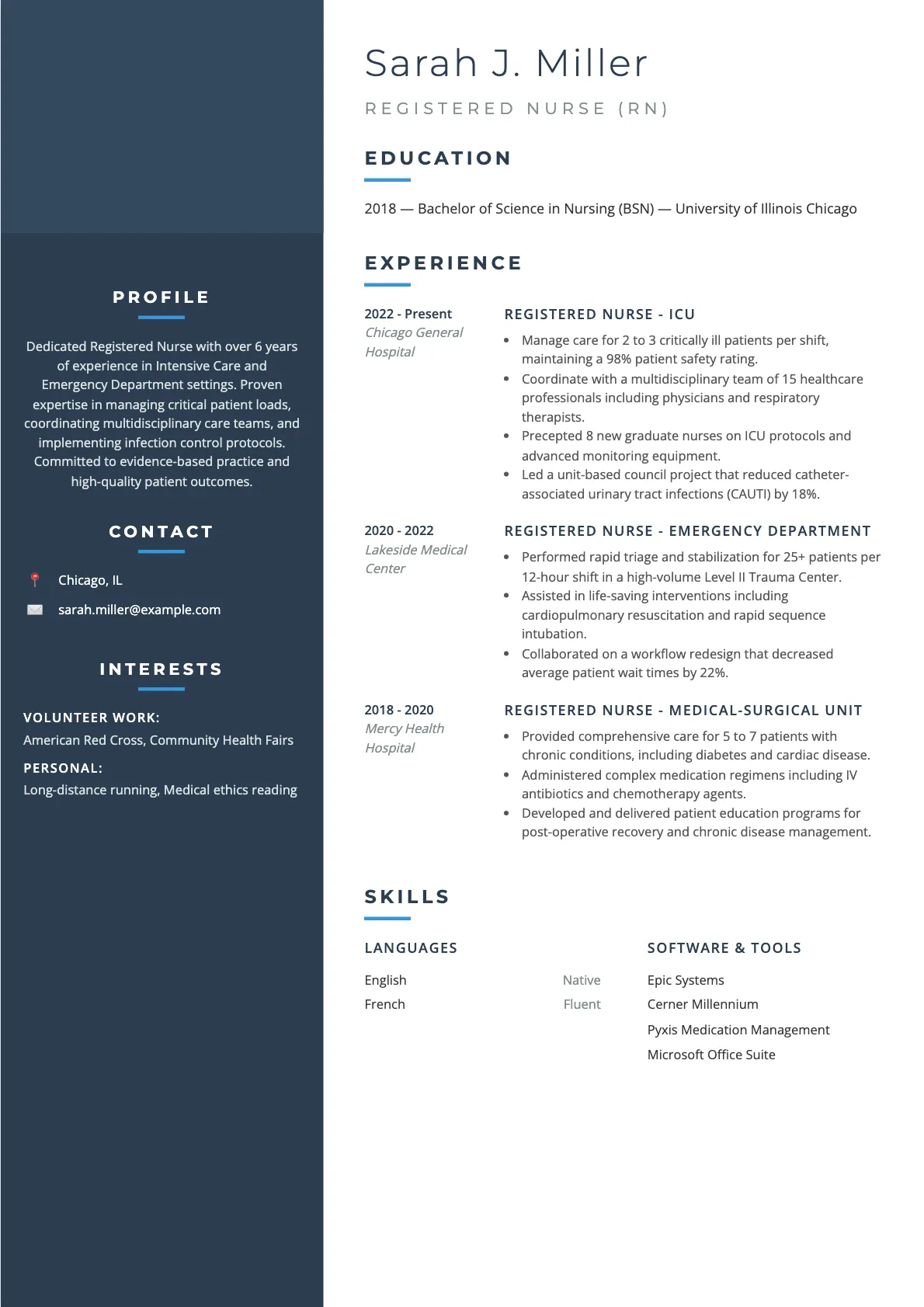
A professional Registered Nurse resume must clearly highlight your clinical expertise, patient load management, and specialized unit experience. In the US healthcare system, distinguishing between an RN and a Nursing Assistant is vital. This guide provides a fictional example and strategic advice to help you showcase your nursing credentials and patient care outcomes effectively for American medical facilities.
Updated
How should you format a Registered Nurse resume?
A reverse-chronological layout is the gold standard for American nursing resumes because it prioritizes your most recent clinical experience for hiring managers. This structure ensures that your current licensure and highest level of responsibility are visible immediately at the top of the professional experience section. You must avoid including personal data such as a photo, age, gender, or marital status, as these violate US labor standards and can lead to automatic rejection by Applicant Tracking Systems.
Use standard one-inch margins and professional fonts like Arial or Calibri to maintain a clean, readable aesthetic. Ensure your contact information includes a professional email address and a link to your LinkedIn profile if applicable. Each job entry should feature a clear job title, facility name, and location, followed by bullet points that focus on quantifiable achievements rather than just daily tasks.
For instance, instead of saying you monitored patients, state that you managed a four-patient load in a high-acuity telemetry unit. This approach demonstrates your ability to handle specific workloads and environments. Consistency in formatting, such as bolding titles and using bullet points for duties, helps recruiters scan your document in under ten seconds.
Finally, save the document as a PDF to preserve the layout across different devices.
What clinical skills are most important to list?
Prioritize high-acuity technical skills and proficiency in Electronic Health Record systems like Epic or Cerner to demonstrate immediate clinical utility. Hospitals in the United States look for specific competencies such as ventilator management, IV infusion titration, and advanced wound care. You should categorize these skills into sections like Clinical Competencies, Certifications, and Technical Proficiencies to improve readability.
Do not forget to include life-support certifications like ACLS, BLS, or PALS, as these are often mandatory requirements for employment. Soft skills are equally vital but should be framed as professional behaviors, such as multidisciplinary collaboration or crisis intervention. Avoid listing generic terms like hard worker and instead use phrases like patient advocacy or family education.
Mentioning experience with specific medical equipment, such as Pyxis medication dispensers or Alaris pumps, can set you apart from other candidates. If you have specialized experience in areas like oncology or trauma, ensure those specific protocols are highlighted. Tailoring your skills list to the specific job description is the most effective way to pass through automated screening filters.
By aligning your terminology with the employer's needs, you prove that you possess the exact toolkit required for the unit. This targeted approach shows you are a specialist rather than a generalist.
How do you handle foreign nursing qualifications?
Keep the original degree and your actual licensing status separate. List the qualification awarded by your university or training institution, with its name and date. A credential evaluation should be described as an evaluation; do not rename a foreign qualification as an American degree you did not earn.
State only the credentials and exam results you actually hold. If an application or assessment is pending, identify that status accurately instead of presenting it as completed. Use the NCSBN state-specific guidance listed in the sources to find the relevant board's information, and check the employer's requested documents rather than treating a sample resume as a licensing checklist.
Explain international experience through concrete clinical responsibilities. Name the setting, patient population, team responsibilities and systems you used, while distinguishing supervised training from employment. Explain unfamiliar institutional abbreviations in plain English so the reader can understand your work without assuming that roles in different countries have identical responsibilities.
Keep the sample's education history coherent when adapting it. The fictional applicant on this page has an American nursing degree; that is an example of one background, not a required template for every candidate. Replace it with your own history and keep dates, qualification names and stated status consistent throughout the application.
What should a new graduate nurse include?
Entry-level nurses must leverage their clinical rotations and any experience as a Nursing Assistant to fill the gap left by a lack of professional RN history. Treat each major clinical placement as a mini-job entry, specifying the hospital unit, the number of hours completed, and the types of patient populations served. If you worked as a Certified Nursing Assistant (CNA) or Patient Care Technician (PCT), highlight your experience with basic patient care and hospital workflow.
It is crucial to distinguish between these assistant roles and your new status as a Registered Nurse to avoid confusing the recruiter. Mentioning a Senior Capstone or Preceptorship is particularly valuable, as it shows you have had concentrated experience in a specific specialty. Include any honors, such as Sigma Theta Tau membership or a high GPA, to demonstrate academic rigor and dedication.
Avoid the mistake of leaving your resume blank or too brief; instead, focus on the skills you mastered during your BSN program. Mentioning volunteer work at community health fairs or blood drives can also demonstrate a commitment to the nursing profession. Ensure your NCLEX-RN results or scheduled exam date are prominently displayed so employers know your authorization to practice is imminent.
This comprehensive view of your training proves you are prepared for the transition from student to professional clinician.
| Vague Description | Concrete Evidence |
|---|---|
| Provided care for patients in the ICU. | Managed 2-3 high-acuity patients per shift, monitoring ventilators and hemodynamic status. |
| Assisted doctors with procedures. | Collaborated with physicians during bedside intubations and central line placements. |
| Handled patient documentation. | Maintained 100% accuracy in Epic EHR for patient assessments and medication administration. |
Frequently asked questions
Should I include my nursing license number on my resume?
Follow the job posting’s instructions for licensure details. State the license type, issuing authority and current status accurately, and check the employer’s process before adding identifiers. A pending application should be described as pending, not as a license already granted.
Is a two-page resume acceptable for a nurse?
Two pages can work when the extra space explains relevant clinical experience, specialist responsibilities or several units. Keep the most relevant evidence first and shorten older or repetitive details. Follow any length or document instructions in the job posting.
How do I distinguish between an RN and a CNA on my resume?
Use the specific job titles and focus the RN section on clinical judgment, medication administration, and care planning, while the CNA section should focus on activities of daily living and support tasks.