CV and cover letter resources
SEN Teaching Assistant CV Example for SEND Support Roles
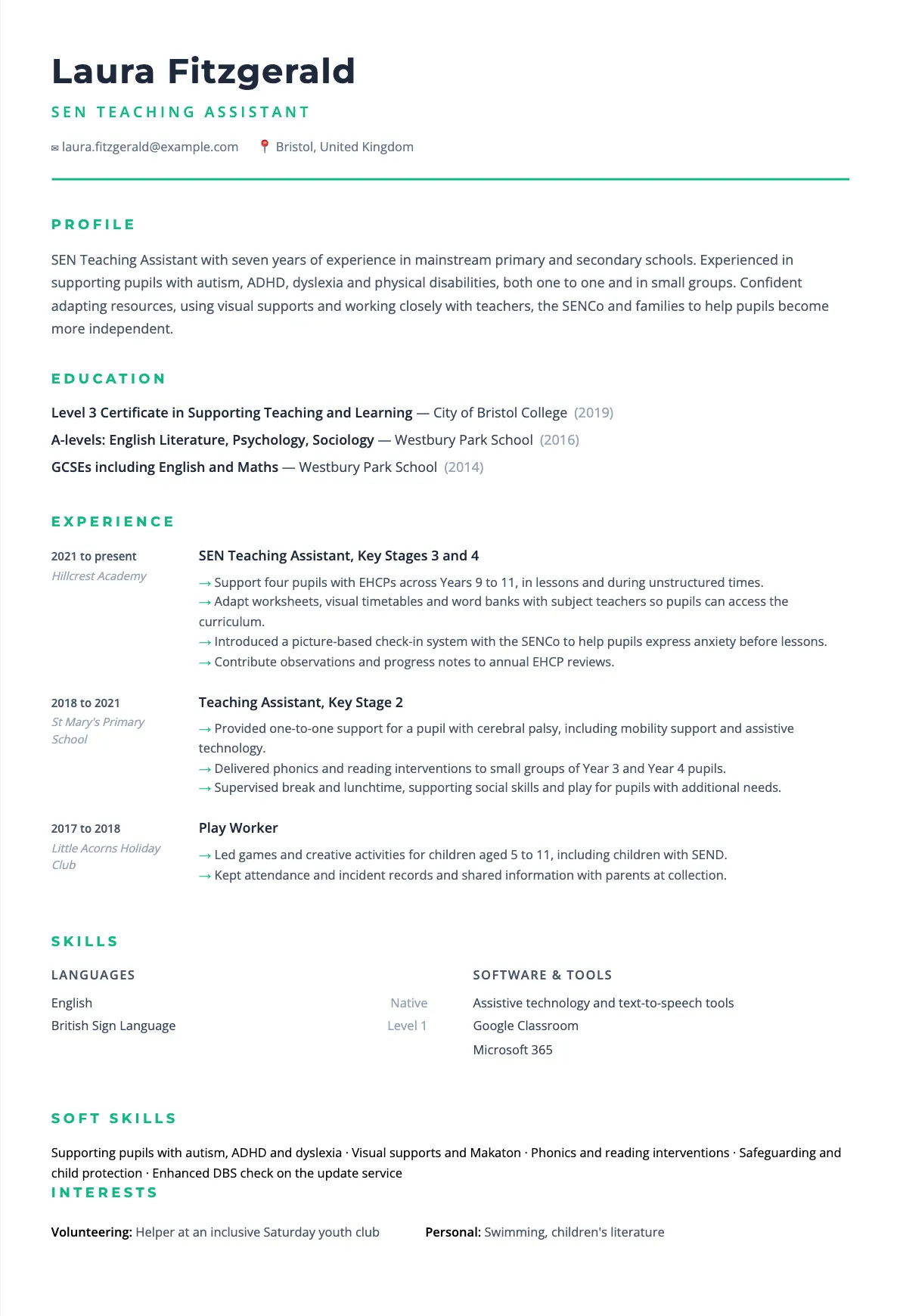
A SEN Teaching Assistant CV should show how you help pupils with special educational needs and disabilities learn, communicate and take part in school life. Schools look for experience with specific needs, work towards EHCP outcomes, close teamwork with teachers and the SENCo, and an enhanced DBS check. This fictional example and the advice below show how to present that experience.
Updated
What should a SEN Teaching Assistant CV include?
Include a short profile, your school experience with the key stages and needs you have supported, your qualifications and your safeguarding training. Headteachers and SENCos want to see quickly which age groups you know and what kind of support you have provided. Say whether you worked one to one, with small groups or across a class.
Under each post, describe the needs you supported in general terms, such as autism, speech and language needs or physical disabilities. Explain the strategies you used, like visual timetables, social stories, sensory breaks or adapted resources. Mention interventions you delivered, for example phonics, reading, fine motor or social skills groups.
Do not add a photo, date of birth or marital status. Schools follow safer recruitment, but that process relies on the application form, references and DBS check, not on personal details in your CV. Keep contact details to a professional email address and your town.
How do you describe SEND and EHCP experience?
Describe how you helped pupils work towards their targets, without sharing anything that could identify them. An Education, Health and Care Plan sets out a pupil's needs and outcomes in England, and teaching assistants often help with the day-to-day support. You can say you supported pupils with EHCPs and contributed to annual reviews.
Never include names, specific diagnoses linked to individuals or details that a reader could connect to a real child. Write about needs and strategies in general, such as supporting a pupil with autism during transitions between lessons. That shows both skill and respect for confidentiality.
Use the terms of the system you worked in. Wales uses Additional Learning Needs and individual development plans, Scotland uses Additional Support for Learning, and Ireland has its own Special Needs Assistant role. If you are moving between systems, name your previous role accurately and explain what it involved, rather than presenting it as the English equivalent.
Which qualifications and checks do schools ask for?
List any Level 2 or Level 3 Teaching Assistant qualification, your GCSEs in English and Maths, and relevant specialist training. Many schools ask for GCSE English and Maths at grade 4 or C or above, so include them. A Level 3 qualification in Supporting Teaching and Learning is common for SEN roles, though not always required.
Specialist courses carry weight in SEND work. Autism awareness, Makaton, British Sign Language, Team Teach or other positive handling training, epilepsy awareness and first aid are worth listing if you hold them. Give the course name and year rather than vague phrases such as SEN training.
Mention your DBS status clearly. An enhanced DBS check with a barred list check is normally required for work in schools in England and Wales, arranged by the school or agency. Scotland uses the PVG scheme, Northern Ireland uses AccessNI and schools in Ireland require Garda vetting.
If you are registered with the DBS update service, saying so can speed up the process.
How can you get a SEN TA job with little experience?
Highlight any work with children or young people and any experience of supporting someone with additional needs. Holiday clubs, Scouts or Guides, sports coaching, tutoring and childminding all build relevant skills. Caring for a family member with a disability also shows patience and understanding, and you can mention it briefly.
Volunteering in a school is one of the most useful steps, because it gives you direct experience and a possible reference. A short course in autism awareness, Makaton or first aid shows commitment. Supply agencies also recruit teaching assistants and can offer a route into permanent posts.
Write a profile that matches the school. A special school, a resource base and a mainstream primary each look for slightly different strengths. Read the job description and person specification, then use their wording where it truthfully describes you.
| Vague wording | Concrete evidence |
|---|---|
| Helped pupils with special needs. | Support four pupils with EHCPs across Years 9 to 11, in lessons and during unstructured times. |
| Made resources. | Adapted worksheets, visual timetables and word banks with subject teachers so pupils could access lessons. |
| Ran reading groups. | Delivered phonics and reading interventions to small groups of Year 3 and Year 4 pupils. |
| Went to meetings. | Contributed observations and progress notes to annual EHCP reviews with the SENCo and families. |
Frequently asked questions
What is the difference between a Teaching Assistant and a SEN Teaching Assistant?
A Teaching Assistant supports learning across a class, while a SEN Teaching Assistant focuses on pupils with special educational needs and disabilities, often one to one or in small groups. Use the title on your contract.
Do I need a qualification to be a SEN Teaching Assistant?
Requirements vary by school. Many ask for GCSE English and Maths, and some prefer a Level 2 or Level 3 Teaching Assistant qualification. Relevant experience and specialist training can matter as much.
How long should a Teaching Assistant CV be?
One to two pages is usually enough. Put your most recent school experience first and keep older, unrelated jobs short.