CV and cover letter resources
GP CV Example: General Practitioner CV for UK and Ireland
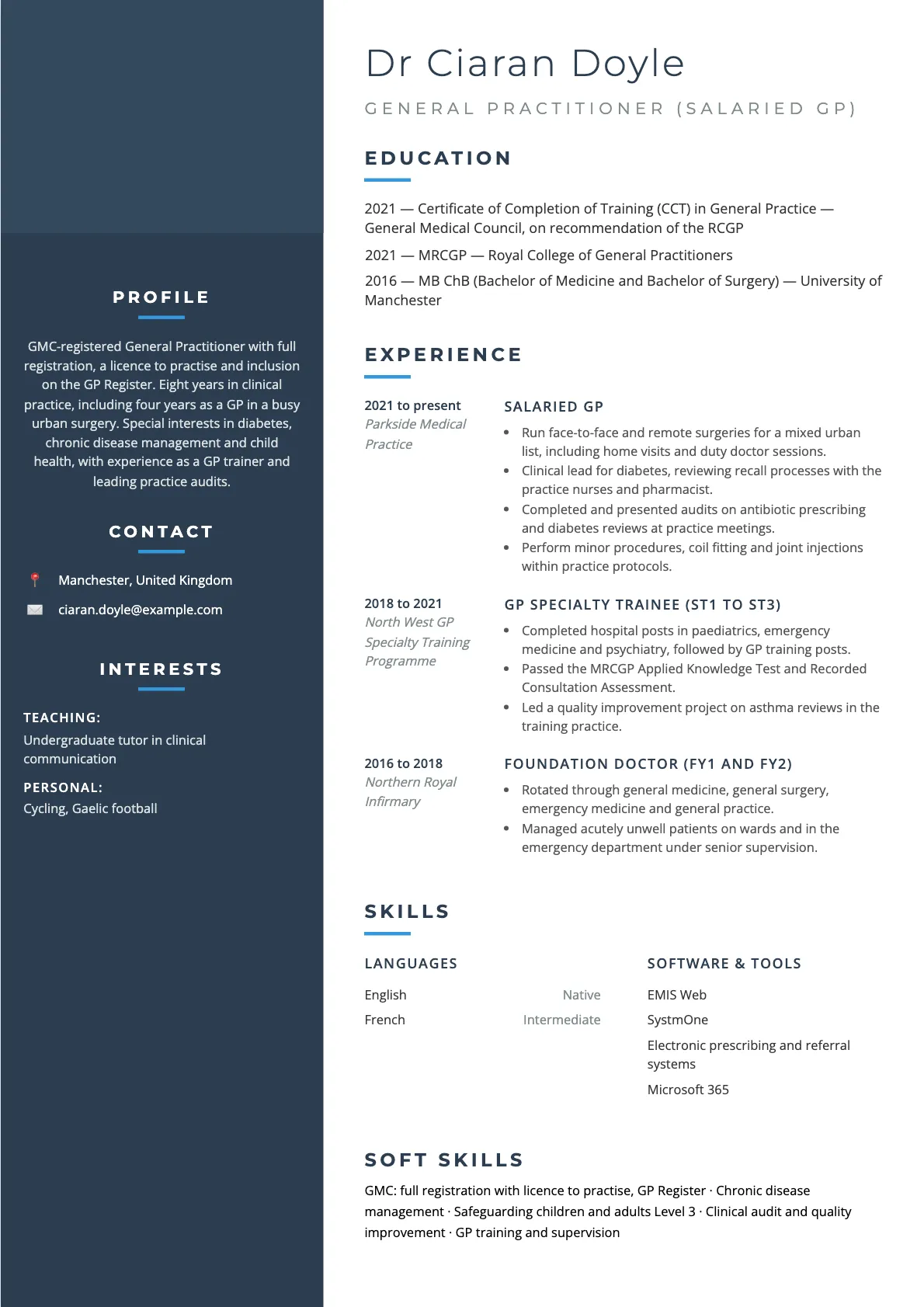
A GP CV should make your registration, training and clinical interests clear in the first few lines, then show how you work within a practice team. Practices hiring salaried GPs, partners or locums look for GMC registration with a licence to practise, MRCGP, your CCT date and evidence of audit, teaching and quality improvement. This fictional example shows one way to present them.
Updated
How should you structure a GP CV?
Start with your name, GMC number and registration status, then a short profile, clinical experience, qualifications and professional development. A practice manager or partner reading your CV wants to confirm registration and training before anything else. Many GPs also add their performers list status, because it affects when you can start seeing patients.
Present your posts in reverse order, with the practice or hospital, your role, dates and sessions per week where relevant. Under each post, summarise the scope of your work: list type, duty doctor sessions, home visits, special interests and procedures. Two to three pages is common for an experienced GP, longer than for most other roles, because training and audit need space.
Leave out your photo, date of birth and marital status. These details are not needed on a UK or Irish CV and do not help a selection panel. Keep the contact section to a professional email address and your town or region.
What registration details should a GP include?
State your GMC registration, licence to practise and GP Register entry exactly as they appear on the medical register. Employers check these online, so the wording on your CV should match. Add your MRCGP and the date your CCT was awarded by the GMC on the recommendation of the RCGP, or your expected CCT date if you are a final year trainee.
If you trained outside the UK, give your primary medical qualification and the country where it was awarded. Do not describe an overseas qualification as a UK one, and explain how you joined the GP Register if your route was through a portfolio pathway. Be honest about any conditions or pending applications.
For Ireland, use the Irish terms. Doctors practising in Ireland register with the Medical Council, and general practice training is overseen by the Irish College of General Practitioners, whose membership is MICGP. A doctor moving between the two systems should list each registration and membership separately rather than claiming automatic equivalence.
How do you show clinical interests and practice contribution?
Show the areas you lead within the practice and what you changed, using facts you can discuss at interview. Partners want to know how you will contribute beyond seeing patients, whether through a clinical lead role, prescribing work or supporting the nursing team. Name your special interests, such as diabetes, women's health, mental health or minor surgery.
Audits and quality improvement projects deserve their own lines. Give the topic, what you measured and the change that followed, without inventing percentages if you no longer have the data. Teaching roles, such as being a GP trainer, supervising medical students or delivering practice education sessions, also strengthen your application.
Keep appraisal and revalidation evidence in mind. Your CV should be consistent with your appraisal portfolio, so the dates, roles and courses match. Recent continuing professional development, such as a diploma in a specialist area, can be listed under a separate heading.
How should a locum or newly qualified GP adapt the CV?
A newly qualified GP should give more detail on training posts, projects and the skills developed during specialty training. List your hospital and GP rotations, your training practice and any extended skills such as joint injections or contraception procedures. Your CCT date and MRCGP should be visible near the top.
A locum GP should show the range of practices worked in and the clinical systems used, because adaptability is the main selling point. Group short sessions under one locum heading with the region and period, rather than listing every practice separately. Mention your indemnity arrangements and DBS status if agencies or practices ask for them.
Partners and aspiring partners should add management experience. Contract work, involvement in primary care network projects, CQC inspection preparation or staff management can all be relevant. Present them as factual responsibilities, and keep clinical work as the core of the CV.
| Vague wording | Concrete evidence |
|---|---|
| Saw lots of patients. | Run face-to-face and remote surgeries for a mixed urban list, including duty doctor sessions and home visits. |
| Interested in diabetes. | Clinical lead for diabetes, reviewing recall processes with the practice nurses and pharmacist. |
| Did some audits. | Completed and presented audits on antibiotic prescribing and diabetes reviews at practice meetings. |
| Can do procedures. | Perform coil fitting, joint injections and minor procedures within practice protocols. |
Frequently asked questions
How long should a GP CV be?
Two to three pages is common for an experienced GP, because training, audit and teaching take space. A newly qualified GP may need two pages. Keep older or less relevant hospital posts brief.
Should I include my GMC number on my CV?
Yes, most GPs include their GMC number, because practices and agencies use it to check registration. If you work in Ireland, include your Medical Council registration number instead or as well.
Do I need a cover letter for a GP job?
Many practices ask for a CV with a short covering letter explaining why you want to join that practice. Mention their list, services or ethos, and how your clinical interests fit.
Can I apply for GP posts before my CCT is awarded?
Yes, many final year trainees apply in the months before completion. State your expected CCT date clearly and confirm the start date the practice needs.