Resume and cover letter resources
Family Medicine Physician Resume Example & Guide 2026
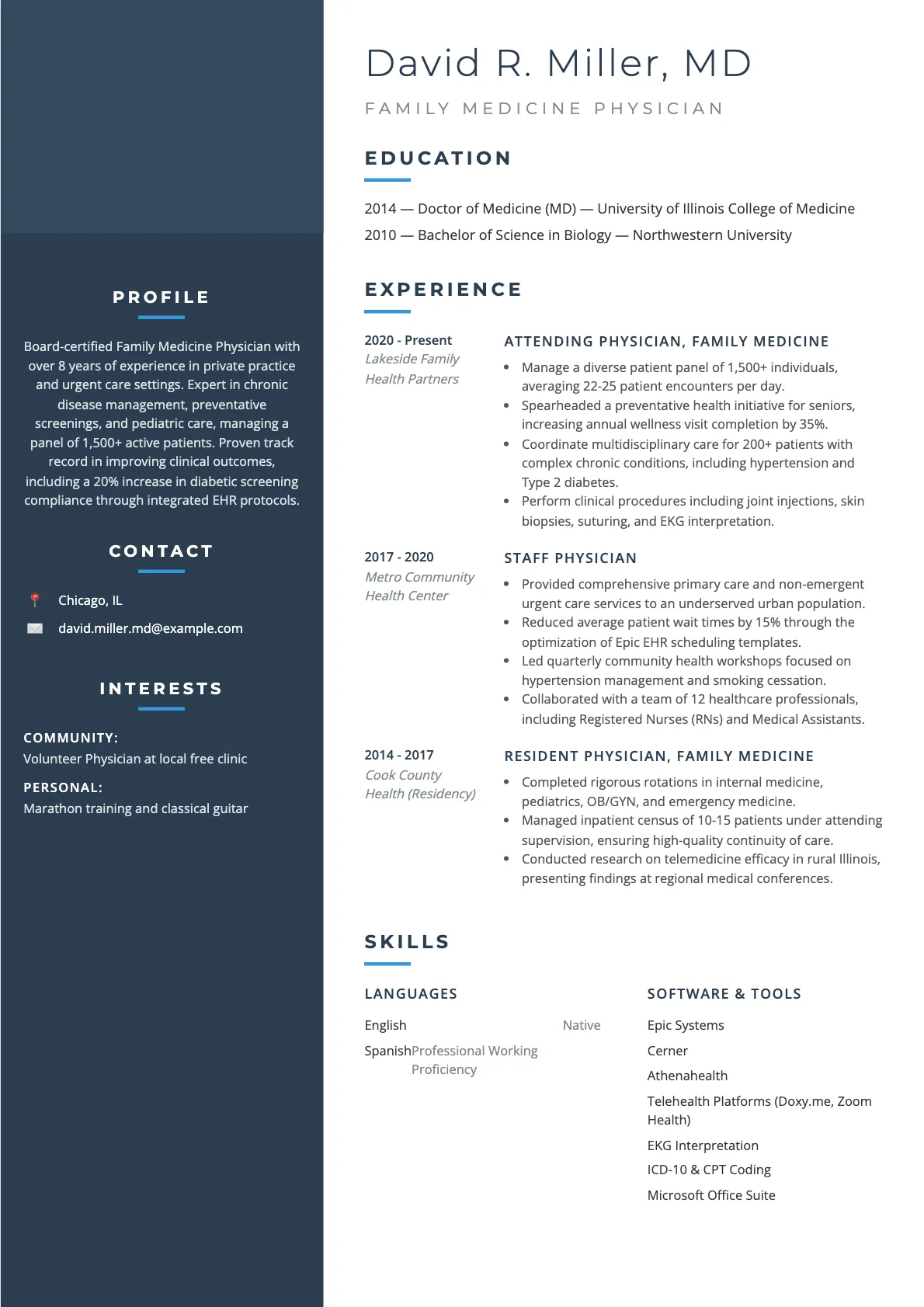
A Family Medicine Physician resume must balance clinical precision with patient-centered outcomes. In the United States, recruiters prioritize board certification status, state licensure, and specific procedural skills. This guide provides a fictionalized example of a high-performing physician, demonstrating how to quantify patient care and highlight technical proficiency without the need for personal identifiers like photos or age.
Updated
How should you format a Physician resume for the US market?
A clean, reverse-chronological format is the standard for American medical recruitment to ensure clarity and ATS compatibility. Start with a professional summary that highlights your board certification and years of practice. Avoid including a photo, age, or marital status, as these are not used in US hiring and can lead to bias concerns.
Focus on your clinical experience, listing your residency separately from your post-residency attending roles to show career progression. This structure allows recruiters to quickly identify your most recent clinical responsibilities and leadership roles. Quantifying your impact is essential for standing out in a competitive healthcare landscape.
Instead of just listing duties, mention your average daily patient volume or the size of your patient panel. If you have improved clinic efficiency or patient satisfaction scores, include those percentages. This data provides recruiters with a concrete understanding of your productivity and clinical reach.
What clinical skills are most valuable on a Family Medicine resume?
Highlighting a mix of diagnostic expertise and procedural skills demonstrates your versatility as a primary care provider. Mention specific procedures such as IUD insertions, joint injections, or minor dermatological surgeries if you perform them regularly. In the US, proficiency with Electronic Health Records (EHR) like Epic or Cerner is a baseline requirement that should be explicitly stated.
Also, emphasize your experience with preventative care and chronic disease management, as these are the pillars of family medicine. Showing expertise in managing complex conditions like diabetes or hypertension is highly valued by private practices and hospital systems. Soft skills like patient communication and interdisciplinary collaboration are equally vital.
Modern healthcare relies on a team-based approach involving Registered Nurses (RNs), Medical Assistants, and specialists. Describe how you lead these teams or coordinate care transitions. Mentioning your experience with Value-Based Care (VBC) models or Quality Improvement (QI) initiatives can also signal that you are aligned with current US healthcare trends.
How do you handle foreign medical qualifications for US roles?
If you were trained outside the United States, you must clearly state your ECFMG certification status and US residency completion. Do not assume that a foreign medical license grants the right to practice in the US. Always list your original degree and the institution, but emphasize your US-based clinical experience and board eligibility or certification.
It is the candidate's responsibility to verify specific state licensing board requirements before applying. This ensures that you meet the legal prerequisites for the specific jurisdiction where the job is located. Distinguish clearly between different nursing and support roles when describing your team.
In the US, a Registered Nurse (RN) has a different scope of practice than a Nursing Assistant or a Medical Assistant. Using the correct terminology shows your familiarity with the American clinical hierarchy. If you are a foreign-trained physician seeking a non-physician role, such as a medical consultant, ensure your job title reflects the functional role rather than asserting a license you do not currently hold in that jurisdiction.
What are common mistakes to avoid on a medical resume?
Avoid using overly dense blocks of text or outdated medical jargon that might confuse non-clinical HR screeners. While your clinical peers will understand your expertise, the initial screening is often done by recruiters looking for keywords. Use bullet points for readability and ensure your contact information is professional.
Never include your Social Security Number or specific medical license numbers directly on the resume for security reasons. These are typically provided during the formal background check phase rather than the initial application. Ensure your resume is tailored to the specific type of facility you are targeting.
A resume for a large academic hospital should emphasize research and teaching, while a resume for a private group practice should focus on patient volume and billing efficiency. Failing to update your profile section to match the employer's mission is a missed opportunity. Always double-check that your certifications, such as ACLS or BLS, are current and listed clearly.
| Common Mistake | Professional Improvement |
|---|---|
| Including a headshot or personal details | Focus strictly on clinical credentials and experience |
| Listing duties without results | Mentioning 'Increased patient satisfaction scores by 12%' |
| Vague software mentions | Specifying 'Expert proficiency in Epic and Cerner EHR' |
| Ignoring residency details | Highlighting specific rotations relevant to the new role |
Frequently asked questions
Should I include my residency if I have 10+ years of experience?
Yes, but keep it brief. For experienced physicians, residency should be listed to show the foundation of your training, but the bulk of your resume should focus on your recent Attending Physician roles and clinical achievements.
Is a brand CV Boost different from a resume for US doctors?
In the US, a brand CV Boost is typically used for academic, research, or teaching positions and can be many pages long. A resume is a shorter, 1-2 page document used for clinical roles in private practices or community hospitals. Most clinical recruiters prefer the concise resume format.
How do I list board certification if it is pending?
You should list it as 'Board Eligible' and include the expected date of your certification exam. This informs the employer that you have completed the necessary training and are in the process of final credentialing.