CV and cover letter resources
Accountant CV Example and Writing Guide for the UK
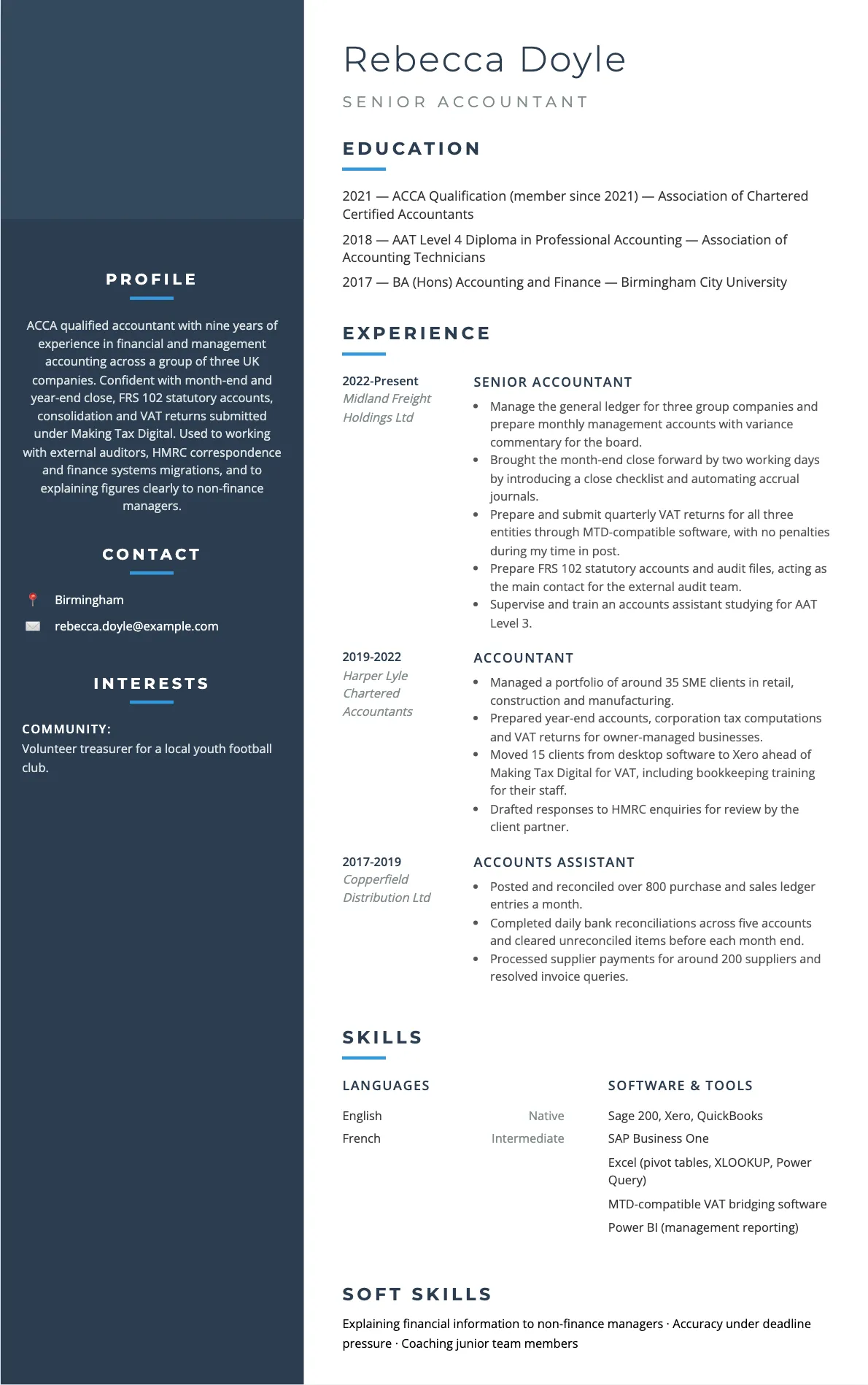
An Accountant CV in the UK needs to show three things quickly: your professional qualification or study stage, the reporting standards you work with and the size of the books you handle. This fictional example covers month-end close, FRS 102, VAT returns and Making Tax Digital, with notes for candidates applying in Ireland. Replace each detail with your own experience.
Updated
How should you structure an Accountant CV in the UK?
Put your professional qualification next to your name or in the first line of your profile. UK employers filter accountancy CVs by ACCA, CIMA, ICAEW, ICAS or AAT status before reading anything else. If you are part qualified, state how many exams you have passed and when you expect to finish.
Use a reverse-chronological layout of no more than two pages. Start with a four or five line profile, then experience, qualifications and systems. Leave out your photo, date of birth and marital status, which are not expected on a UK or Irish CV.
Make it clear whether your background is in practice or in industry. Practice roles involve a client portfolio, year-end accounts and tax work. Industry roles focus on management accounts, month-end close and business partnering, so describe the side that matches the job.
Which technical skills matter most on an accounting CV?
Name the reporting frameworks you actually use, such as FRS 102, FRS 105 or IFRS. Private companies in the UK and Ireland commonly report under FRS 102, while listed groups use IFRS. Showing the right framework tells a recruiter you can work on their accounts without retraining.
Include tax and compliance work that relates to HMRC. VAT returns, Making Tax Digital submissions, payroll and corporation tax computations are all valuable. For roles in Ireland, refer to Revenue, VAT and ROS filing instead, since the systems and rules differ.
List finance software and Excel skills precisely. Name the ledger systems you know, such as Sage, Xero, QuickBooks or SAP. Describe Excel skills by function, for example pivot tables, lookups or Power Query, rather than writing "advanced Excel".
How do you show your achievements as an accountant?
Describe the scale of your responsibility and what you improved. The number of entities, the size of the client portfolio or the volume of transactions gives useful context. Improvements such as a faster close or cleaner audit files show you add value beyond processing.
Be careful with confidential figures. You can describe turnover bands or the number of companies without revealing an employer's results. Never include client names from practice unless the information is public.
Show your relationship with auditors, HMRC and management. Acting as the main audit contact or drafting responses to HMRC enquiries signals trust and maturity. Explaining figures to managers shows the communication skills that senior roles require.
How should you adapt your CV for Ireland?
Keep the same structure, but adjust the qualifications and tax references to the Irish system. Chartered Accountants Ireland, ACCA and CPA Ireland are the main bodies employers recognise. ACCA and CIMA are widely accepted in both countries, which makes it easier to move between them.
Replace HMRC terms with their Irish equivalents only where you have real experience. Irish employers will look for Revenue, ROS and Irish VAT and payroll knowledge. Do not claim familiarity with a system you have not used, as interviewers will test it.
State your right to work clearly if it is not obvious from your history. A short line in the profile or cover letter avoids uncertainty. This applies to applications in both the UK and Ireland.
| Vague description | Specific achievement |
|---|---|
| Did the month-end close. | Brought the month-end close forward by two working days with a close checklist and automated accruals. |
| Handled VAT. | Prepared and filed quarterly VAT returns for three companies through MTD-compatible software. |
| Worked with auditors. | Prepared FRS 102 audit files and acted as the main contact for the external audit team. |
| Good with accounting software. | Migrated 15 practice clients from desktop software to Xero and trained their bookkeepers. |
Frequently asked questions
Should I put ACCA or CIMA after my name on my CV?
Yes, if you are a full member. Use the designatory letters your body allows, such as ACCA or FCCA, ACMA and CGMA for CIMA, or ACA for ICAEW. If you are still studying, write your stage instead, for example ACCA finalist or CIMA Management Level.
Is AAT worth including if I am now chartered?
Include it briefly in your qualifications. It shows a solid grounding in bookkeeping and how your career developed, but it should sit below your chartered qualification.
How long should an Accountant CV be?
Two pages is the usual maximum in the UK and Ireland. Senior finance professionals can use the second page fully, while trainees and part qualified candidates often fit everything on one page.