Resume and cover letter resources
Accountant Resume Example and Writing Guide
A professional Accountant resume must balance technical precision with business impact. Recruiters look for specific software proficiency, knowledge of accounting standards, and a track record of meeting tight closing deadlines. This guide provides a fictional sample and expert advice to help you showcase your financial expertise and attention to detail effectively in the American market.
Updated
How to Format an Accountant Resume for the US Market
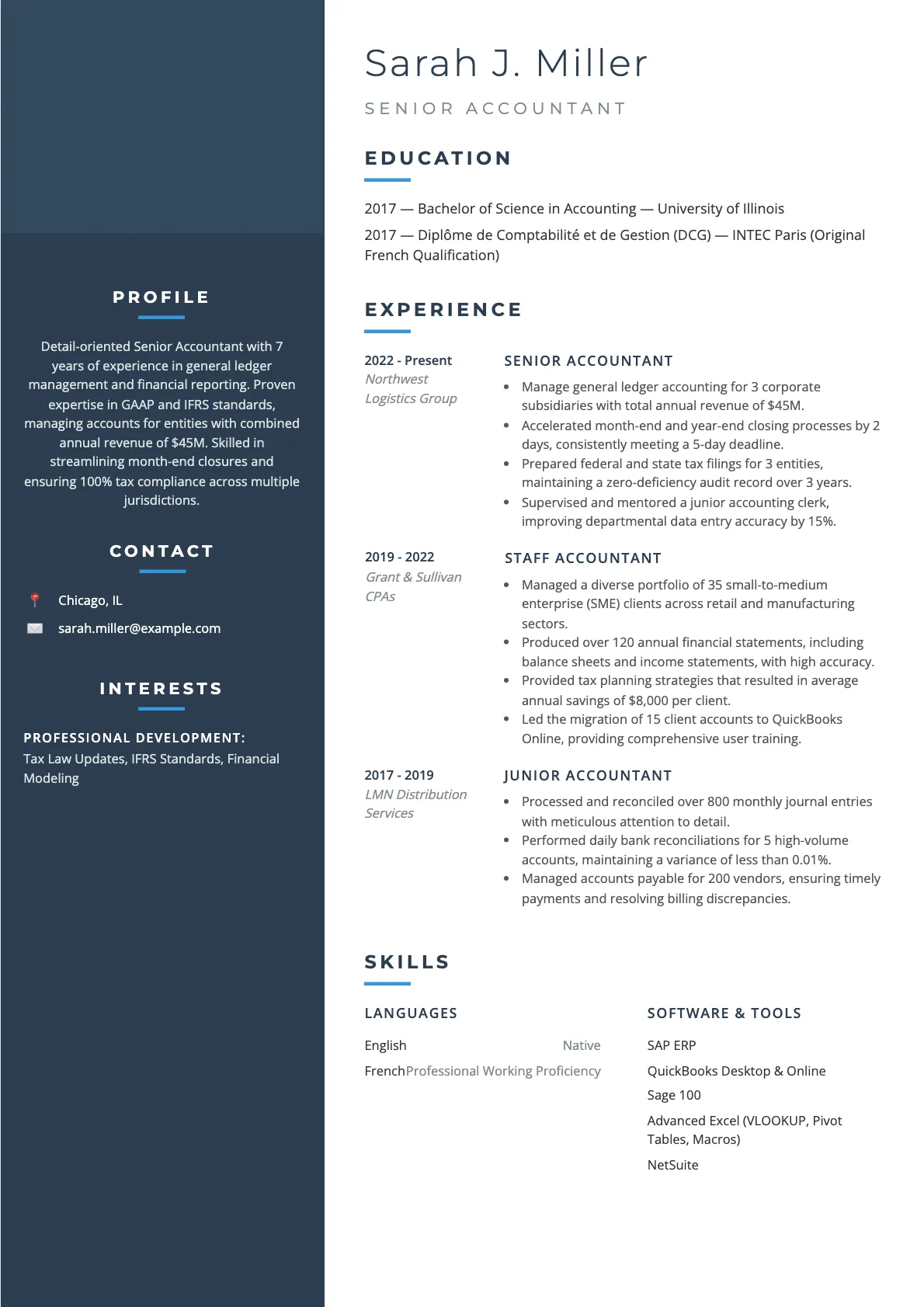
A reverse-chronological layout is the gold standard for American accounting resumes because it emphasizes recent technical growth and fiscal responsibility. This structure allows hiring managers to immediately verify your current level of authority and the complexity of the financial environments you have navigated. You must exclude personal identifiers such as age, gender, marital status, or a photo to comply with US labor laws and professional norms.
Focus on a clean, single-column design that utilizes standard fonts to ensure your document is easily parsed by Applicant Tracking Systems. For candidates with international backgrounds, it is vital to retain the original names of foreign qualifications like the French DCG rather than inventing a US equivalent. While you should list the original degree, you may provide a brief parenthetical note regarding the scope of study to help recruiters understand its rigor.
Ensure that your contact information is professional and located at the top of the page for quick access. This approach balances local expectations with a transparent representation of your global educational history. By prioritizing clarity and professional distance, you present yourself as a candidate who understands the nuances of the American corporate landscape.
Essential Technical Skills and Software Proficiency
Modern accounting roles require a sophisticated blend of ERP mastery and a deep understanding of regulatory frameworks like GAAP and IFRS. You should explicitly list your experience with platforms such as SAP, NetSuite, or Oracle, as these are often used as primary keywords in recruitment software. Simply listing the software is insufficient; you must describe how you applied these tools to enhance reporting accuracy or streamline data migration.
Advanced Excel capabilities, including the use of VLOOKUPs, pivot tables, and complex macros, remain the most critical baseline requirement for any US-based accountant. Beyond software, your resume must reflect a strong grasp of tax compliance, internal controls, and audit preparation. If you are an entry-level candidate, focus on your exposure to cloud-based tools like QuickBooks Online or Sage to demonstrate technical agility.
When discussing financial oversight, always specify the accounting standards you are proficient in to avoid ambiguity. Highlighting your ability to adapt to new financial technologies shows that you are prepared for the evolving digital demands of the industry. This technical section serves as the foundation of your professional credibility.
Quantifying Achievements and Financial Impact
Successful accounting resumes use specific metrics to define the scale and success of previous financial oversight. Instead of stating that you managed a budget, specify that you oversaw a $45M annual revenue stream across multiple corporate subsidiaries. This level of detail provides recruiters with a concrete understanding of the stakes you are accustomed to handling.
Highlighting efficiency improvements, such as reducing the month-end close cycle by two business days, offers tangible proof of your operational value. Mentioning a consistent record of zero-deficiency audits or specific dollar amounts saved through strategic tax planning further validates your expertise. These figures act as evidence of your attention to detail and your ability to deliver results under pressure.
For entry-level applicants, quantification can include the volume of journal entries processed or the number of vendor accounts managed daily. Avoid generic filler phrases and focus on the action-result formula to make your bullet points more impactful. By turning routine duties into measurable successes, you distinguish yourself from candidates who only list their job descriptions.
Tailoring Your Resume and Avoiding Common Mistakes
Tailoring your resume for each specific job description is the most effective way to pass through automated filters and reach a human recruiter. You should mirror the language used in the job posting, whether the employer emphasizes forecasting, variance analysis, or regulatory filings. A common mistake is submitting a generic resume that fails to address the specific industry needs of the hiring company.
Another frequent error is the inclusion of irrelevant personal information or outdated certifications that do not align with US accounting standards. If you are a foreign-trained professional, do not claim to hold a US license unless you have been officially certified by a State Board of Accountancy. Instead, focus on the transferable skills gained during your international tenure, such as managing multi-jurisdictional tax compliance.
Ensure that your professional summary is concise and avoids subjective cliches like hardworking or team player. Instead, use that space to summarize your years of experience and your primary areas of technical specialization. A well-tailored resume shows that you have researched the company and are genuinely interested in their specific financial challenges.
| Vague Description | Quantified Achievement |
|---|---|
| Responsible for month-end closing. | Reduced month-end closing time by 25% through Excel automation. |
| Managed client tax filings. | Prepared 50+ federal and state tax returns with 100% on-time compliance. |
| Handled accounts payable. | Managed AP for 200+ vendors, resolving 15% more discrepancies than the previous year. |
Frequently asked questions
Should I list my CPA status if it is still in progress?
Yes, you can list CPA Candidate and include your expected completion date or the number of sections passed. This shows commitment to professional growth, which is highly valued by employers.
How do I list international accounting degrees on a US resume?
List the original name of the degree and the institution. You may add a brief parenthetical explanation of the equivalent US level (e.g., Bachelor's equivalent) but avoid claiming a US license you do not hold.
Is a summary or an objective better for an Accountant?
A professional summary is generally better as it highlights your years of experience and key technical skills immediately. Objectives are often seen as outdated unless you are a recent graduate changing fields.