CV and cover letter resources
Journalist CV Example and Writing Guide for UK Newsrooms
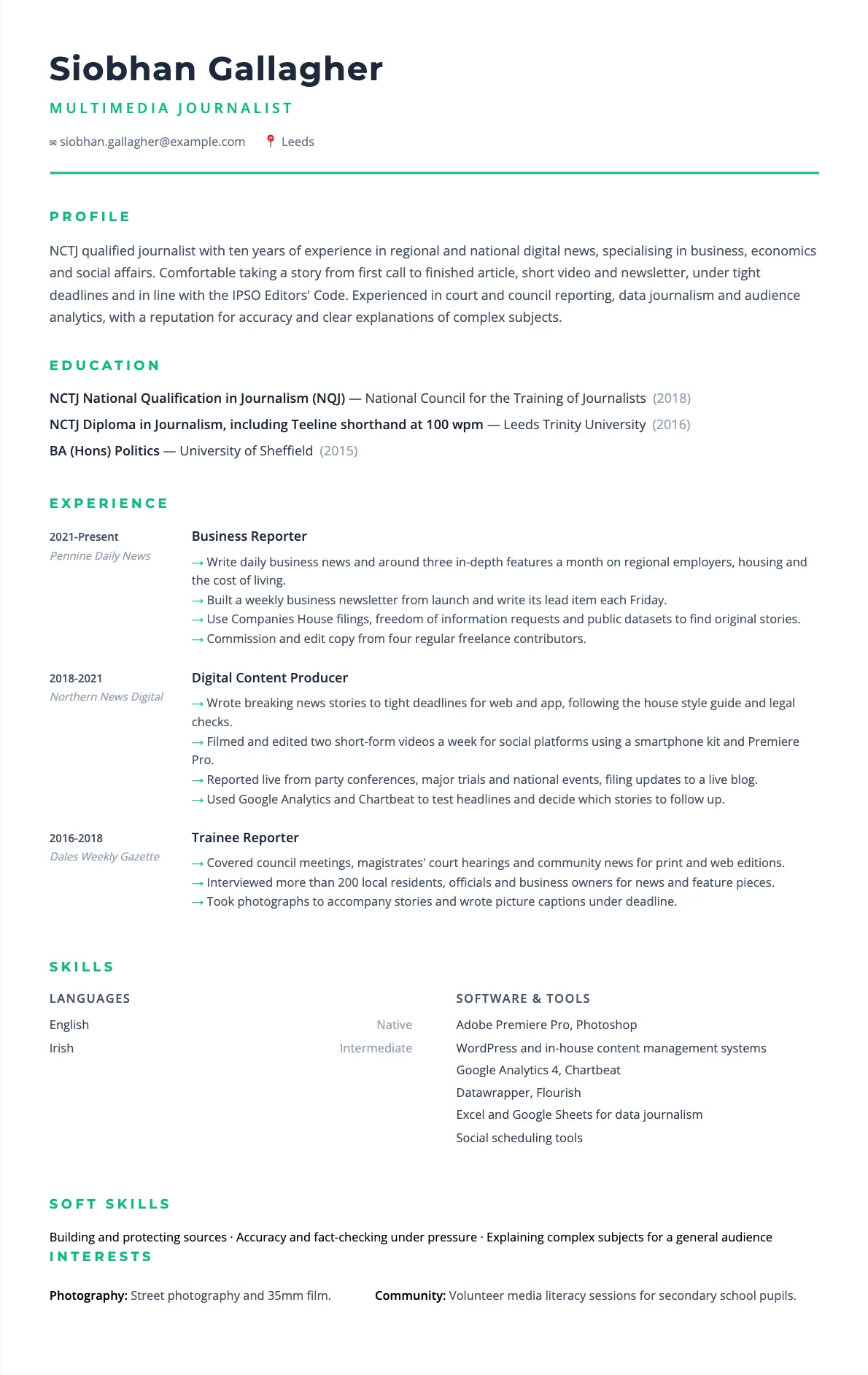
A Journalist CV has to prove you can find stories, check them and publish them on several platforms. This fictional example for UK newsrooms puts NCTJ training, a cuttings link and multimedia skills up front, and shows how to describe reporting work without inflating it. It also explains how to present freelance commissions. Replace every detail with your own bylines and experience.
Updated
How should you structure a Journalist CV for UK newsrooms?
Use a reverse-chronological CV of no more than two pages, with a link to your cuttings in the header. Editors usually check published work before anything else, so a portfolio site or a page on a cuttings platform is essential. Choose recent pieces that match the beat you are applying for.
Mention your NCTJ qualification and shorthand speed early. Many UK editors still look for the NCTJ Diploma or the National Qualification in Journalism, especially for regional and court reporting roles. If you trained through an apprenticeship or a degree accredited by another body, name it clearly.
Leave out a photo and personal details such as age or marital status. They are not expected on a UK or Irish CV. Your bylines and the quality of your writing do the persuading.
Which skills should a modern journalist highlight?
Show that you can publish across formats, not just write copy. Filming and editing short video, recording audio, building simple charts and writing newsletters are now part of many reporting roles. Name the tools you use, such as Premiere Pro, Datawrapper or your CMS.
Demonstrate your knowledge of media law and the IPSO Editors' Code. Court reporting restrictions, defamation, contempt and privacy are central to safe publishing in the UK. For Irish roles, mention the Code of Practice of the Press Council of Ireland, applied by the Press Ombudsman, if you have worked under it.
Include research and data skills. Freedom of information requests, Companies House searches and spreadsheet analysis are valued because they lead to original stories. Give a short example of a story that came from this work.
How do you present freelance or contract work?
Group freelance commissions under one heading with your main clients and the type of work. A line such as "Freelance reporter, with commissions for national newspapers and trade titles" is clearer than many short entries. List the dates and the subjects you covered.
Pick a few strong commissions to describe in detail. Name the publication, the angle and anything notable about the piece, such as a follow-up by other outlets. Keep claims accurate, as editors can check each one.
Show that you run your freelance work professionally. Pitching, meeting deadlines and managing invoices show reliability. This reassures employers that you can work with limited supervision.
What mistakes should you avoid on a journalism CV?
The most damaging mistake is a typo or factual error. A journalism CV is itself a writing sample, so check names, dates and spelling with care. Ask a colleague to proofread it before you send it.
Avoid vague claims about passion or creativity. Replace them with evidence: bylines, exclusives, formats you produce and the audiences you write for. Editors want to know what you would bring to the newsroom from the first week.
Do not send the same CV to every title. Adapt your profile and the order of your experience to the beat and the outlet. A trade magazine, a regional daily and a broadcaster will each look for different strengths.
| Weak description | Stronger alternative |
|---|---|
| Wrote articles about business. | Reported daily on regional employers and housing, with three in-depth features a month. |
| Did some video. | Filmed and edited two short videos a week for social platforms using a smartphone kit and Premiere Pro. |
| Covered local news. | Covered council meetings and magistrates' court hearings in line with reporting restrictions. |
| Good research skills. | Used freedom of information requests and Companies House filings to find original business stories. |
Frequently asked questions
Do I need an NCTJ qualification to be a journalist in the UK?
It is not a legal requirement, but many UK editors look for it, particularly for regional news and court reporting. Strong published work and relevant experience can sometimes compensate, especially in digital and specialist roles.
Should I include my shorthand speed?
Yes, if you have it. Shorthand is still valued for court, council and interview work in the UK. State the system and speed, for example Teeline at 100 wpm.
How many cuttings should I share?
Choose a small, focused selection of recent pieces that match the role. Quality and relevance matter more than volume, and each link should open without a paywall where possible.