CV and cover letter resources
Data Analyst CV Example and Writing Guide for the UK
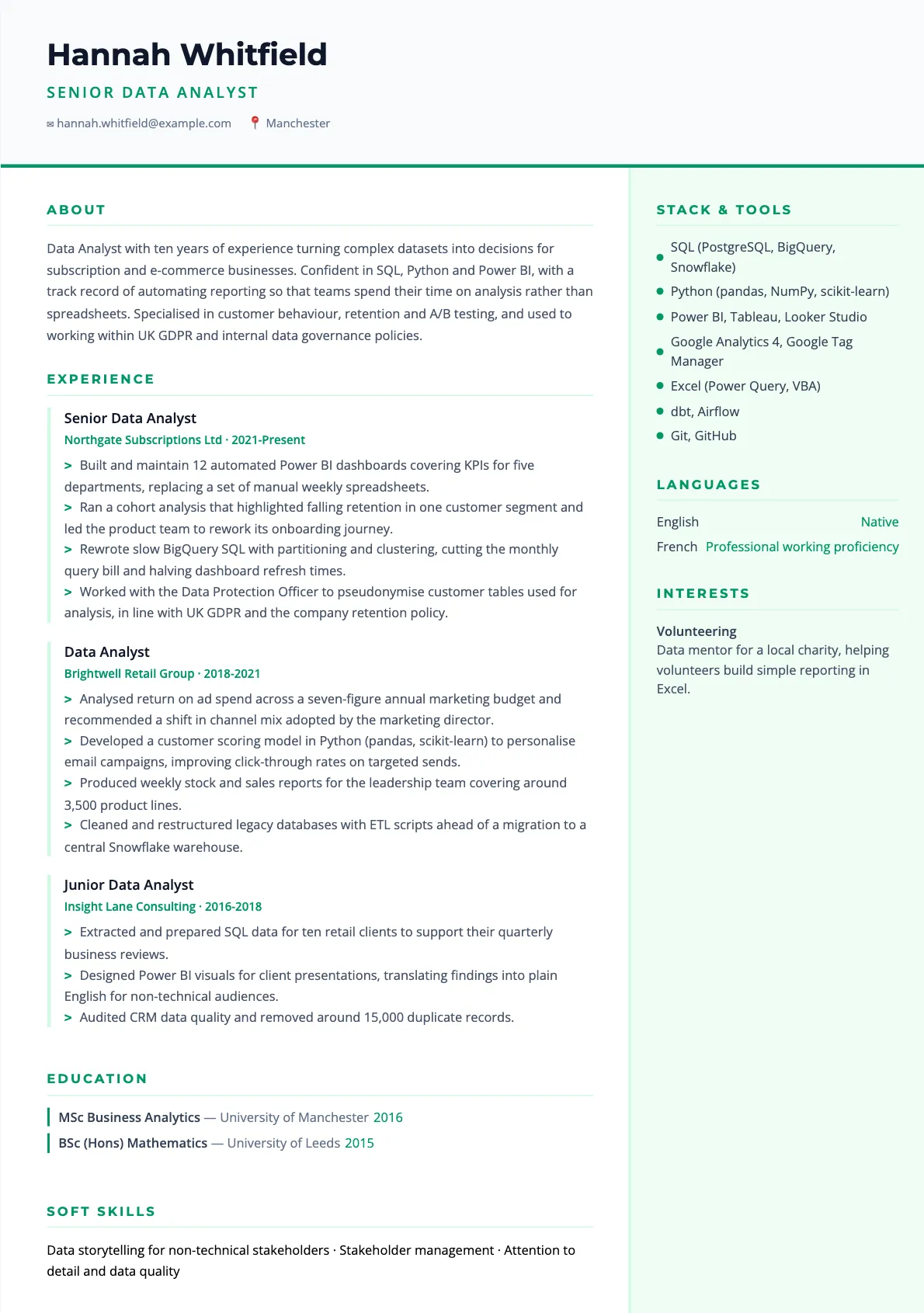
A strong Data Analyst CV shows two things at once: that you can handle the technical stack, and that your analysis changes decisions. This fictional example for the UK market pairs SQL, Python and Power BI with concrete outcomes and responsible handling of personal data under UK GDPR. Use it as a model, then replace every detail with your own.
Updated
How should you structure a Data Analyst CV in the UK?
Use a reverse-chronological CV of two pages at most, with your most recent role first. UK employers expect a short personal profile at the top, then experience, education and skills. Hiring managers want to see quickly which tools you use today and what you achieved with them.
Leave out your photo, date of birth, marital status and nationality. These are not expected on a UK or Irish CV, and equality law means many employers would rather not receive them. If you need sponsorship or already hold the right to work, a single line in the profile or cover letter is enough.
Put a clear skills section near the top or straight after your experience. Group tools by type, such as query languages, programming, visualisation and data platforms. This helps both applicant tracking systems and the person shortlisting to match your CV against the job advert.
How do you show the impact of your analysis?
Describe what changed because of your work, not just the task you performed. Writing that you analysed churn data tells the reader very little. Explaining that your cohort analysis led the product team to redesign onboarding shows business value.
Focus on three kinds of outcome: decisions influenced, time saved and costs reduced. If an automated dashboard replaced hours of manual reporting, say so. If a query rewrite reduced cloud costs, give the scale you are allowed to share.
Only quote figures you can explain and defend at interview. Interviewers often ask how a number was calculated, so keep a note of your method. Where results are confidential, describe the direction and scope of the change instead of an exact value.
Why should a UK Data Analyst mention GDPR?
Responsible handling of personal data is part of the job in the UK and Ireland, so it deserves a line on your CV. Most analysts work with customer or employee records covered by UK GDPR, the Data Protection Act 2018 or, in Ireland, the EU GDPR. Employers want reassurance that you understand access controls, minimisation and retention.
Show it through a concrete example rather than a buzzword in your skills list. Pseudonymising tables, working with a Data Protection Officer or documenting data lineage are all good evidence. Public sector and health roles in particular look for this awareness.
Do not overstate your legal knowledge. You are an analyst, not a privacy lawyer, so describe the practical steps you took.
Should you include certifications and a portfolio?
Add a portfolio link when it shows work your job history cannot. For graduates and career changers, a GitHub repository or a published Power BI report can prove your ability far better than a list of tools. Make sure the code is tidy and uses public or synthetic data only.
List recognised certifications with the issuing body and the year. Microsoft, Google and cloud providers all offer analyst certifications that support your technical credibility. In the UK, a data analyst apprenticeship at Level 4 is also a well understood route and is worth naming if you completed one.
Keep certifications in proportion to your experience. For experienced candidates, real projects remain the strongest evidence, so place certifications after your roles.
| Weak description | Impact-focused alternative |
|---|---|
| Responsible for SQL reports. | Automated weekly SQL reporting for the finance team, removing a manual spreadsheet process. |
| Used Python for data cleaning. | Built a Python ETL pipeline that standardised supplier data before it reached the warehouse. |
| Analysed website traffic. | Identified a drop-off point in the checkout journey using GA4 and briefed the product team on fixes. |
| Aware of GDPR. | Pseudonymised customer tables with the Data Protection Officer so analysts no longer saw direct identifiers. |
Frequently asked questions
How long should a Data Analyst CV be in the UK?
Two sides of A4 is the usual maximum in the UK and Ireland. Graduates can often fit everything on one page, while experienced analysts should use the second page for earlier roles and education rather than extra detail on old projects.
Should I list SQL or Python first?
SQL is the foundation of most analyst roles, so it usually comes first. Follow the order of the job advert, though: if the role focuses on modelling or automation, Python may deserve the top spot.
Do I need a degree to become a Data Analyst in the UK?
Not always. Many employers accept a Level 4 data analyst apprenticeship, a bootcamp or strong self-taught project work instead of a degree, as long as you can show solid SQL and reporting skills.