Resume and cover letter resources
Professional Photographer Resume Example 2026
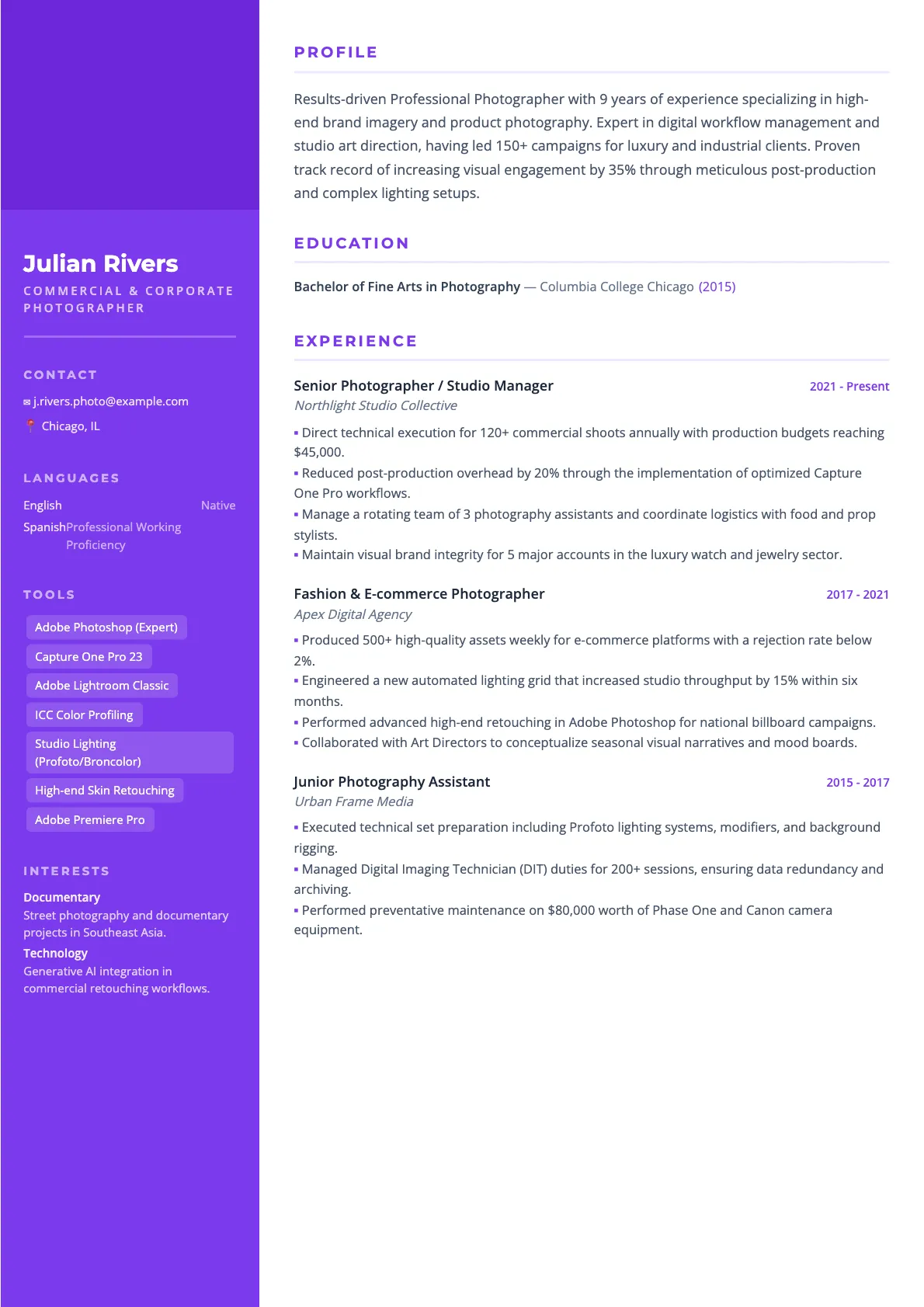
A professional photographer resume must balance technical mastery with commercial efficiency. In the American market, your resume serves as the business case for your creative talent, focusing on production volume, client retention, and software proficiency. This guide provides a fictional sample and strategic advice to help you showcase your visual expertise and operational reliability to agencies and corporate clients.
Updated
How should you present your portfolio on a resume?
Your online portfolio link must be the most prominent element of your contact information, placed immediately under your name. In the United States, recruiters often view the portfolio before reading the professional experience section. Ensure the link is live, clickable in a PDF, and leads to a curated selection rather than a dump of all your work.
Organize your portfolio by niche, such as Commercial, Portrait, or Product, to help hiring managers find relevant evidence quickly. Avoid password-protecting your main galleries unless the content is strictly under NDA. A clean, mobile-responsive site demonstrates that you understand modern digital delivery standards.
If you have worked for recognizable brands, include a Client List section on your portfolio site to build instant credibility. This approach allows the hiring manager to verify your technical proficiency and aesthetic style within seconds of opening your application. Ensure that your most recent and high-quality work is displayed first to capture immediate attention.
Consistency in your visual voice across the portfolio and resume builds a cohesive professional brand that resonates with high-end agencies. By treating your portfolio as a strategic extension of your resume, you provide the tangible proof required for creative roles.
Which technical skills are essential for a modern photographer?
Beyond basic camera operation, you must emphasize your mastery of digital workflow software and studio lighting environments. Mentioning Photography is too vague; instead, specify your expertise in Capture One Pro, which is the industry standard for tethered shooting in professional studios. Highlight your knowledge of color management, including ICC profiling and monitor calibration, to show you can deliver print-ready files.
Detail your experience with specific lighting brands like Profoto or Broncolor, as this proves you can step onto a high-budget set without a learning curve. Don't overlook post-production skills like frequency separation or non-destructive editing in Photoshop. These capabilities make you a more versatile hire who can handle a project from shutter click to final delivery.
For entry-level candidates, demonstrating proficiency in file organization and metadata tagging is equally important. Mastery of these technical nuances separates a hobbyist from a professional who understands the rigors of a commercial production environment. Mentioning your ability to troubleshoot equipment on the fly shows reliability during high-pressure shoots.
This technical depth ensures that you are viewed as a technician who can maintain the integrity of a brand's visual assets across various platforms.
How do you quantify achievements in a creative field?
Translate your artistic output into business metrics like production volume, budget management, and efficiency gains. For example, instead of saying you took photos for a website, state that you produced 500 plus e-commerce assets weekly with a 98 percent approval rate. Quantifying your speed and accuracy proves to a studio manager that you are a profitable asset who can meet tight deadlines.
Mention the scale of the budgets you have influenced or managed to demonstrate professional responsibility. If your work contributed to a specific marketing outcome, such as a 20 percent increase in social media engagement, include that data. This shows you understand the commercial purpose of your imagery and how it serves the client's bottom line.
For those in assistant roles, quantify the number of sets managed or the value of the equipment maintained. Highlighting your role in reducing post-production turnaround time through workflow optimization is another powerful way to show value. Using specific numbers provides a concrete framework for your creative success and makes your resume more persuasive to non-creative stakeholders.
This data-driven approach helps bridge the gap between artistic talent and the operational needs of a modern photography studio or corporate marketing department.
What are the standard formatting rules for a US photographer resume?
Stick to a clean, one-page reverse-chronological layout that prioritizes readability over decorative graphics. While you are in a creative industry, the resume itself should not be an art project that confuses Applicant Tracking Systems. Omit personal details such as age, gender, marital status, and a headshot to comply with US labor standards and anti-discrimination practices.
Use standard headings and bullet points to describe your achievements rather than long paragraphs. Ensure your font choice is professional and modern, reflecting your aesthetic sensibility without sacrificing clarity. Save the document as a PDF to preserve your formatting across different devices while ensuring the text remains selectable for scanning software.
Avoid using multiple columns or complex tables that can disrupt the reading flow of automated software. Focus on high-contrast design with plenty of white space to ensure the document is easy on the eyes for human recruiters. Clearly distinguish between different levels of experience, such as the difference between a Registered Nurse and a Nursing Assistant if applying for medical photography.
This level of precision in formatting and content ensures your application is treated with the professional respect required for high-level commercial photography roles in the American market.
| Vague Description | Concrete Achievement |
|---|---|
| Experienced in studio lighting. | Designed and executed 3-point lighting setups for 150+ high-end product shoots. |
| Good at photo editing. | Reduced retouching turnaround time by 25% using custom Photoshop actions and batch processing. |
| Worked with many clients. | Managed visual assets for 10+ Fortune 500 clients, ensuring 100% adherence to brand guidelines. |
Frequently asked questions
Should I include a photo of myself on my photographer resume?
No. In the United States, including a photo on your resume is generally discouraged to avoid potential bias and discrimination issues. Your visual talent should be demonstrated through your portfolio link, not a selfie or self-portrait on the document itself.
Is a degree in photography required for commercial roles?
While a BFA can be helpful, especially for networking, most commercial photography roles prioritize your portfolio and technical experience. Focus on highlighting your proficiency with industry-standard gear and software if you are self-taught.
How do I list freelance work on my resume?
Group your freelance work under a single heading like 'Freelance Photographer' and list your most impressive clients or projects as bullet points. This prevents your resume from looking fragmented while showcasing your ability to manage multiple accounts.