Resume and cover letter resources
Corporate Counsel Resume: 2026 Example and Writing Guide
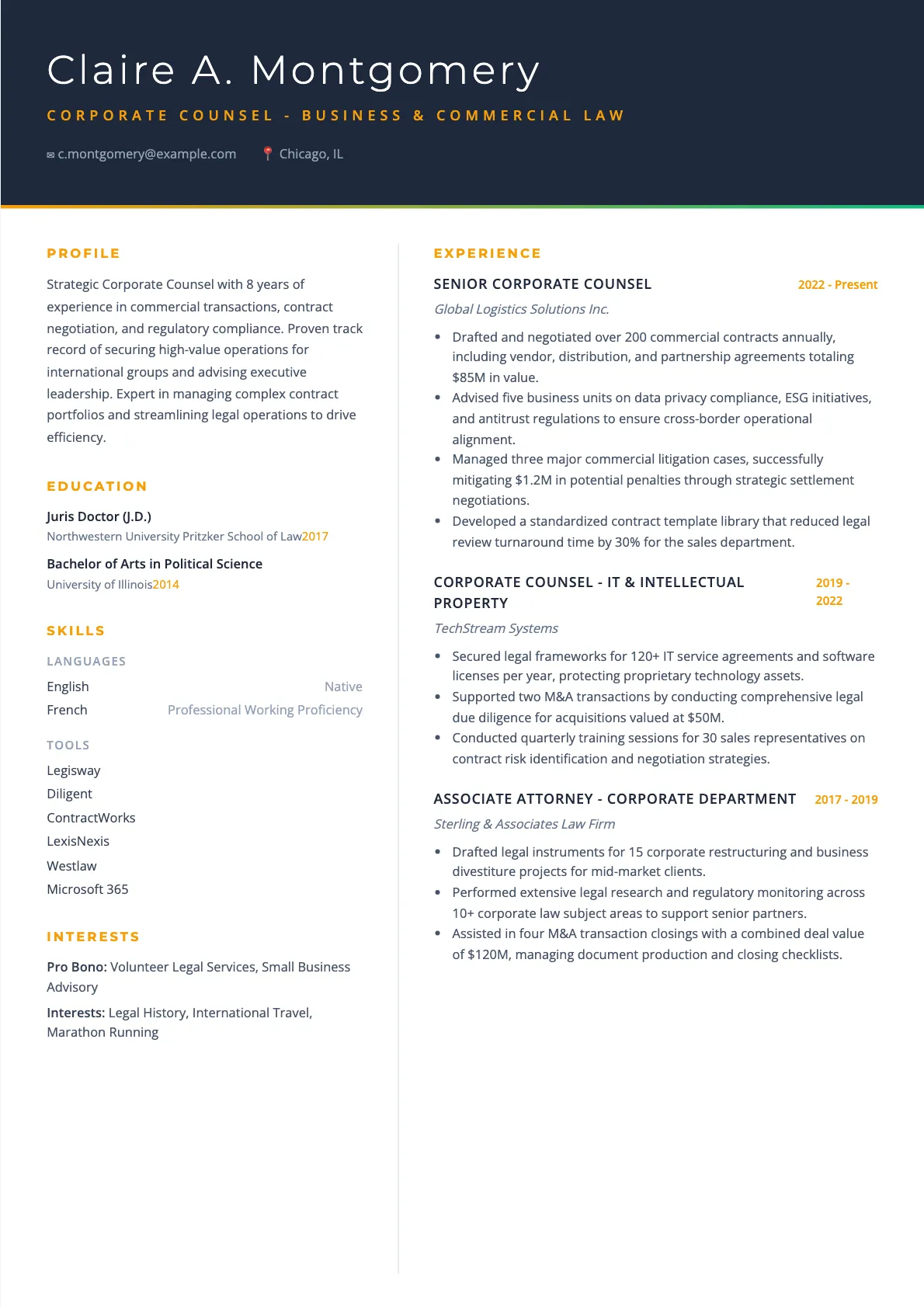
A corporate counsel resume must demonstrate a strategic balance between legal expertise and business acumen. In the United States, employers look for candidates who can mitigate risk while facilitating commercial growth. This guide provides a fictional sample and expert advice on presenting your legal background, contract management skills, and regulatory knowledge to secure interviews at top-tier firms or in-house departments.
Updated
How to define your legal specialization on a resume?
A generic title like Legal Counsel is often too broad for modern Applicant Tracking Systems and busy recruiters. You should align your job title with the specific needs of the posting, such as Corporate Counsel - M&A or Commercial Contracts Attorney. This immediate clarity helps the hiring manager categorize your expertise within the first few seconds of review.
When describing your experience, focus on specific practice areas rather than general administrative duties. Detail the types of contracts you handle, the industries you serve, and the specific stakeholders you advise. This approach demonstrates that you understand the operational nuances of the business.
Entry-level candidates should emphasize their clinical experience or internships in specific departments. If you lack a long history, highlight your focus on corporate governance or securities law during your Juris Doctor program. This helps bridge the gap between academic study and professional application.
What are the essential skills for a Corporate Counsel resume?
Successful corporate attorneys must demonstrate a blend of technical legal drafting and strategic risk assessment. Highlight your ability to negotiate complex commercial terms, manage intellectual property portfolios, and oversee corporate governance. If you have experience with specific regulations like GDPR, CCPA, or the Sarbanes-Oxley Act, ensure these are prominent in your skills section.
Legal operations and technology proficiency are increasingly important in the US market. Mention your experience with Contract Lifecycle Management software and legal research databases like Westlaw or LexisNexis. Do not neglect soft skills like cross-functional collaboration and executive communication.
You must prove that you can translate complex legal risks into actionable business advice for non-legal stakeholders. This involves demonstrating a track record of working with sales, product, and finance teams to achieve organizational goals. Quantify your impact whenever possible, such as reducing contract turnaround time or saving costs on outside counsel.
How should you present international legal experience?
If you are moving from a foreign jurisdiction to the US, focus on functional expertise rather than direct license equivalence. Do not claim your foreign degree is a J.D. or that your previous qualification is a US Bar admission if it is not. Instead, describe the scope of your work, such as cross-border M&A or international trade law, which translates well across borders.
Emphasize your understanding of comparative law and your ability to manage outside counsel in different regions. US employers value candidates who can bridge the gap between different legal systems. Retain the original names of your qualifications while providing context for their US counterparts.
For example, if you hold a Master 2 from a French university, list it accurately rather than renaming it. Explain the rigor of the program or the specific legal focus to help recruiters understand its value. Always check with the relevant State Bar and the employer regarding specific requirements for foreign-trained attorneys, as these vary significantly by state.
How to write a Corporate Counsel cover letter?
Your cover letter should move beyond your resume by telling the story of how you solved a specific business problem through legal strategy. Instead of listing your duties, describe a time you facilitated a major deal or prevented a costly litigation through proactive compliance. This demonstrates your value as a business partner who understands the bottom line.
Keep the tone professional, authoritative, and concise, typically between 220 and 300 words. Address the specific challenges the company is facing, such as rapid expansion or new regulatory hurdles. Avoid repeating the exact bullet points found in your professional experience section.
Use the cover letter to explain your motivation for joining this specific industry or company. This is the place to highlight your cultural fit and your alignment with the mission. A common mistake is using a generic template that fails to mention the company by name.
| Weak Description | Stronger Alternative |
|---|---|
| Responsible for drafting contracts. | Negotiated 150+ vendor agreements annually, reducing procurement costs by 12%. |
| Handled company litigation. | Managed a $2M litigation portfolio, achieving favorable settlements in 90% of cases. |
| Ensured regulatory compliance. | Implemented a company-wide GDPR compliance framework for 50,000+ customer records. |
Frequently asked questions
Do I need to list my Bar admission on my resume?
Yes, always list the state(s) where you are admitted to practice and the status of your license. If you are a foreign-trained lawyer, clearly state your original jurisdiction and any pending US credentials.
Should I include my law school GPA?
For experienced attorneys with more than three years of practice, the GPA is generally omitted. However, recent law school graduates should include it if it is a 3.5 or higher to demonstrate academic rigor.
Is a two-page resume acceptable for a senior counsel?
Yes, for legal professionals with over 10 years of experience or extensive lists of representative matters and publications, a two-page resume is standard in the US market.