Resume and cover letter resources
Art Director Resume Example and Writing Guide
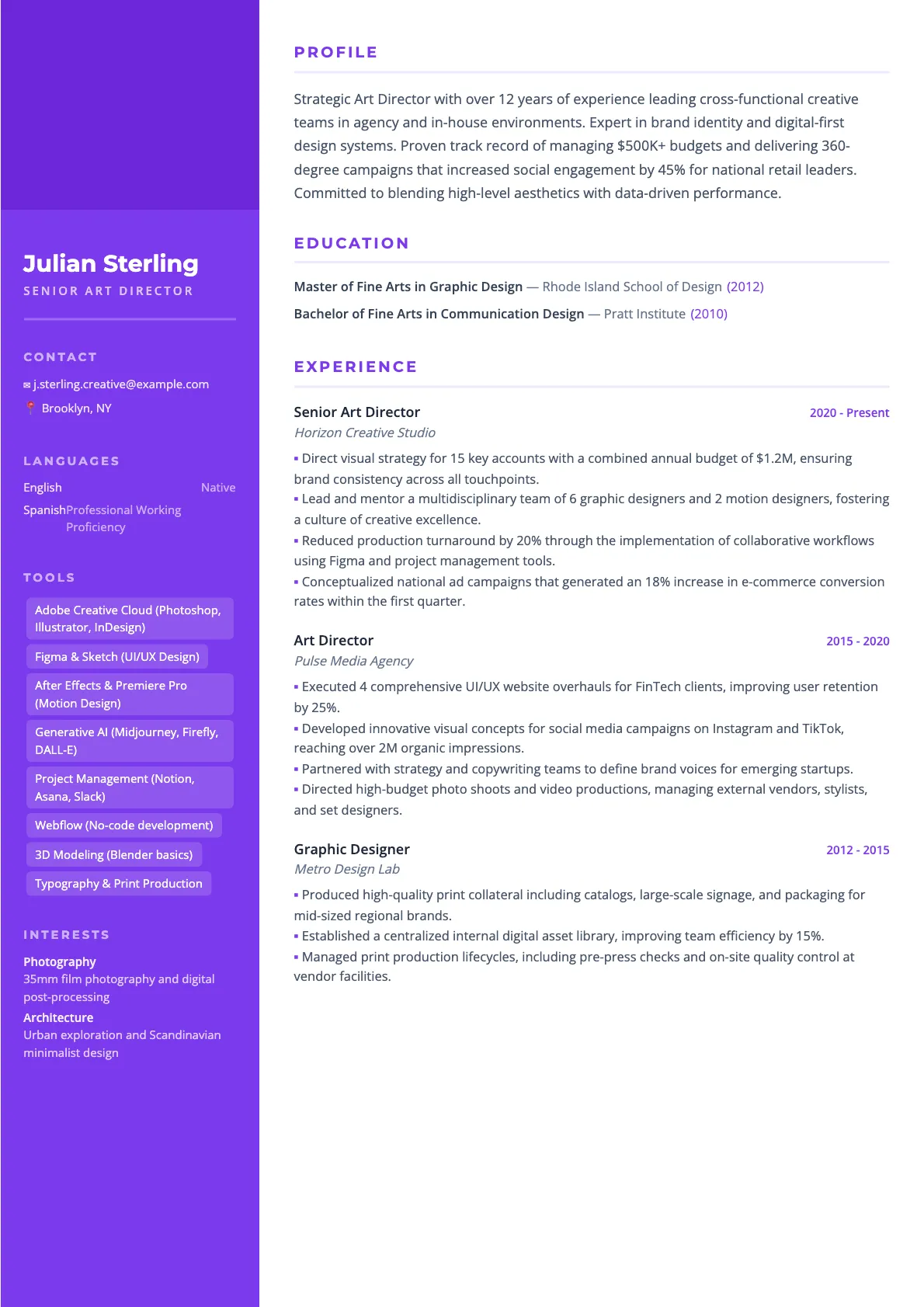
Securing a leadership role in the American creative industry requires a resume that balances visual sophistication with hard business metrics. As an Art Director, your document must prove you can translate brand strategy into high-performing visual assets. This guide provides a fictional native example and strategic advice to help you navigate the competitive US job market effectively.
Updated
How should an Art Director structure their resume?
An Art Director resume must prioritize a clean, professional layout that demonstrates design sensibility without sacrificing ATS readability. While it is tempting to use overly complex graphics, US recruiters prefer a structured approach where your portfolio link is prominent. Use a reverse-chronological format to highlight your most recent leadership roles and high-impact projects.
Ensure there is ample white space to reflect your understanding of visual hierarchy and composition.
The header should include your name, location, and a direct link to your online portfolio. In the American market, do not include a photo, age, or marital status, as these can lead to compliance issues for HR departments. Focus instead on a strong professional summary that defines your creative philosophy and leadership style.
This section acts as your elevator pitch, setting the tone for the rest of the document.
What creative skills are most in demand for 2026?
Mastery of the Adobe Creative Suite remains the baseline, but modern Art Directors must also showcase proficiency in collaborative UI/UX tools and Generative AI. Proficiency in Figma has become non-negotiable for digital-first roles, as it facilitates real-time collaboration between design and engineering teams. Mentioning your ability to integrate AI tools like Midjourney or Firefly into your ideation process shows you are at the forefront of industry efficiency.
These tools are not replacements for creativity but accelerators for prototyping and concept development.
Beyond technical software, emphasize your soft skills in creative direction and team management. Art Direction is as much about people as it is about pixels. Highlight your experience in mentoring junior designers, managing vendor relationships, and presenting concepts to stakeholders.
If you have experience in motion design or no-code platforms like Webflow, include these to demonstrate your versatility in a 360-degree creative environment.
How do you quantify design achievements on a resume?
To stand out, you must translate your aesthetic choices into measurable business outcomes like conversion rates, engagement, or cost savings. A beautiful design is expected, but a design that drives an 18% increase in e-commerce sales proves your strategic value. Use specific metrics whenever possible to ground your creative work in reality.
For example, instead of saying you 'designed social media posts,' state that you 'developed a visual strategy that increased organic reach by 2M impressions.'
Focus on the scale of the projects you have managed to demonstrate seniority. Mentioning budget sizes, such as a $1.2M account, gives recruiters an immediate sense of your level of responsibility. If you improved internal workflows, quantify the time saved.
For instance, implementing a new design system that reduced production time by 20% is a powerful indicator of operational leadership. This data-driven approach bridges the gap between the creative department and the executive suite.
What are common mistakes to avoid in a design resume?
The biggest mistake is submitting a resume that is either too cluttered to read or too generic to be memorable. Avoid using 'skill bars' or percentage charts to represent your proficiency in software, as these are subjective and often ignored by recruiters. Instead, list your tools clearly and let your experience bullets describe how you use them.
Ensure every word earns its place on the page, focusing on achievements rather than just listing daily tasks.
Never forget to double-check your portfolio link and ensure it is not password-protected for recruiters. A broken link is an immediate disqualification for a design role. Additionally, avoid using outdated fonts or clichéd design elements that might suggest your style is behind current trends.
Your resume is a piece of design in itself; it should feel contemporary, professional, and perfectly aligned with the brands you wish to work for.
| Common Phrasing | Strategic Alternative |
|---|---|
| Responsible for designing social media content. | Increased social engagement by 45% through a comprehensive brand identity refresh. |
| Managed a team of designers. | Mentored a 10-person creative team, reducing turnover and increasing output by 20%. |
| Proficient in Photoshop and Illustrator. | Leveraged Adobe CC and Generative AI to accelerate concept prototyping by 30%. |
Frequently asked questions
Should I use a highly creative resume template?
Your resume should demonstrate design skill through typography and layout rather than excessive decoration. A clean, minimalist design is usually more effective for passing through Applicant Tracking Systems (ATS) while still looking professional to a human eye.
How do I list my portfolio on my resume?
Place a clickable URL in your contact header. Use a clean, short link like 'yourname.com' or a customized LinkedIn URL. Ensure the landing page of your portfolio immediately showcases your best work without requiring multiple clicks.
Is a cover letter necessary for Art Directors?
Yes, a cover letter allows you to explain the 'why' behind your creative decisions. It is the perfect place to discuss a specific challenge you solved or to detail your leadership philosophy in a way that a bulleted list cannot.