Resume and cover letter resources
Web Designer Resume Example and Guide for 2026
A professional Web Designer resume must bridge the gap between aesthetic creativity and technical functionality. In the competitive US tech market, your resume needs to demonstrate not just how you design, but how your designs solve business problems and improve user engagement. This guide provides a fictional sample and expert strategies to showcase your portfolio and technical stack effectively.
Updated
How should you structure a Web Designer resume for US employers?
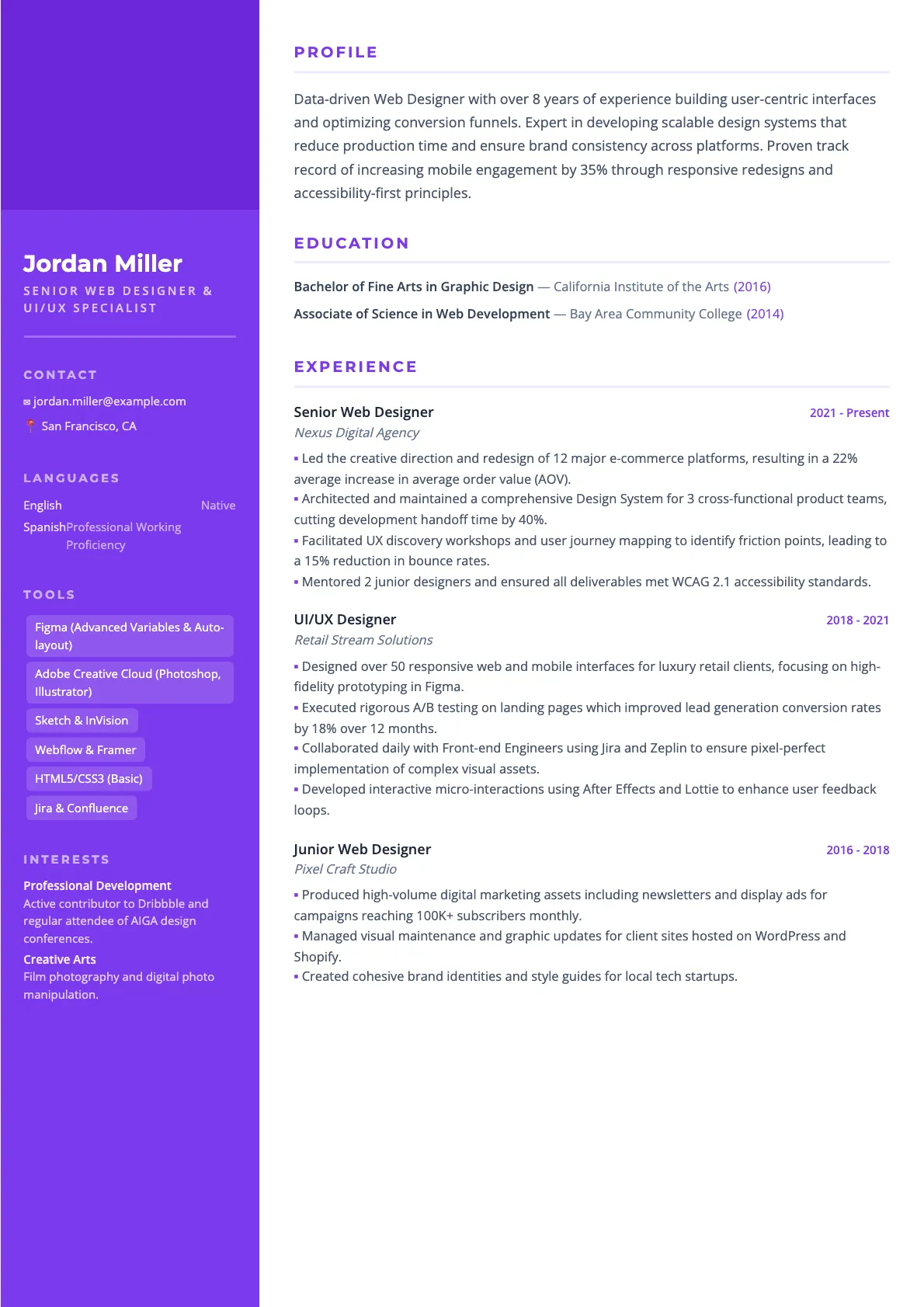
Prioritize a clean, single-column layout that emphasizes readability and technical proficiency over decorative elements. While it is tempting to use your resume as a canvas for complex graphics, Applicant Tracking Systems (ATS) often struggle to parse multi-column layouts or text embedded in images. Focus on a clear hierarchy using standard fonts like Helvetica or Roboto.
This fictional sample demonstrates how to organize information for maximum impact.
Ensure your contact information includes a direct link to your online portfolio, as recruiters will rarely consider a designer without seeing their live work. Use the reverse-chronological format to highlight your most recent and relevant achievements. This structure allows hiring managers to see your career progression and current skill level immediately.
Avoid including personal details like age or photos which are not standard in the US market.
Each role should include a brief description of the company context followed by bullet points that focus on outcomes rather than just tasks. For example, instead of saying you designed websites, explain how those designs improved user retention or streamlined the checkout process. This approach proves you understand the business value of design.
Which technical skills are essential for Web Designers in 2026?
Mastery of Figma has become the industry standard, specifically regarding advanced features like variables, auto-layout, and dev-mode handoffs. Employers are no longer looking for designers who just create static mockups; they want professionals who understand the entire product lifecycle. Mentioning your ability to build and maintain Design Systems is a significant advantage, as it demonstrates an understanding of scalability and efficiency.
Knowledge of prototyping tools like ProtoPie or Framer can also set you apart from candidates who only provide flat designs. Complement your visual skills with a strong understanding of UX research and basic front-end constraints. You do not need to be a developer, but mentioning your familiarity with HTML5, CSS3, and React components shows you can communicate effectively with engineering teams.
This cross-functional literacy is highly valued in agile environments.
Additionally, emphasize your knowledge of accessibility standards such as WCAG. Designing for inclusivity is a major priority for modern US corporations, and proving you can create accessible interfaces is a high-value asset. Mentioning specific compliance successes can make your application stand out to large enterprise employers.
How do you quantify design impact on a resume?
Translate your design choices into business metrics like conversion rates, click-through rates, and user engagement scores. A beautiful design is subjective, but a design that increases revenue by 20% is an objective success. When describing a project, use the STAR method (Situation, Task, Action, Result) to provide context.
This helps recruiters understand the scale of your contributions.
For instance, describe how a navigation redesign reduced customer support tickets or how an A/B test on a call-to-action button led to higher sign-up volumes. Include specific data points to validate your seniority and expertise. Mention the size of the user base you designed for or the number of stakeholders you managed during a project.
These details provide a sense of your professional maturity.
If you worked on a design system, quantify how much time it saved the development team. These figures provide a sense of scale and show that you understand the commercial implications of your creative work. US recruiters look for designers who think like product owners and prioritize efficiency alongside aesthetics.
What are the common mistakes to avoid on a design resume?
Avoid including a photo, age, or marital status, as these are not standard in US resumes and can lead to immediate rejection for compliance reasons. Unlike some international markets, the US hiring process strictly avoids personal identifiers to prevent bias. Another common error is neglecting the text-based descriptions of your work in favor of purely visual links.
The resume must stand on its own as a professional document.
While the portfolio is crucial, the resume itself must contain the keywords that recruiters search for, such as UI/UX, responsive design, and wireframing. Do not overlook the importance of proofreading and typography on your own document. As a designer, your resume is a direct reflection of your attention to detail.
Inconsistent margins or poor font choices can signal a lack of professionalism.
Typos, inconsistent spacing, or poor font choices will undermine your claims of being a detail-oriented professional. Ensure that all links to your portfolio or LinkedIn profile are active and not broken. Finally, avoid using generic skill bars or percentages to represent your software knowledge, as these are arbitrary and do not provide meaningful information to a recruiter.
| Weak Description | Impactful Alternative |
|---|---|
| Responsible for designing the company website. | Led a full-scale responsive redesign that increased mobile conversion rates by 25%. |
| Used Figma to create wireframes and mockups. | Developed a scalable Figma Design System, reducing design-to-dev handoff time by 30%. |
| Collaborated with the marketing team on ads. | Designed high-performing display ad sets that achieved a 4% CTR for a national campaign. |