Resume and cover letter resources
UX Designer Resume Example and Writing Guide
A successful UX Designer resume must bridge the gap between creative problem-solving and measurable business outcomes. In the competitive American tech landscape, recruiters look for evidence of user-centric methodologies and cross-functional collaboration. This guide provides a fictional sample and strategic advice to help you translate your design process into a compelling professional narrative.
Updated
How to Structure a UX Designer Resume for Maximum Impact
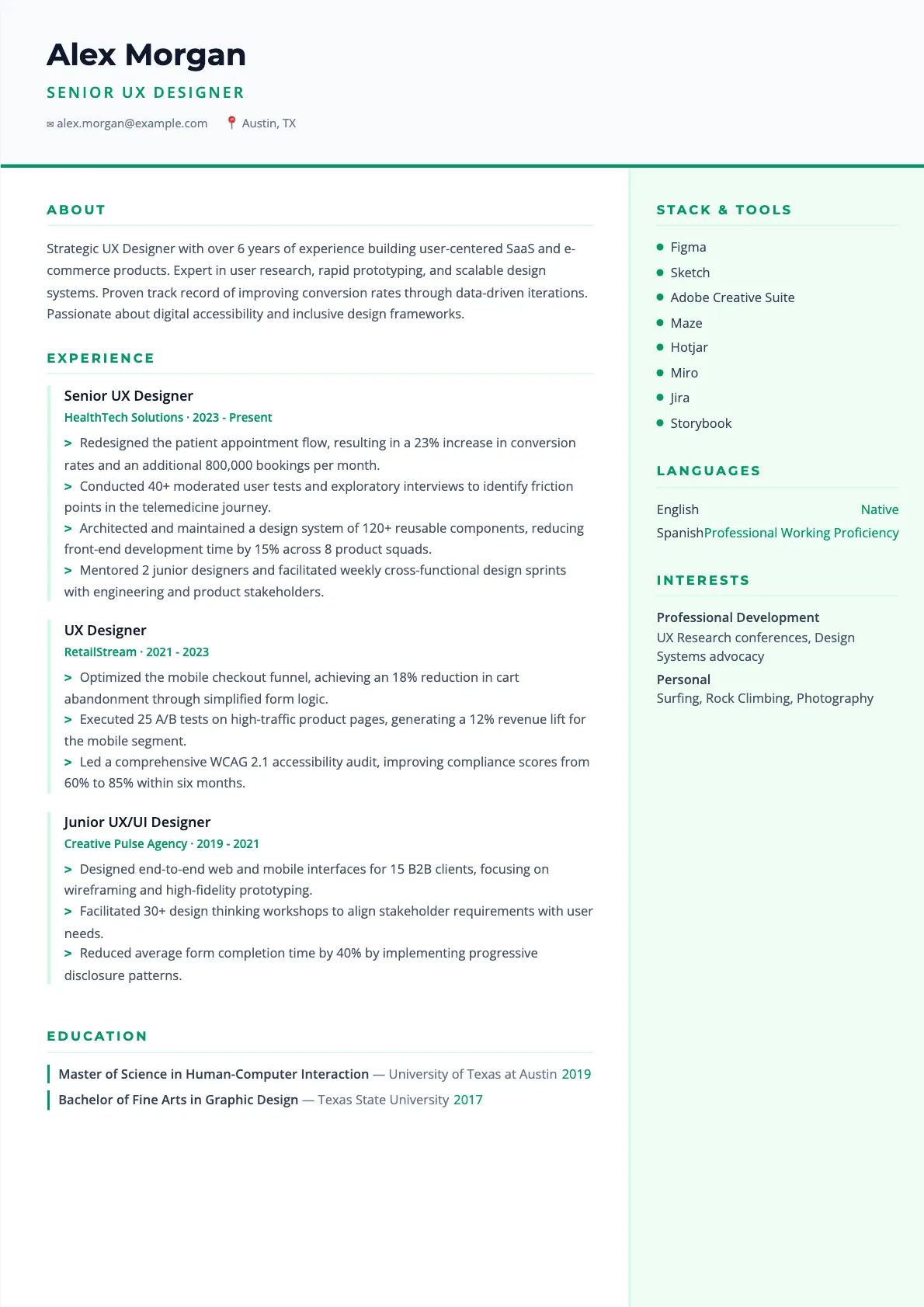
A high-performing UX resume must prioritize a clean, single-column layout that balances visual hierarchy with ATS compatibility. While designers often feel pressured to create overly artistic layouts, American recruiters prefer standard fonts and clear headings that allow for rapid scanning. Start with a professional summary that explicitly defines your niche, such as SaaS, mobile-first, or enterprise design, to immediately establish your value proposition.
Your experience section should follow a strict reverse-chronological order, ensuring your contact information includes a direct link to your portfolio. This portfolio link is the most critical asset for a design recruiter and should be easily accessible at the top of the page. Use white space effectively to demonstrate your understanding of layout principles, which serves as a subtle proof of your core UX skills.
Avoid using subjective skill bars or percentages to represent your proficiency, as these metrics are arbitrary and often confuse hiring managers. Instead, focus on a clear list of software and methodologies that align with the specific job description. This approach ensures your resume is both human-readable and optimized for digital screening tools used by major tech firms.
Quantifying Design Success with Business Metrics
Quantify your design decisions by linking them to specific business KPIs like conversion rates, task completion time, or churn reduction. A resume that only lists tasks like "created wireframes" fails to demonstrate the strategic value you bring to a product team. Instead, explain the rationale behind your design choices and the measurable impact they had on the user experience and the company's bottom line.
For example, mention how a comprehensive accessibility audit expanded the reachable market or how a new design system improved development velocity by a specific percentage. If you worked on internal tools, focus on efficiency gains, reduced support tickets, or improved employee productivity metrics. Using specific numbers makes your contributions tangible and sets you apart from candidates who only describe their creative process without mentioning outcomes.
For entry-level designers, this can include metrics from freelance projects or academic case studies where user testing led to measurable improvements. Highlighting these results proves you are a data-driven professional who understands that design is a tool for solving business problems. This level of detail is particularly important for Senior and Lead roles where strategic impact is expected.
Showcasing User Research and Evidence-Based Design
Explicitly name the methodologies you utilize, such as ethnographic interviews, usability testing, or card sorting, to demonstrate a rigorous, evidence-based approach. Research is the foundation of effective UX, and employers want to see that your designs are rooted in user needs rather than personal intuition. Detail how you translated complex research findings into actionable design changes that solved specific pain points.
Mention the specific tools you use for synthesis and testing, such as Maze, Dovetail, or UserTesting, to show technical proficiency. If you have experience with A/B testing, highlight your collaboration with data analysts and product managers to validate design hypotheses. Showing that you can advocate for the user while respecting technical and business constraints is a key trait of a mature designer.
This evidence proves you can handle the discovery phase of the product lifecycle and reduces the perceived risk of hiring you. For those transitioning from nursing or other fields, emphasize transferable skills like patient interviewing or clinical observation as foundational research experience. Clearly articulating your research process demonstrates that you are a disciplined professional who values validation over guesswork.
Essential Technical Skills and Industry Trends for 2026
Mastery of industry-standard tools like Figma is mandatory, but knowledge of design-to-code handoff and AI-assisted design workflows is increasingly vital. List your software proficiency clearly, but do not stop at creative tools; mentioning familiarity with HTML, CSS, or React helps recruiters see you can communicate with engineering teams. Include soft skills that are vital for modern UX roles, such as stakeholder management, cross-functional collaboration, and workshop facilitation.
As design systems become the industry norm, experience with design tokens and component documentation is highly sought after by enterprise employers. If you have specialized knowledge in niche areas like motion design, voice UI, or AR/VR, include these to differentiate your profile from the general applicant pool. Always tailor your skills list to the specific requirements mentioned in the job description to ensure you pass through initial ATS filters.
Avoid the mistake of listing every tool you have ever touched; focus on the ones that are most relevant to the role you are targeting. For entry-level applicants, showcasing a willingness to learn emerging AI tools can demonstrate a forward-thinking mindset that appeals to innovative startups and established tech giants alike.
| Vague Responsibility | Impact-Driven Achievement |
|---|---|
| Responsible for the company design system. | Scaled the design system to 200+ components, reducing design-to-dev handoff time by 25%. |
| Conducted user testing on the mobile app. | Led 15 usability sessions that identified a navigation flaw, resulting in a 10% lift in user retention. |
| Created wireframes for a new checkout page. | Redesigned the checkout flow using a single-page architecture, decreasing cart abandonment by 15%. |
Frequently asked questions
Should I include a photo on my UX Designer resume?
No. In the United States, it is standard practice to exclude photos from resumes to prevent unconscious bias and comply with anti-discrimination laws. Focus on your portfolio link instead.
Is a portfolio more important than a resume for UX roles?
They serve different purposes. The resume gets you past the initial screening and ATS, while the portfolio proves your skills through case studies. You need both to be professional and aligned.
How long should a Senior UX Designer resume be?
Aim for one to two pages. If you have over 10 years of experience, two pages are acceptable, but ensure the most relevant and recent achievements are on the first page.