Resume and cover letter resources
Store Manager Resume Example and Writing Guide
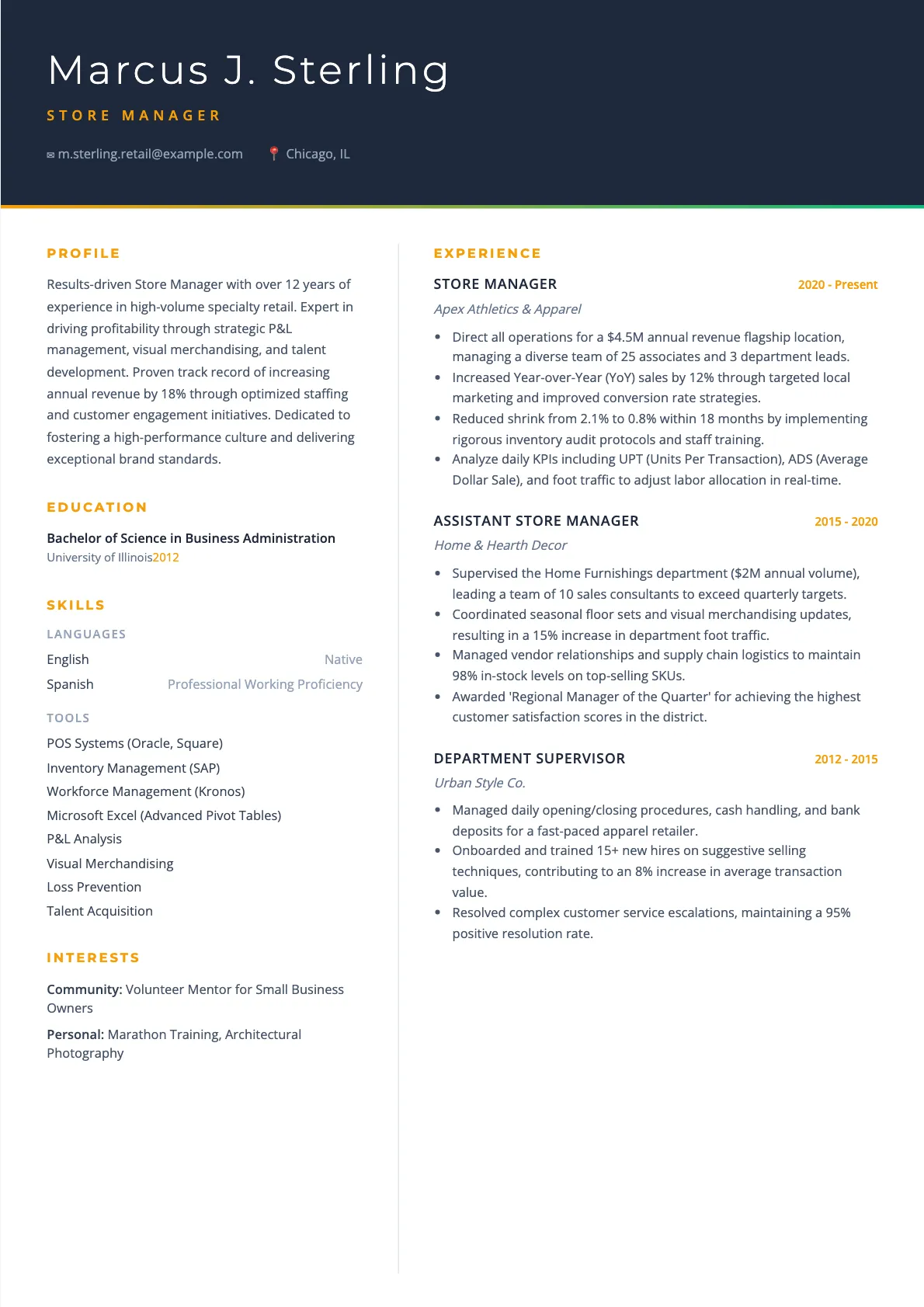
A Store Manager resume must demonstrate a balance between operational excellence and people leadership. In the competitive US retail market, hiring managers look for candidates who can prove their impact through hard data, such as sales growth percentages and cost reduction. This guide provides a fictionalized sample and strategic advice to help you build a resume that highlights your commercial achievements and management style.
Updated
How to Quantify Retail Impact and Operational Success
Effective Store Manager resumes must translate daily activities into measurable financial outcomes to capture recruiter attention. Instead of stating you managed a team, specify that you directed a staff of thirty across a ten-million-dollar annual volume location. Use percentages to demonstrate your ability to drive growth, such as increasing Year-over-Year sales or improving Units Per Transaction through suggestive selling initiatives.
Recruiters look for candidates who understand the direct correlation between labor allocation and store profitability. Focus on the three core pillars of retail performance: revenue growth, talent retention, and loss prevention. For revenue, highlight your success in boosting conversion rates or Average Dollar Sale through visual merchandising adjustments.
Regarding people, document your success in reducing staff turnover by twenty percent or promoting three associates to leadership roles. For operations, detail your specific achievements in reducing shrink or maintaining inventory accuracy during high-volume seasonal transitions. These figures provide a concrete scale for your previous responsibilities and prove you can handle the pressure of a high-stakes retail environment.
Demonstrating Strategic Leadership and Team Development
Leadership in a modern retail environment is defined by the ability to coach others toward peak performance. Avoid using passive phrases like 'responsible for staff' and instead use active verbs like 'orchestrated,' 'mentored,' or 'cultivated.' Describe how you led a specific number of department heads to exceed their quarterly key performance indicators.
If you managed a flagship location, emphasize your role in setting the standard for the entire district or region. Highlight your involvement in the full employee lifecycle to show comprehensive management capabilities. Discuss your specific strategies for talent acquisition, including how you sourced and interviewed candidates to build a diverse workforce.
If you developed a new onboarding curriculum that shortened the time to productivity for new hires, include that as a major achievement. Showing that you can build a sustainable culture of excellence is often more valuable than individual sales prowess. Employers want to see that you can delegate effectively while maintaining high brand standards and ensuring a consistent customer experience across all shifts.
Essential Technical Proficiencies and Digital Literacy
Modern retail management requires a sophisticated blend of software proficiency and traditional operational expertise. You must explicitly list the Point of Sale systems and Inventory Management Software, such as SAP or Oracle, that you have mastered. Proficiency in workforce management tools like Kronos or Workday is highly sought after for optimizing labor costs and scheduling.
These technical skills demonstrate that you can leverage technology to improve store efficiency and bottom-line results. Data analysis is a critical competency for store-level leadership in the current market. Mention your ability to interpret complex retail analytics and translate those insights into actionable floor plans or staffing adjustments.
Visual merchandising is another essential skill; describe your experience executing planograms and seasonal floor sets to maximize foot traffic. If you have managed omni-channel workflows, such as Buy Online Pick Up In Store or ship-from-store logistics, ensure these are prominent. Mastery of Microsoft Excel for P&L tracking and reporting is also a standard requirement that should be clearly stated to show you are prepared for the administrative demands of the role.
Navigating Education and Professional Certifications
While a Bachelor of Science in Business Administration is common, your professional trajectory often speaks louder than your degree. List your highest level of education clearly, including the institution name and the year you graduated. If you do not possess a four-year degree, emphasize your career progression from an entry-level sales associate to a senior management position.
Many major US retailers highly value 'homegrown' talent who has demonstrated loyalty and a deep understanding of the retail floor. Include specialized certifications that prove your expertise in specific niches of the retail industry. This might include food safety certifications for grocery environments or professional loss prevention credentials.
If you are a recent graduate, you may include relevant coursework such as Consumer Behavior, Accounting, or Marketing to bolster your profile. However, for seasoned managers, the focus must remain on the increasing complexity and volume of the stores you have successfully operated. Avoid including high school information if you have significant professional experience or a college degree, as this takes up valuable space that could be used for achievements.
| Common Weakness | Stronger Evidence-Based Alternative |
|---|---|
| Responsible for store sales and hitting targets. | Exceeded annual sales target of $3.2M by 14% through local outreach and staff incentive programs. |
| Managed a large team of retail associates. | Led a cross-functional team of 30+ employees, including 4 department supervisors, across two shifts. |
| Improved store appearance and merchandising. | Executed weekly planogram updates and seasonal floor sets, increasing high-margin accessory sales by 20%. |
Frequently asked questions
Should I include my retail experience from ten years ago?
Yes, but keep it brief. Focus 80% of your resume space on your most recent 5 to 7 years of experience, especially your roles in management. Earlier roles as a sales associate can be summarized to show your career progression from the floor to leadership.
What are the most important KPIs for a Store Manager resume?
The most critical KPIs are Sales vs. Plan, Year-over-Year (YoY) growth, Shrink percentage, Labor Cost as a percentage of sales, and Conversion Rate. Including these shows you have a deep understanding of store profitability.
Do I need a summary or an objective statement?
Use a Professional Profile or Summary. An objective focuses on what you want, whereas a summary focuses on what you offer the employer, such as '10 years of experience managing $5M+ retail environments.'