Resume and cover letter resources
Software Architect Resume Example 2026
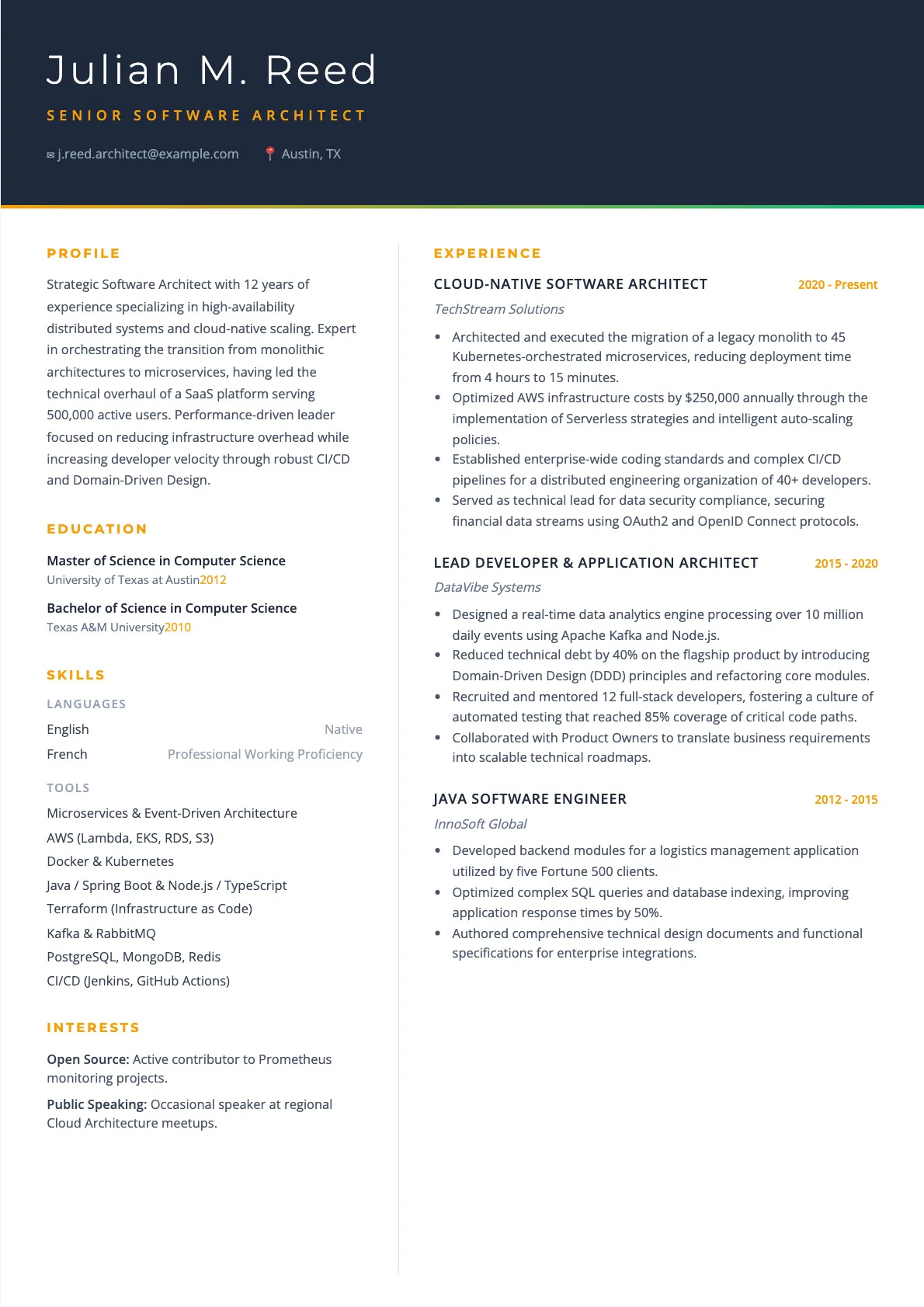
A Software Architect resume must demonstrate the ability to bridge high-level business strategy with low-level technical execution. In 2026, hiring managers look for evidence of scalable system design, cost optimization, and cross-functional leadership. This fictional sample and guide provide the framework to showcase your technical authority and architectural vision effectively for the American job market.
Updated
How should you quantify architectural impact on a resume?
Focus on cost savings, deployment velocity, and system reliability metrics to demonstrate the business value of your technical decisions. Software architecture is not just about choosing a framework; it is about the economic and operational outcomes of those choices. If you migrated a system to the cloud, state the exact percentage of infrastructure cost reduction or the increase in uptime.
Recruiters need to see that your designs solve real-world bottlenecks.
Use specific figures to describe the scale of the systems you have managed. Mentioning that you handled 10 million events per day or supported 500,000 concurrent users provides immediate context for your seniority. Avoid vague statements like "improved system performance" and instead use "reduced latency by 200ms."
This level of detail separates a high-level architect from a senior developer.
Which technical skills are essential for a 2026 Software Architect?
Prioritize cloud-native technologies, Infrastructure as Code (IaC), and distributed system patterns in your skills section. Modern architecture roles heavily favor candidates who understand Kubernetes, Terraform, and Serverless environments. You should explicitly list your experience with specific cloud providers like AWS, Azure, or GCP.
Highlighting your proficiency in Event-Driven Architecture and Microservices is mandatory for most enterprise-level roles today.
Balance your stack between backend languages and architectural frameworks. While you may not be coding 40 hours a week, you must show mastery in languages like Java, Go, or Node.js alongside tools like Kafka or RabbitMQ. Mentioning Domain-Driven Design (DDD) or Test-Driven Development (TDD) shows you have a methodology for managing complexity.
This combination proves you can both design the blueprint and understand the building materials.
How do you demonstrate leadership without a management title?
Highlight your role in mentoring engineering teams and influencing cross-functional stakeholders. An architect’s success depends on their ability to get buy-in from both developers and executives. Describe instances where you defined coding standards, led technical committees, or mentored junior engineers through code reviews.
These actions demonstrate that you can scale your expertise through others, which is a core requirement for architectural roles.
Emphasize your communication skills by detailing how you bridge the gap between business and tech. Mentioning your experience in writing RFCs (Request for Comments) or technical roadmaps shows you can document and defend your decisions. If you have negotiated technical debt with Product Owners, include that in your bullet points.
This proves you understand that architecture must serve the product's long-term goals, not just technical purity.
What are the common mistakes to avoid on an Architect resume?
Avoid becoming an "Ivory Tower" architect by ensuring your resume reflects hands-on technical involvement. A common red flag for recruiters is a candidate who seems too far removed from the actual codebase. Ensure your recent experience includes mentions of Proof of Concepts (PoCs), debugging critical production issues, or contributing to core libraries.
This keeps your profile grounded and attractive to fast-moving tech companies.
Do not list every technology you have ever touched; focus on the ones relevant to your target role. A cluttered resume with obsolete technologies like SOAP or older EJB versions can make you look out of touch. Keep your "Skills" section curated to modern, high-demand tools that align with the job description.
Finally, ensure your resume follows a clean, single-column layout to remain compatible with Applicant Tracking Systems (ATS).
| Weak Description | Strong Architectural Evidence |
|---|---|
| Designed microservices for the company. | Architected a transition to 45 microservices, reducing deployment time by 85%. |
| Responsible for AWS cloud management. | Reduced AWS annual spend by $250k through Serverless and auto-scaling implementation. |
| Worked on improving system speed. | Optimized SQL indexing and query logic to improve response times by 50% for 500k users. |
Frequently asked questions
Should a Software Architect resume be one or two pages?
For an architect with over 10 years of experience, a two-page resume is standard and often necessary to detail complex projects. However, ensure the most impactful achievements and modern tech stack are on the first page.
How do I pass the ATS as a Software Architect?
Use standard section headings and include specific keywords found in the job description, such as 'Kubernetes', 'Distributed Systems', or 'CI/CD'. Avoid using tables or graphics within the experience section, as these can scramble the data for some parsers.
Is it necessary to include a summary or profile?
Yes, a professional summary is vital for an architect to define their 'architectural philosophy' and highlight their years of experience and primary areas of expertise, such as Cloud-Native or FinTech systems.