Resume and cover letter resources
Osteopath Resume Example and Writing Guide
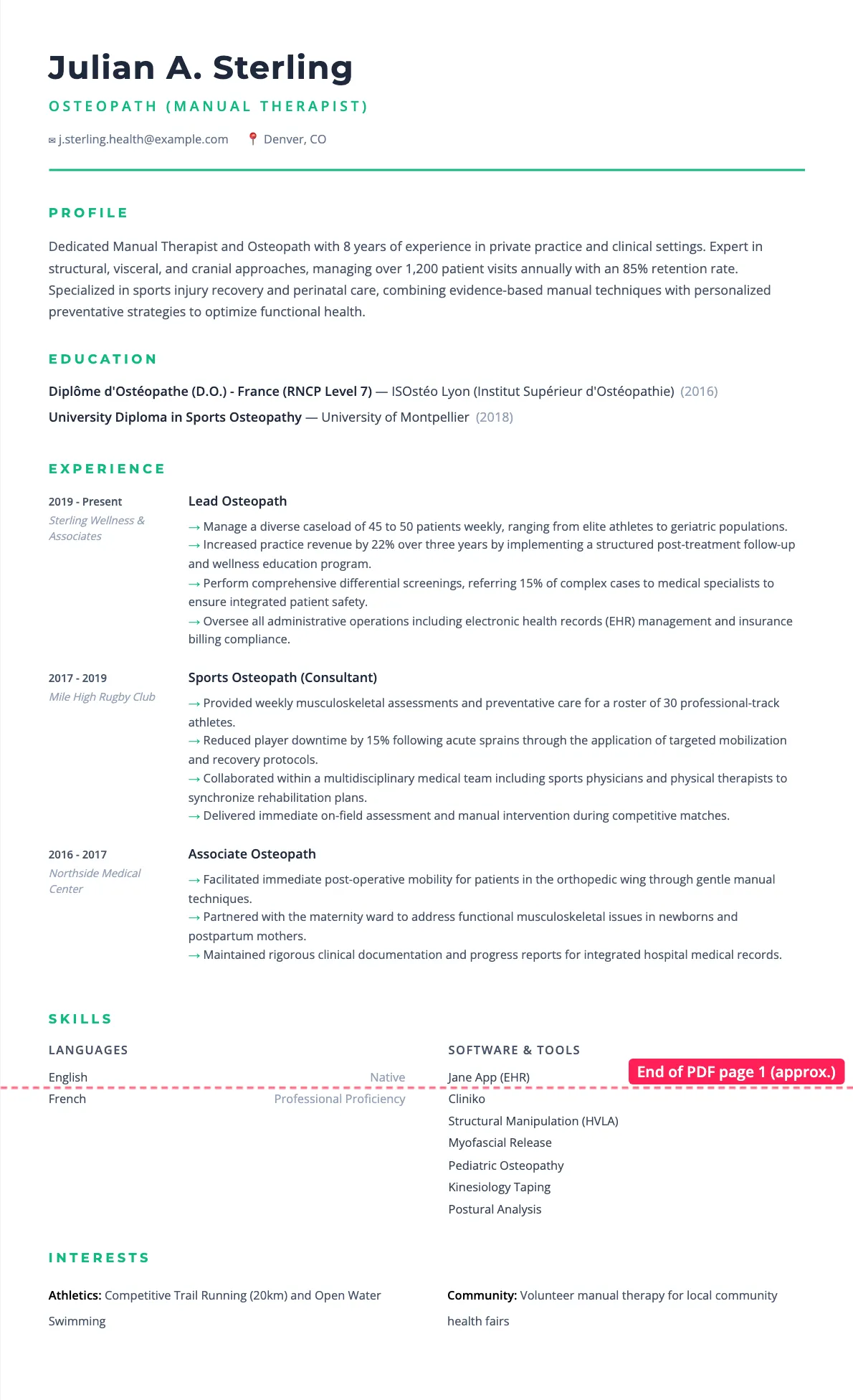
A professional resume for an Osteopath must bridge the gap between clinical expertise and patient-centered care. While the profession involves manual therapy, your resume needs to demonstrate diagnostic precision and business acumen. This guide provides a fictional sample and strategic advice to help you present your credentials effectively to clinics, sports teams, or private practices.
Updated
How to present international osteopathic credentials?
When applying for US roles with international qualifications, you must explicitly state your specific degree and country of origin without claiming local medical licensure equivalence. The American healthcare system distinguishes between US-trained Doctors of Osteopathic Medicine (DOs), who are fully licensed physicians with prescribing rights, and international Osteopaths who focus on manual therapy. Ensure your resume reflects your specific scope as a manual therapist or clinical practitioner to avoid legal misrepresentation.
You should advise the employer that you understand local regulatory boundaries and are prepared to provide NACES-approved credential evaluations. Avoid using the title Physician or Doctor unless you hold a US medical license, as this is a common mistake that leads to immediate rejection. Focus instead on your clinical hours, patient outcomes, and specific manual techniques to demonstrate your value to a wellness center or multidisciplinary clinic.
If you previously worked as a nursing assistant or RN while studying, distinguish these roles clearly to show your progression within the healthcare hierarchy. Highlighting your original qualifications, such as a French Diplôme d'Ostéopathe, preserves your professional integrity while clarifying your educational background for American recruiters.
What clinical evidence should you highlight?
Quantify your clinical impact by documenting patient volume, retention rates, and specific recovery outcomes across your professional history. A resume that simply lists manual therapy is less effective than one that mentions managing 50 patients per week or reducing recovery time for specific musculoskeletal injuries. Use concrete figures to show you can handle the pace of a busy private practice while maintaining high standards of evidence-based care.
Mentioning your patient retention rate is particularly important for private clinics, as it proves your ability to build trust and long-term therapeutic relationships. If you have worked with specific populations like professional athletes or postpartum mothers, include the number of cases or the percentage of your caseload they represent. This data provides a clear picture of your professional maturity and your ability to generate revenue for the practice.
For entry-level applicants, focus on clinical internship hours and the diversity of pathologies encountered during your supervised training. Avoid generic filler like 'hardworking' and instead use metrics like 'achieved a 90% patient satisfaction rating' to provide tangible proof of your clinical competence and bedside manner.
Which technical skills are most valuable for Osteopaths?
Beyond manual techniques, emphasize your proficiency in differential diagnosis and multidisciplinary collaboration to ensure patient safety. Employers look for practitioners who know when to treat and when to refer, as identifying red flags is the highest priority in a primary care setting. Highlight your ability to perform thorough orthopedic and neurological screenings alongside your traditional osteopathic assessments.
Mentioning specific Electronic Health Record (EHR) software like Jane App or Cliniko shows you are ready to manage administrative tasks and insurance billing compliance immediately. If you have specialized training in areas like Kinesiology Taping, ergonomic assessments, or pediatric care, list these clearly to differentiate yourself from generalists. These additional certifications make you a more versatile asset to a clinic that may want to expand its service offerings to new demographics.
Do not overlook the importance of soft skills; your ability to explain complex biomechanical issues in simple terms is a technical necessity for patient compliance. Ensure you distinguish between advanced manual techniques like HVLA and gentler approaches like myofascial release to show a well-rounded clinical toolkit that can be adapted to geriatric or sensitive patients.
How to tailor your resume for different clinical settings?
Tailoring your resume requires aligning your specific manual expertise with the primary patient demographic of the hiring clinic. If applying to a sports medicine facility, prioritize your experience with acute injury management, return-to-play protocols, and collaboration with physical therapists. Conversely, a family-oriented wellness center will value your experience in perinatal care, pediatric osteopathy, and long-term postural correction.
Avoid the mistake of sending a generic resume to every opening; instead, mirror the language used in the job description to pass through applicant tracking systems. For hospital-based roles, emphasize your experience with integrated medical records and your ability to work alongside RNs and specialized medical staff. If you are an entry-level practitioner, highlight your clinical rotations and any volunteer work at community health fairs to demonstrate hands-on experience.
Ensure your contact information is professional and your location is clearly stated to show you are local or ready to relocate. A well-tailored resume should demonstrate that you are not just a practitioner, but a strategic fit for the clinic's specific business model and patient care philosophy. This targeted approach significantly increases your chances of securing an interview in a competitive metropolitan market.
| Vague Description | Concrete Evidence |
|---|---|
| Treated many patients with back pain. | Managed a caseload of 40+ patients weekly, specializing in chronic lumbar dysfunction and postural correction. |
| Worked with a sports team. | Served as consultant Osteopath for a rugby club, reducing injury-related downtime by 15% over two seasons. |
| Knowledge of clinical software. | Proficient in EHR management and billing using Jane App and Cliniko for a 3-practitioner office. |