Resume and cover letter resources
Logistics Manager Resume Example for 2026
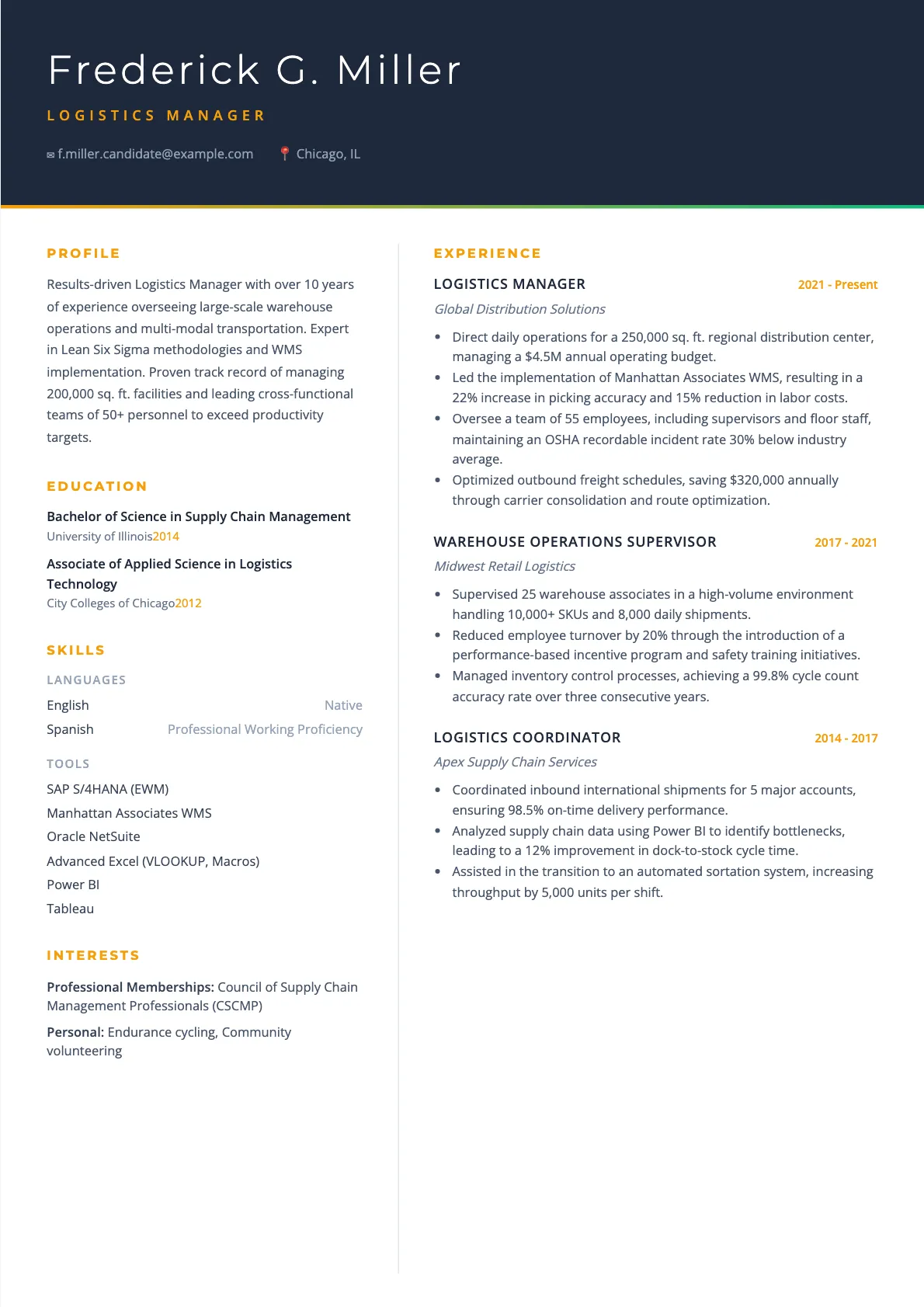
A successful Logistics Manager resume must demonstrate a mastery of operational efficiency and team leadership. In the American market, hiring managers look for quantifiable achievements in cost reduction, safety compliance, and inventory accuracy. This guide provides a fictional sample and expert strategies to showcase your ability to manage complex supply chain networks and high-volume warehouse environments.
Updated
How to quantify your logistics achievements?
Logistics resumes must translate daily tasks into measurable business value to capture the attention of American recruiters. Instead of stating you managed a warehouse, specify the square footage and the number of SKUs under your supervision. Use hard numbers to describe your impact on the bottom line, such as percentage reductions in shipping errors or dollar amounts saved through vendor negotiations.
Focus on metrics that matter to executive leadership, including inventory turnover, order cycle time, and transportation costs per unit. If you managed a team, mention the headcount and any improvements in safety metrics or retention rates. These figures provide the concrete evidence needed to prove you can handle the scale of the employer's operations.
Highlighting a 15% increase in throughput is far more persuasive than simply listing warehouse management as a skill.
Which technical skills are essential for this role?
Proficiency in Warehouse Management Systems (WMS) and Enterprise Resource Planning (ERP) software is the foundation of a modern logistics resume. Employers look for specific platforms like SAP, Oracle, or Manhattan Associates to ensure you can hit the ground running. Beyond basic data entry, you should demonstrate an ability to use these tools for strategic decision-making and process optimization.
Analytical skills are equally critical in 2026, as logistics becomes increasingly data-driven. Mention your experience with data visualization tools like Power BI or Tableau and your ability to perform complex analysis in Excel. If you have experience with automation technology, such as Automated Storage and Retrieval Systems (AS/RS) or robotics, ensure these are prominently featured.
These technical competencies signal that you are prepared for the technological evolution of the supply chain industry.
How to structure your professional experience?
The reverse-chronological format is the standard for US logistics professionals, emphasizing your most recent and relevant leadership roles. Start each bullet point with a strong action verb like Spearheaded, Optimized, or Negotiated to convey authority. Ensure your job titles reflect your actual level of responsibility, using terms like Manager, Supervisor, or Coordinator as appropriate for the US market.
Avoid long paragraphs of text and instead use concise bullet points that follow the Situation-Action-Result (SAR) method. This structure allows recruiters to quickly scan your resume and identify your key contributions at each fictional workplace. For those with extensive experience, focus the most space on the last 5 to 10 years of your career.
Earlier roles can be summarized more briefly to keep the document focused on your current capabilities and seniority.
What certifications add the most value?
Professional certifications serve as a benchmark for your expertise and commitment to the logistics field. While not always mandatory, credentials such as the Certified Supply Chain Professional (CSCP) or Certified in Planning and Inventory Management (CPIM) are highly regarded by US employers. If you have completed Lean Six Sigma training, specify your belt level to demonstrate your ability to eliminate waste and improve process flow.
For candidates who have moved from international markets, it is important to list your original qualifications accurately. Do not attempt to convert a foreign degree into a US equivalent; instead, list the degree as earned and provide context regarding the coursework if necessary. Always check with the specific employer or relevant industry body regarding the recognition of international credentials.
Highlighting ongoing professional development shows that you stay current with global supply chain trends and regulatory requirements.
| Common Task | Impact-Focused Achievement |
|---|---|
| Managed warehouse staff and daily schedules. | Led a team of 40+ associates, reducing overtime costs by 18% through optimized shift scheduling. |
| Responsible for inventory and stock levels. | Maintained 99.9% inventory accuracy across 15,000 SKUs using daily cycle counting and WMS auditing. |
| Handled shipping and receiving operations. | Streamlined inbound receiving processes, reducing dock-to-stock time from 24 hours to 6 hours. |
Frequently asked questions
Should I include my forklift certification on a management resume?
While a Logistics Manager primarily focuses on strategy and leadership, mentioning equipment certifications can be beneficial if you are applying to smaller facilities where managers are hands-on. However, for senior roles, prioritize management and software certifications over operational licenses.
How long should a Logistics Manager resume be?
A two-page resume is generally acceptable for managers with over 10 years of experience. If you are an entry-level supervisor or have less than 5 years of experience, aim for a concise one-page document that focuses on your most impactful achievements.
Is a cover letter necessary for logistics roles in the US?
Yes, a cover letter is highly recommended. It allows you to explain the context behind your achievements and demonstrate your communication skills, which are vital for coordinating between vendors, carriers, and internal departments.