Resume and cover letter resources
Learning and Development Manager Resume Example 2026
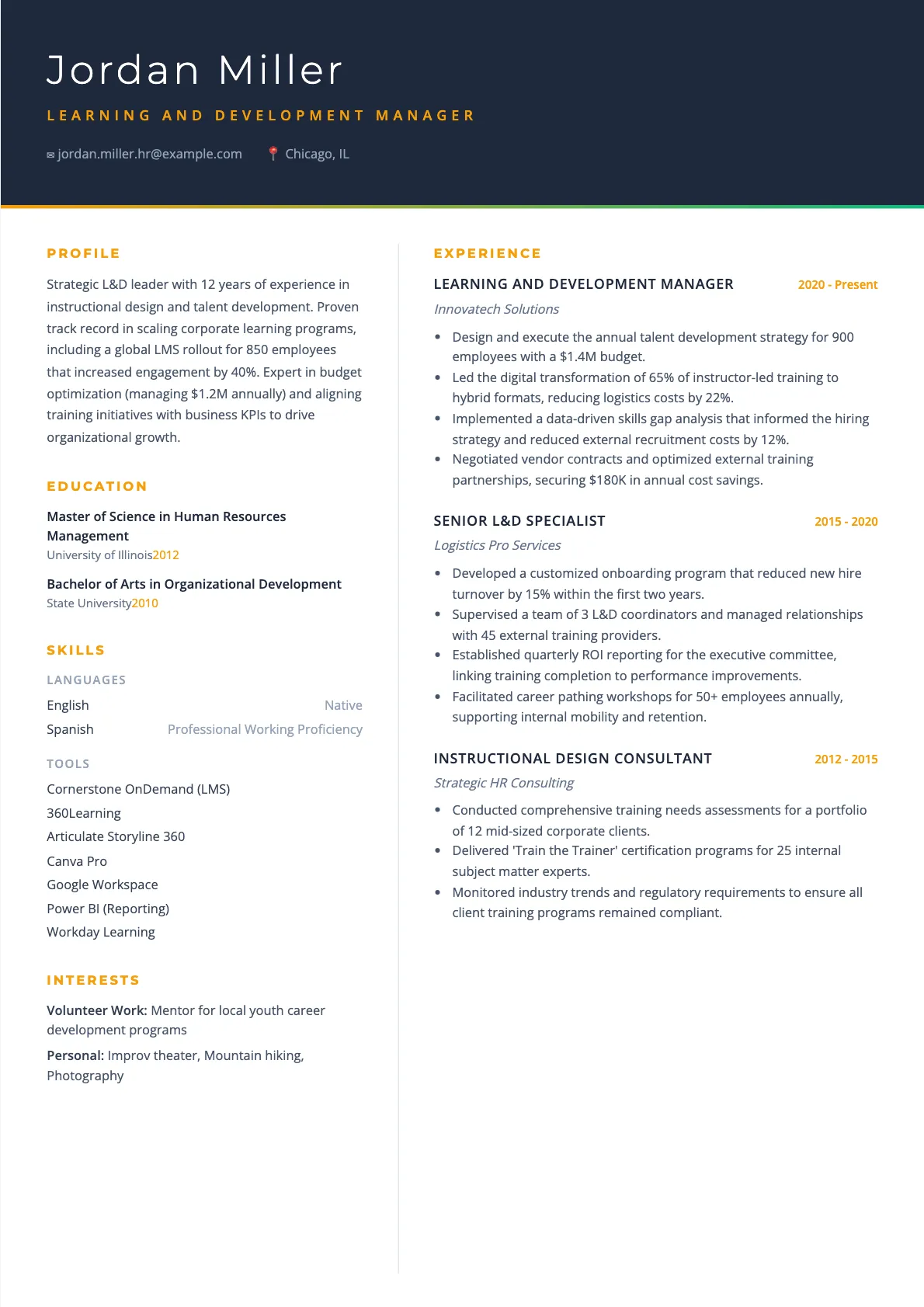
A Learning and Development (L&D) Manager bridges the gap between organizational goals and employee capabilities. In the current job market, your resume must demonstrate more than just scheduling classes; it needs to showcase strategic alignment, digital transformation, and measurable ROI. This guide provides a fictional sample and expert advice to help you secure your next leadership role in talent development.
Updated
How to highlight L&D impact on a resume?
Quantifying your achievements is the most effective way to demonstrate your value as an L&D Manager. Instead of listing duties like 'managed training,' focus on the outcomes such as 'increased sales productivity by 10% through targeted coaching.' Recruiters look for evidence that your programs solved specific business problems or improved employee performance metrics.
Use percentages and dollar amounts to illustrate budget management and cost savings. Mentioning the size of the workforce you supported or the number of training hours delivered provides necessary scale. If you led a digital transformation, highlight the reduction in travel costs or the increase in accessibility for remote teams.
These figures prove you are a business-oriented leader rather than just an administrator. Connect your learning initiatives directly to organizational key performance indicators. For instance, if you reduced onboarding time, explain how that accelerated the time-to-productivity for new hires.
Demonstrating a clear link between training and revenue growth or retention makes your candidacy much more compelling. Avoid vague descriptions of soft skills in favor of concrete project outcomes. Instead of saying you are a 'good communicator,' describe how you facilitated executive-level workshops that resulted in a new leadership development framework.
This approach provides the proof that hiring managers need to justify your salary requirements. Ensure that your most recent role contains the highest density of these metrics. This shows that your skills are current and that you are ready to handle the complexities of a modern corporate environment.
Which technical skills are essential for 2026?
Proficiency in Learning Management Systems and instructional design software is mandatory for modern L&D roles. You should explicitly name tools like Cornerstone, Workday Learning, or Articulate Storyline to pass through Applicant Tracking Systems. Mentioning experience with AI-driven content creation or adaptive learning platforms shows you are staying ahead of industry trends.
Data analytics and reporting skills are increasingly vital for proving the ROI of learning initiatives. Being able to use Power BI or Tableau to visualize training completion rates and performance correlations sets you apart. Additionally, knowledge of agile project management methodologies can be a significant advantage when designing rapid-response training for fast-paced industries.
Digital fluency now extends to virtual collaboration tools and remote facilitation platforms. Expertise in Zoom Events, Microsoft Teams, or specialized webinar software is expected for hybrid work environments. You should also highlight your ability to integrate third-party content libraries like LinkedIn Learning or Coursera into a cohesive internal curriculum.
Understanding the technical side of SCORM and xAPI standards remains a foundational requirement. These protocols ensure that your content is portable and that you can track learner behavior across different platforms. Mentioning these technical details demonstrates a deep understanding of the learning ecosystem.
Finally, do not overlook the importance of mobile learning optimization. As more employees access training on the go, the ability to design responsive, mobile-first content is a highly marketable skill.
How to structure an L&D Manager professional summary?
Your professional summary should act as a high-level pitch that combines your years of experience with your greatest hits. Start with your job title and a core strength, such as 'Strategic L&D leader with 10+ years of experience in global talent development.' This immediately establishes your seniority and area of expertise for the hiring manager.
Include a specific, impressive achievement that involves both scale and results. For example, mention a successful LMS implementation or a significant reduction in the skills gap. Finish by highlighting your leadership style or your ability to align L&D with corporate strategy.
Tailor this section for every application to mirror the keywords found in the job posting. If the company emphasizes 'culture of learning,' ensure that phrase appears in your summary. This alignment helps you pass through automated filters and catches the eye of the human recruiter.
Avoid using generic filler words like 'passionate' or 'hardworking' that do not add value. Instead, use professional descriptors like 'data-driven,' 'results-oriented,' or 'cross-functional collaborator.' These terms carry more weight in a business context and better reflect your professional identity.
Keep the length between three and four sentences to maintain impact. A concise summary ensures that the reader quickly understands your value proposition without getting bogged down in detail. This section is your chance to define your professional brand before the reader dives into your work history.
What should be included in the experience section?
Focus on the strategic lifecycle of training, from needs assessment to evaluation, rather than just the delivery phase. Describe how you identified a business need, designed the solution, and measured the final impact on the organization. Use strong action verbs like 'orchestrated,' 'engineered,' and 'optimized' to lead your bullet points.
Distinguish between internal team management and external vendor coordination. Managing a team of specialists requires different skills than negotiating contracts with third-party providers. Highlighting both shows you can handle the operational and administrative complexities of a large L&D department.
If you have experience with compliance-heavy industries, mention your success in maintaining audit-ready training records. This is particularly important in sectors like healthcare or finance where regulatory adherence is critical. For entry-level candidates, focus on transferable skills such as public speaking, project coordination, or content creation.
Avoid the common mistake of listing every minor task you performed. Instead, curate your bullet points to show progression and increasing levels of responsibility over time. Each entry should tell a story of how you left the department better than you found it.
Ensure that you mention the specific methodologies you used, such as ADDIE or SAM. This demonstrates that your work is grounded in established instructional design principles. Finally, always proofread for consistency in tense and formatting.
A clean, professional layout reflects the attention to detail required for a management-level position.
| Weak Description | Strong Achievement-Based Alternative |
|---|---|
| Responsible for employee training. | Designed and launched a leadership development program for 50+ managers, improving internal promotion rates by 20%. |
| Managed the L&D budget. | Optimized a $1.2M annual budget, reallocating funds to digital initiatives that saved $150K in annual travel costs. |
| Used Articulate to make courses. | Developed 15+ interactive e-learning modules using Articulate Storyline, achieving a 95% learner satisfaction score. |
Frequently asked questions
Should I include my teaching experience if I am applying for a management role?
Yes, but frame it as 'facilitation' or 'subject matter expertise.' While the focus should be on strategy and management, showing you understand the classroom experience adds credibility to your leadership.
How do I mention certifications like CPTD or SHRM-CP?
List these in a dedicated 'Certifications' section or next to your name in the header if they are highly relevant to the role. These credentials validate your professional knowledge and commitment to the field.
Is a photo required on a US L&D resume?
No, you should never include a photo, age, or marital status on a resume for the US market. Focus entirely on your professional qualifications and achievements to avoid bias.