Resume and cover letter resources
Inventory Manager Resume: 2026 Example and Writing Guide
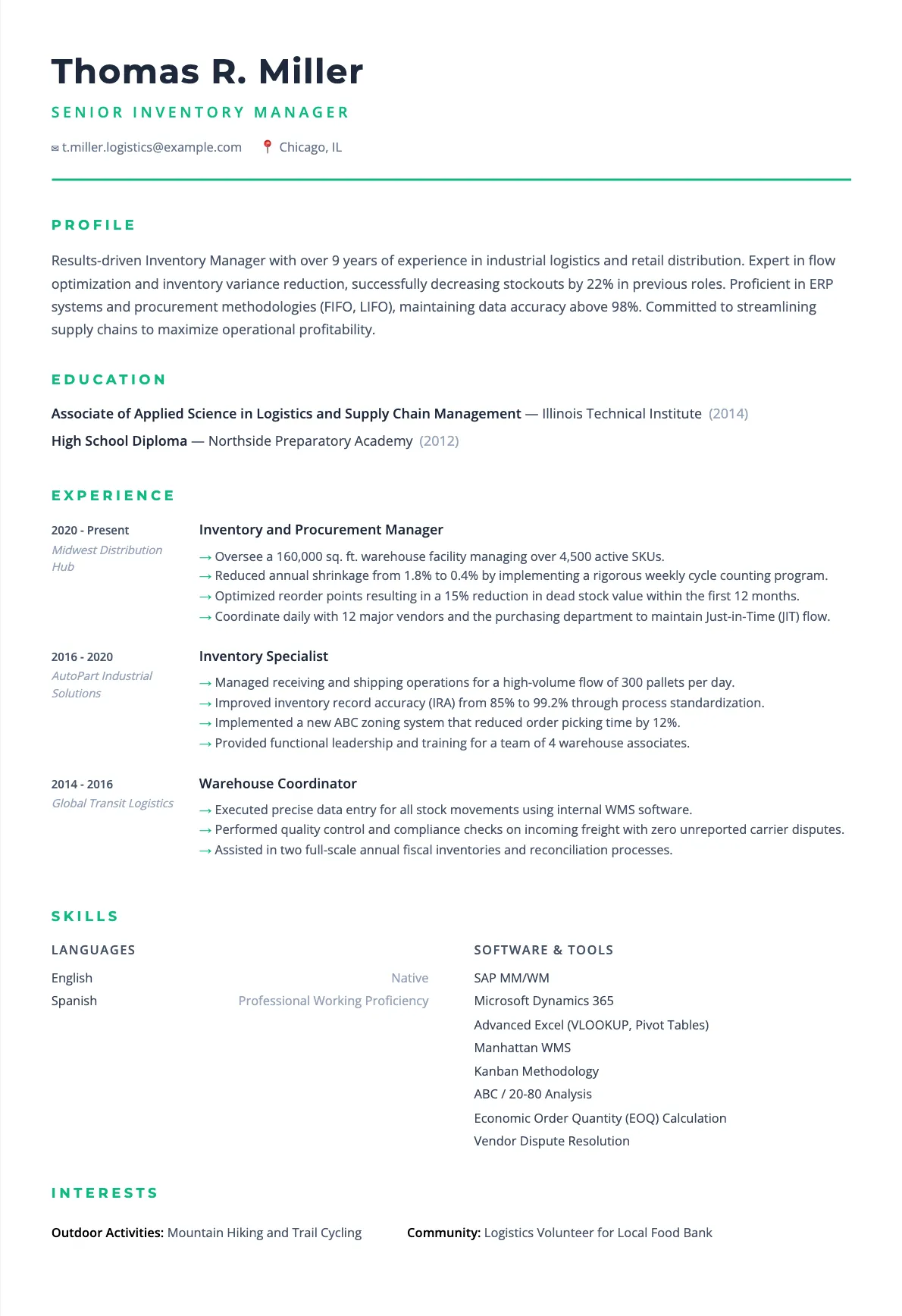
A professional inventory manager ensures operational efficiency by balancing stock levels and minimizing costs. This guide provides a fictional native resume example for a Senior Inventory Manager, focusing on quantifiable achievements like inventory accuracy and shrinkage reduction. We will explore how to present technical skills in ERP systems and supply chain methodologies to pass Applicant Tracking Systems (ATS) and impress hiring managers.
Updated
How should you quantify inventory management achievements?
Quantifying your impact requires translating daily warehouse activities into financial and operational metrics that demonstrate bottom-line value. Recruiters prioritize candidates who provide specific data points such as inventory turnover ratios, shrinkage reduction percentages, and order fulfillment accuracy. Instead of claiming you managed a large stock, specify that you oversaw 8,000 SKUs valued at $12 million while maintaining a 99.7% record accuracy.
Mentioning the total square footage of the distribution center or the volume of daily outbound shipments provides essential context regarding the scale of your responsibilities. Highlighting a 15% reduction in carrying costs through reorder point optimization proves you possess the strategic mindset needed for senior roles. These figures serve as concrete evidence of your ability to protect company assets and improve liquidity.
By focusing on these key performance indicators, you demonstrate a results-oriented approach that appeals to hiring managers looking for efficiency. Ensure that every bullet point in your experience section includes at least one measurable outcome to validate your professional claims. This level of detail distinguishes a high-performing manager from a generalist who merely performs routine tasks without analyzing the broader economic impact.
Which technical skills are essential for this role?
Mastery of Enterprise Resource Planning software and Warehouse Management Systems is the most critical technical requirement for modern inventory leaders. You must explicitly list platforms such as SAP S/4HANA, Oracle NetSuite, or Microsoft Dynamics 365 to satisfy automated Applicant Tracking Systems. Beyond software, your resume should showcase a deep understanding of inventory methodologies like ABC analysis, Economic Order Quantity, and Just-in-Time procurement.
Advanced Excel proficiency is non-negotiable, specifically the ability to use VLOOKUPs, pivot tables, and macros for complex data reconciliation. If you have experience with automated data collection tools like RFID or barcode integration, include these to show technological adaptability. Demonstrating this blend of technical literacy and mathematical precision positions you as a candidate capable of data-driven decision-making.
You should also highlight your ability to generate and interpret aging reports or demand forecasting models. Proficiency in these tools allows you to mitigate risks associated with overstocking or stockouts. As the industry moves toward automation, mentioning familiarity with robotics or automated storage and retrieval systems can provide a competitive edge.
Clearly defining your technical stack ensures that recruiters recognize your ability to integrate seamlessly into their existing digital infrastructure.
How do you transition from a warehouse role to management?
Transitioning into management requires a shift in focus from manual task execution to the oversight of systems, processes, and personnel. If you are currently a warehouse coordinator or lead, emphasize your experience with cycle count scheduling, vendor communication, and discrepancy investigation. Highlight instances where you identified a bottleneck in the receiving process or suggested a new racking layout that improved picking efficiency.
Leadership can be demonstrated by mentioning your role in training junior associates or managing safety compliance during peak seasons. Focus on your analytical contributions, such as using WMS reports to identify slow-moving stock or dead inventory. This narrative shift proves to hiring managers that you understand the broader supply chain implications of floor-level activities and are ready for administrative accountability.
You should also seek to highlight any cross-departmental collaboration, such as working with sales or finance to align stock levels with seasonal promotions. Showing that you can manage external relationships with freight carriers or suppliers further reinforces your readiness for a managerial title. Entry-level candidates should emphasize their attention to detail and ability to maintain data integrity under pressure.
By framing your experience through the lens of process improvement, you bridge the gap between labor and leadership.
What formatting rules apply to a US inventory resume?
A professional American resume must follow a clean, reverse-chronological format that excludes all personal demographic details to comply with labor standards. Do not include a photo, age, gender, or marital status, as these elements are considered unprofessional and can lead to immediate rejection. The document should be one to two pages long, utilizing standard fonts and one-inch margins to ensure maximum readability for human recruiters.
Use clear, bolded section headers for Professional Experience, Education, and Technical Skills to facilitate quick scanning. Ensure your contact information is current and professional, typically including a phone number, city and state, and a LinkedIn URL. For those with international backgrounds, retain original degree titles but use American terminology for job titles, such as Inventory Manager rather than Stock Controller.
Avoid using overly decorative templates that might confuse parsing software used by large logistics firms. Consistency in date formatting and bullet point structure is vital for maintaining a polished appearance. If you are applying for roles in the healthcare sector, distinguish clearly between a Registered Nurse and a nursing assistant, as these roles have distinct licensing requirements.
Finally, ensure that your summary statement highlights your years of experience and primary areas of expertise to immediately capture the reader's attention.
| Common Task | Quantified Achievement |
|---|---|
| Responsible for doing inventory counts | Maintained 99.5% inventory accuracy through weekly cycle counting |
| Managed warehouse staff | Supervised a team of 10 associates, improving picking speed by 15% |
| Used SAP for stock tracking | Leveraged SAP MM to reduce stockouts by 20% and optimize reorder points |
Frequently asked questions
What is the difference between a Warehouse Manager and an Inventory Manager?
A Warehouse Manager typically focuses on the physical operations, safety, and personnel of the facility. An Inventory Manager focuses on the data, stock levels, procurement strategy, and financial accuracy of the goods held within that facility.
Should I list forklift certifications on a management resume?
Yes, listing certifications like OSHA forklift operation is beneficial. It demonstrates that you understand the safety requirements and operational realities of the floor, which builds credibility when managing warehouse staff.
How do I describe a French 'BTS' or 'Bac Pro' on a US resume?
Do not attempt to claim a US license equivalent. Instead, list the original degree name and school, then provide a functional description such as 'Two-year technical degree in Logistics' to help the recruiter understand the level of education.