Resume and cover letter resources
Illustrator Resume Example and Writing Guide for 2026
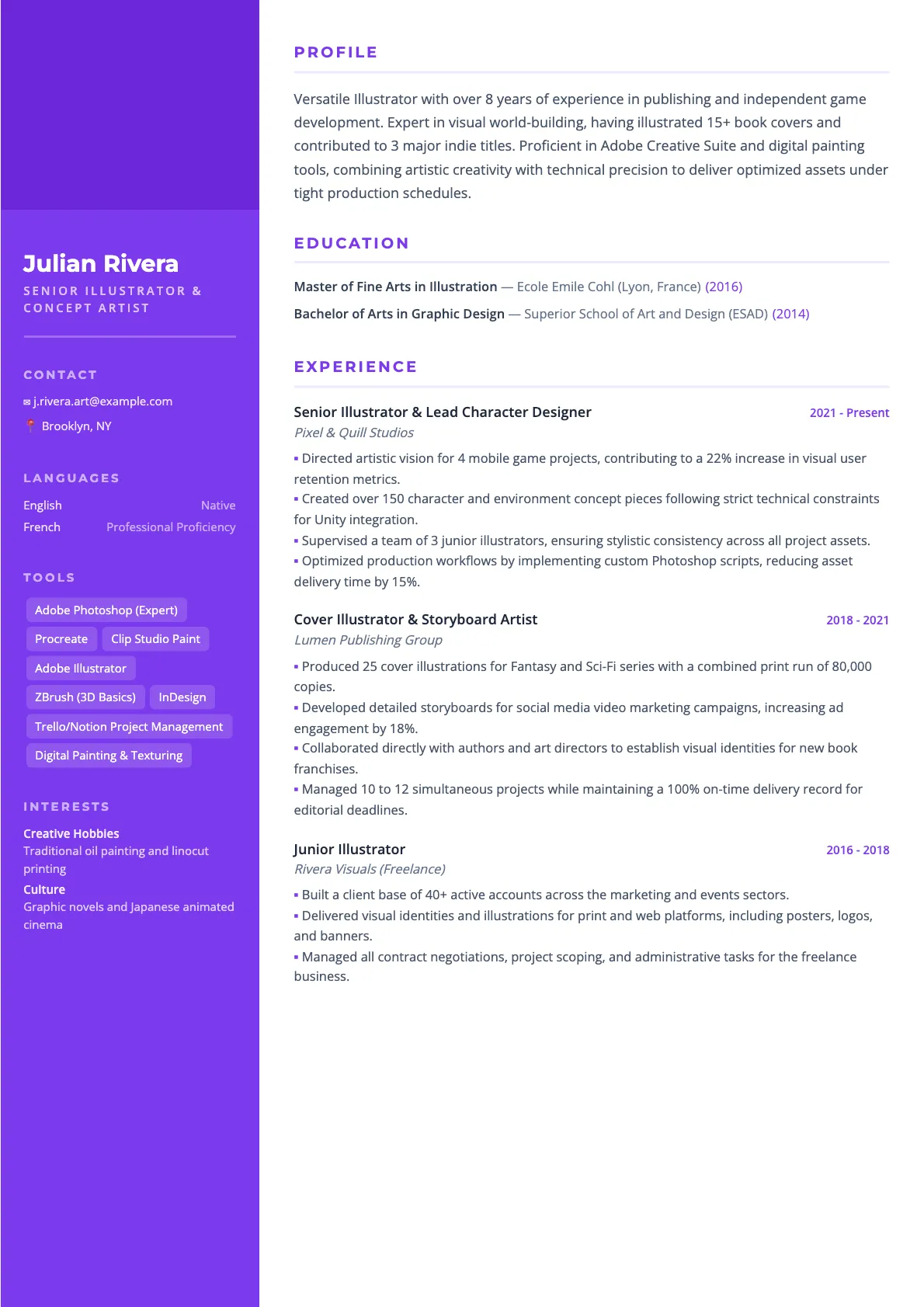
A professional Illustrator resume must bridge the gap between artistic vision and commercial reliability. While your portfolio showcases your style, your resume proves you can meet deadlines, follow technical specs, and collaborate within a production pipeline. This guide provides a fictional sample and strategic advice to help you secure roles in publishing, gaming, or advertising.
Updated
How should you present your portfolio on a resume?
Place a clear, clickable link to your online portfolio at the very top of your resume, ideally right under your name or contact information. In the creative industry, your visual work is the primary filter for recruiters, but the resume provides the professional context. Ensure the link is professional, such as a personal domain or a reputable platform like ArtStation or Behance.
Avoid requiring passwords or complex navigation to view your best work. Recruiters often spend less than a minute on the first pass, so your top three pieces should be immediately visible. If you are applying for a specific niche, like character design, consider creating a landing page that highlights that specific skill set.
This shows you understand the employer's needs and have curated your presentation accordingly.
What technical skills are essential for Illustrators in 2026?
Beyond mastery of Adobe Creative Suite and Procreate, modern illustrators must demonstrate proficiency in 3D block-out tools and collaborative software. Tools like Blender or ZBrush are increasingly used to establish perspective and lighting before the final paint-over. Mentioning these skills proves you can work faster and more accurately in a modern production environment.
Technical knowledge of print and digital output is equally vital. You should explicitly list your understanding of color profiles, DPI requirements, and file optimization for different platforms. Understanding how your art integrates into a game engine or a CMYK print process makes you a low-risk hire.
Highlighting experience with version control or project management tools like Jira or Notion further demonstrates your readiness for professional studio life.
How do you quantify creative achievements?
Use specific metrics such as project volume, print runs, or engagement rates to give weight to your artistic contributions. Instead of saying you 'drew covers,' state that you 'illustrated 20+ covers for a series with 50,000 copies in circulation.' This provides a sense of scale and commercial impact that words alone cannot convey.
Focus on the efficiency and results of your creative process. If you developed a new brush set or template that saved the team hours of work, include that as a bullet point. Mentioning that you met 100% of editorial deadlines over a three-year period is often more impressive to a project manager than a specific artistic technique.
These data points prove that you are not just an artist, but a reliable professional asset.
Should you include freelance work as a separate section?
Treat freelance experience with the same structural rigor as a full-time staff position, grouping clients or project types to show consistency. Rather than listing every small commission, highlight your most prestigious clients or long-term contracts. Use a title like 'Lead Illustrator (Freelance)' to signal that you managed the entire project lifecycle.
Emphasize the business and communication skills gained during your freelance tenure. Mentioning contract negotiation, client management, and schedule coordination shows a high level of professional maturity. This is particularly important for senior roles where you may be expected to interface with stakeholders or manage external vendors.
Clearly defining your freelance scope helps recruiters see you as a business partner rather than just a temporary contractor.
| Generic Description | Impactful Alternative |
|---|---|
| Drew characters for a mobile game. | Designed 50+ character assets under strict technical specs, increasing player engagement by 15%. |
| Proficient in Photoshop. | Expert in Adobe Photoshop, utilizing advanced masking and custom scripts to reduce production time by 20%. |
| Freelance Illustrator. | Managed a freelance studio serving 10+ corporate clients, delivering high-res marketing assets on 24-hour turnarounds. |
| Did book covers. | Illustrated 12 award-winning Sci-Fi covers for major publishers, managing the full process from sketch to CMYK pre-press. |
Frequently asked questions
Do I need a resume if my portfolio is excellent?
Yes, because the resume serves a different purpose. While the portfolio proves your talent, the resume proves your employability. It shows your work history, your ability to stay at a company, your technical education, and your experience with professional workflows. Many HR departments use resumes to verify background and soft skills before the Art Director even sees your portfolio.
Should I include a photo on my US Illustrator resume?
No. In the United States, it is standard practice to exclude photos from resumes to prevent unconscious bias and comply with fair hiring laws. Your appearance is irrelevant to your ability to illustrate. Let your artwork in your portfolio be the only visual representation of your professional identity.
How do I list international degrees on a US resume?
List the original degree name and the institution's location clearly. You do not need to claim a 'US equivalent' unless you have had a formal credential evaluation. Instead, focus on the skills and specialized training you received. If the school is prestigious in your home country, you can briefly mention its focus, such as 'Specialized in Narrative Illustration.'