Resume and cover letter resources
Graphic Designer Resume Example and Writing Guide
Creating a standout Graphic Designer resume requires balancing visual flair with technical precision. In the competitive US design market, your resume must serve as a functional extension of your brand while remaining readable for Applicant Tracking Systems. This guide provides a fictional sample and expert strategies to highlight your creative impact and technical proficiency effectively.
Updated
How should a Graphic Designer structure their resume?
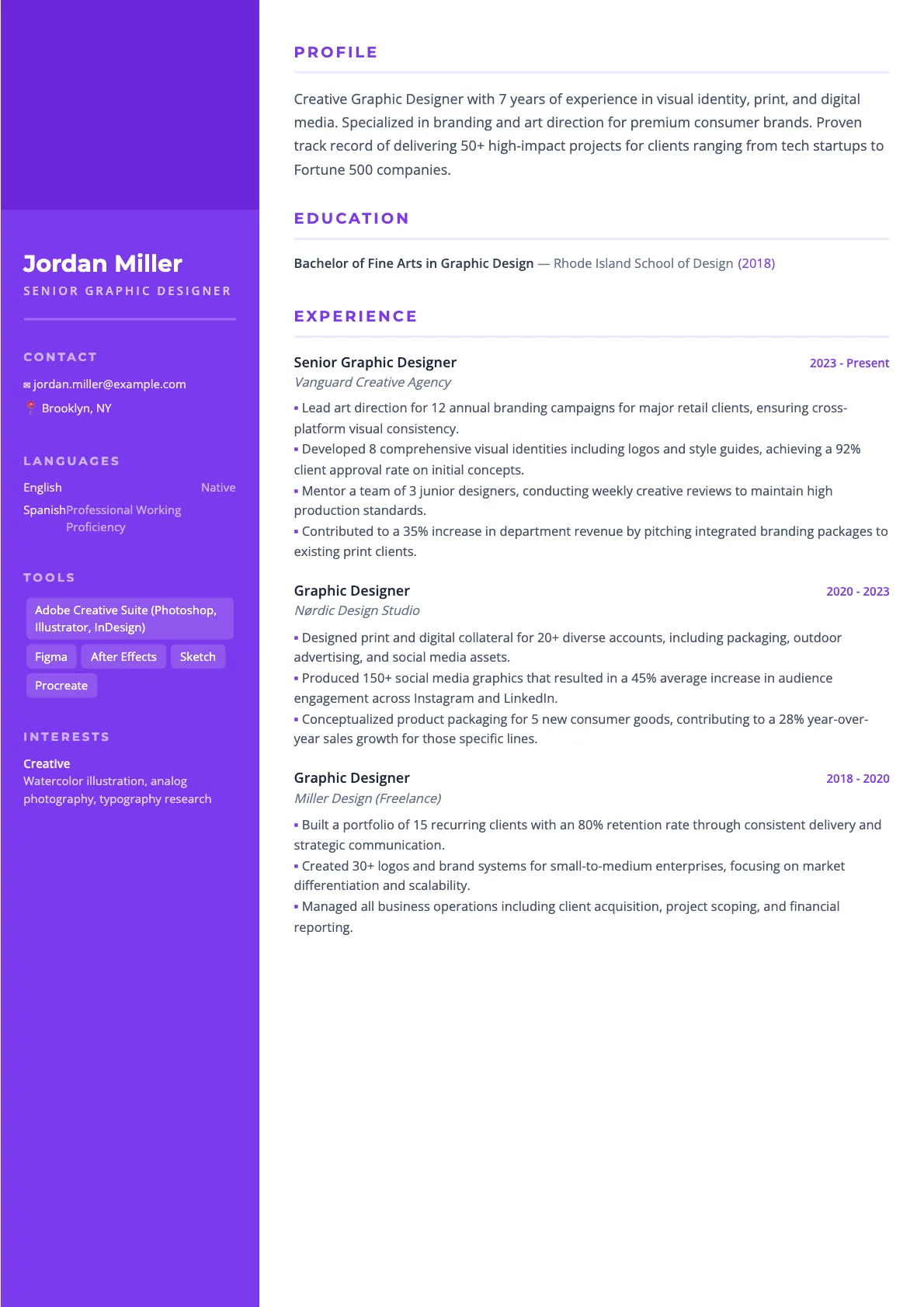
A Graphic Designer resume must prioritize a clean, professional layout that balances white space with dense information. While you are a creative professional, the document itself should follow a standard reverse-chronological format to ensure it passes through ATS software. Use a single-column or clear two-column layout that guides the eye naturally from your profile to your technical skills.
Avoid overly complex graphics or background images that might obscure the text during scanning.
Focus on a strong professional summary that links your creative talent to business outcomes. Instead of just listing software, mention how you use those tools to solve client problems or increase brand awareness. Your experience section should lead with your most recent role and use bullet points that start with strong action verbs.
Ensure your contact information includes a direct link to your online portfolio, as this is the most critical component of your application.
What technical skills are essential for a modern design resume?
Technical proficiency in the Adobe Creative Cloud remains the industry standard, but modern designers must also showcase digital product tools. List Photoshop, Illustrator, and InDesign as your core foundation, but include Figma or Sketch if you work in web or UI design. If you have experience in motion graphics, specifically mention After Effects or Premiere Pro to differentiate yourself from static-only designers.
Group these tools clearly so a recruiter can verify your software stack in seconds.
Beyond software, include specific design methodologies and production knowledge. Mentioning expertise in typography, color theory, prepress for print, or responsive design for web shows a deeper level of professional maturity. If you have experience with CMS platforms like Webflow or WordPress, include them to demonstrate your ability to see a project through to implementation.
This technical breadth proves you can handle the full lifecycle of a creative project.
How do you quantify creative achievements on a resume?
Translate your artistic success into measurable business metrics to prove your value to non-creative stakeholders. While aesthetics are subjective, results like engagement rates, sales growth, and production efficiency are concrete. If you redesigned a website, mention the percentage increase in user retention or the decrease in bounce rate.
For branding projects, note the number of assets delivered or the speed at which you moved from concept to final approval.
Use specific project scopes to demonstrate the scale of your work. Instead of saying you "designed logos," state that you "developed a comprehensive brand identity system for a $10M startup launch." Mentioning the number of campaigns managed or the size of the budgets you influenced helps recruiters understand your seniority level.
This data-driven approach transforms your resume from a simple list of tasks into a compelling narrative of professional impact.
Should a Graphic Designer use a creative resume template?
A creative resume template is appropriate for designers, provided it does not sacrifice legibility or ATS compatibility. You can use subtle brand colors, custom typography, and a unique grid to show your design sensibility. However, avoid using infographics to represent skill levels, such as progress bars or star ratings, as these are difficult for software to interpret and provide no real context.
Your design should enhance the content, not distract from it.
Ensure your resume design matches the aesthetic of the companies you are targeting. A designer applying to a corporate financial firm should use a more conservative, structured layout than one applying to a boutique fashion agency. Always save your final document as a PDF to preserve your layout and font choices across different devices.
Remember that your resume is a test of your ability to organize complex information beautifully and functionally.
| Vague Description | Concrete Achievement |
|---|---|
| Responsible for social media graphics. | Created 200+ social assets resulting in a 30% increase in Instagram engagement over 6 months. |
| Designed logos for various clients. | Developed 15+ unique brand identities for tech startups, including full style guides and stationery. |
| Proficient in Adobe Suite. | Expert-level mastery of Photoshop and Illustrator, reducing production time by 20% through template creation. |
| Helped with website redesign. | Collaborated on a UI/UX overhaul that improved mobile conversion rates by 15% for an e-commerce client. |
Frequently asked questions
Do I need a portfolio link on my resume?
Yes, a link to your online portfolio is mandatory for Graphic Designers. Place it prominently in your contact header. Ensure the link is clickable in the PDF version and leads to a curated selection of your best work rather than a dump of every project you have ever done.
How long should a Graphic Designer resume be?
For most designers, a one-page resume is ideal. If you have over 10 years of experience or a very extensive list of high-profile clients, two pages are acceptable. Focus on quality over quantity, highlighting only the most relevant and recent work that aligns with the job you are applying for.
Should I include my photo on a US design resume?
No, you should not include a photo on a resume for the US market. Standard US hiring practices discourage photos to prevent unconscious bias and comply with anti-discrimination laws. Let your portfolio and the design of the resume itself showcase your visual identity.