Resume and cover letter resources
Financial Controller Resume Example and 2026 Writing Guide
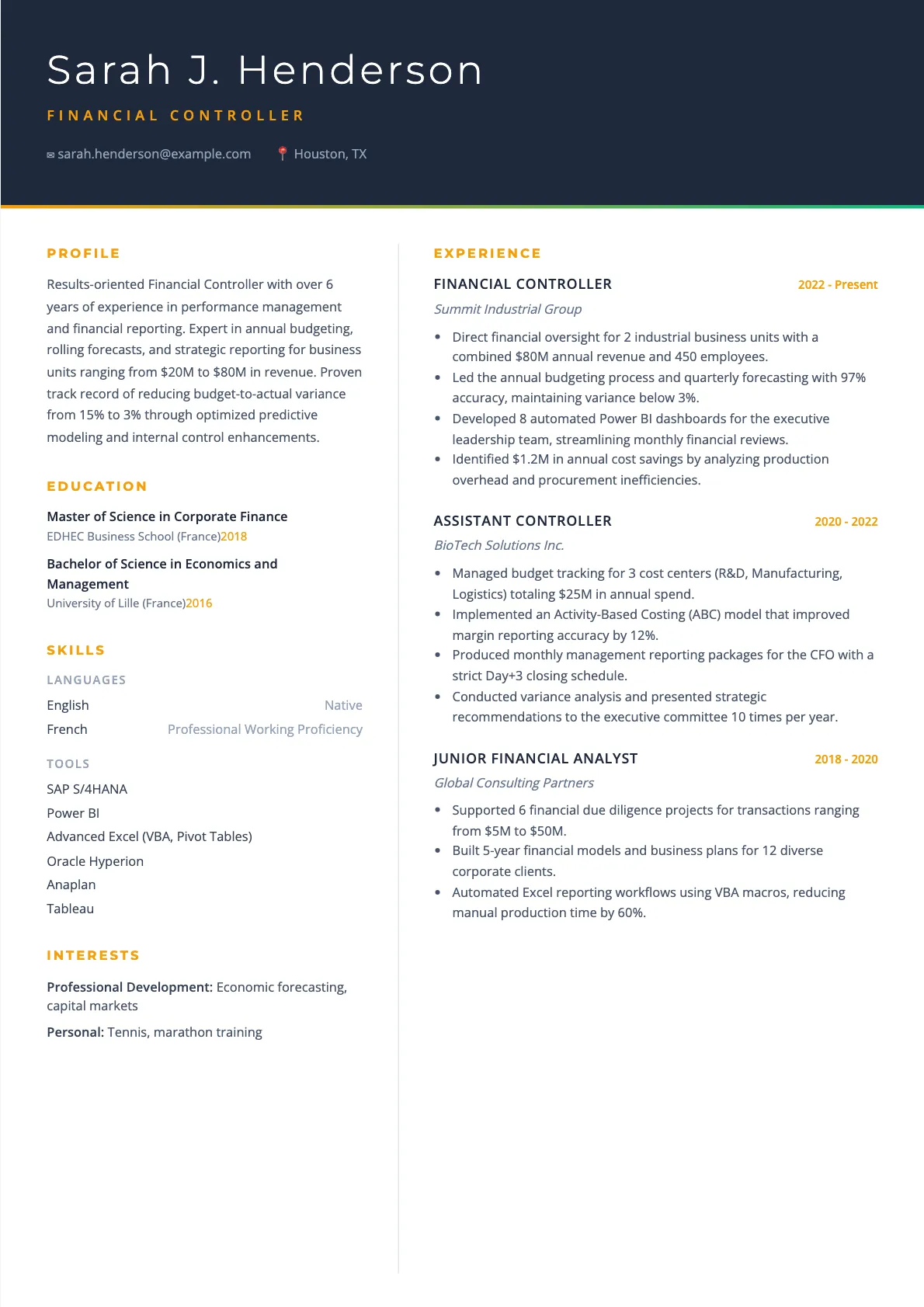
A Financial Controller in the United States acts as the backbone of corporate fiscal health, balancing rigorous accounting oversight with strategic business partnership. This guide provides a fictional resume sample for a mid-level professional, demonstrating how to quantify achievements in internal controls and financial reporting. Use this template to align your experience with American corporate standards and ATS requirements.
Updated
How should you structure a Financial Controller resume for US employers?
A reverse-chronological layout is the standard for corporate finance roles in the United States to highlight recent career progression. This format ensures that your most recent achievements in budgeting and forecasting are the first things a recruiter sees. You must strictly exclude personal details such as a photo, age, gender, or marital status to comply with US labor laws and anti-discrimination practices.
Use a clean, single-column design with standard margins to ensure your document is easily parsed by modern Applicant Tracking Systems. This technical optimization is vital for large firms that use software to filter candidates before a human ever sees the file.
Bullet points should lead with strong action verbs like orchestrated, forecasted, or mitigated to convey authority. For seasoned controllers, the professional summary should replace the outdated objective statement to provide a high-level snapshot of your financial expertise and the scale of budgets you have managed.
How do you quantify financial impact and strategic contributions?
Success in financial control is measured by your ability to drive fiscal discipline through precise data storytelling. You must move beyond listing duties like monthly reporting and instead focus on the scale of the assets you managed. For instance, specify if you oversaw a $50M OpEx budget or identified $2M in procurement redundancies.
Recruiters look for evidence of variance reduction, such as improving forecast accuracy from 85% to 98% over a fiscal year. These metrics provide concrete proof of your technical competence and attention to detail.
Highlighting your role in cross-functional decision support demonstrates that you are a business partner rather than a back-office accountant. Mention specific instances where your modeling influenced a go-or-no-go decision on a capital expenditure or a strategic acquisition. Always tie your technical outputs to the broader corporate strategy to show you understand the why behind the numbers.
Which technical proficiencies and software are required for 2026?
Advanced Excel remains the cornerstone of the finance function, but modern resumes must showcase a broader tech stack. You should explicitly mention your experience with specific ERP systems like SAP S/4HANA, Oracle Cloud EPM, or Microsoft Dynamics. Proficiency in specialized planning tools such as Anaplan, Workday Adaptive Planning, or OneStream is highly sought after by large-cap firms.
Data visualization skills are now a core requirement for presenting financial narratives to executive leadership. Listing Power BI or Tableau experience shows you can translate complex datasets into digestible dashboards for non-financial stakeholders.
Mentioning your familiarity with US GAAP (Generally Accepted Accounting Principles) is essential for ensuring your reporting standards align with American expectations. If you have utilized SQL for data extraction or Python for predictive modeling, these should be highlighted to distinguish you from traditional analysts. Continuous learning through certifications like the CPA or CMA should be prominently displayed.
How should you handle international transitions and common pitfalls?
Translating international experience requires adapting foreign job titles to their closest American functional equivalents. A French Controleur de Gestion should be listed as a Financial Controller or FP&A Analyst to ensure US recruiters recognize the functional level. While you must retain the names of real original qualifications like a Master from EDHEC Business School, provide context regarding the degree focus.
Avoid the mistake of including a hobbies section unless the interests demonstrate leadership or high-level discipline, such as marathon training. Most personal interests do not add value to a professional finance document.
Tailoring your resume for each specific industry is the most effective way to bypass automated filters. A resume for a manufacturing firm should emphasize COGS and inventory analysis, while a SaaS resume should focus on MRR and churn rates. Ensure your spelling follows United States conventions, such as modeling with one l and labor without a u.
| Common Weakness | Stronger Alternative |
|---|---|
| Responsible for monthly reporting. | Reduced monthly closing cycle from 6 days to 3 days through process automation. |
| Assisted with the annual budget. | Orchestrated $40M annual budgeting process across 5 departments with 98% forecast accuracy. |
| Knowledge of financial software. | Expert-level proficiency in SAP S/4HANA and Power BI dashboard development. |
Frequently asked questions
Is a cover letter required for Financial Controller roles in the US?
While not always mandatory, a cover letter is highly recommended for Financial Controller roles to explain the why behind the numbers. It allows you to describe your analytical philosophy and how you have partnered with business leaders to drive results.
Should I include my GPA on a finance resume?
If you are a recent graduate with less than 2 years of experience, including a GPA of 3.5 or higher is standard. For mid-career professionals, your work experience and professional certifications are far more important than your university grades.
What is the difference between an Accountant and a Financial Controller resume?
An Accountant resume focuses on historical accuracy, compliance, and tax. A Financial Controller resume should focus on the future: forecasting, strategic planning, and providing insights that influence upcoming business decisions.