Resume and cover letter resources
Financial Analyst Resume Example and Guide for 2026
A professional Financial Analyst resume must bridge the gap between complex data modeling and strategic business insights. In the competitive US finance sector, recruiters look for candidates who demonstrate measurable fiscal impact and technical mastery of ERP systems. This guide provides a fictionalized sample and expert strategies to showcase your expertise in forecasting, budgeting, and corporate valuation.
Updated
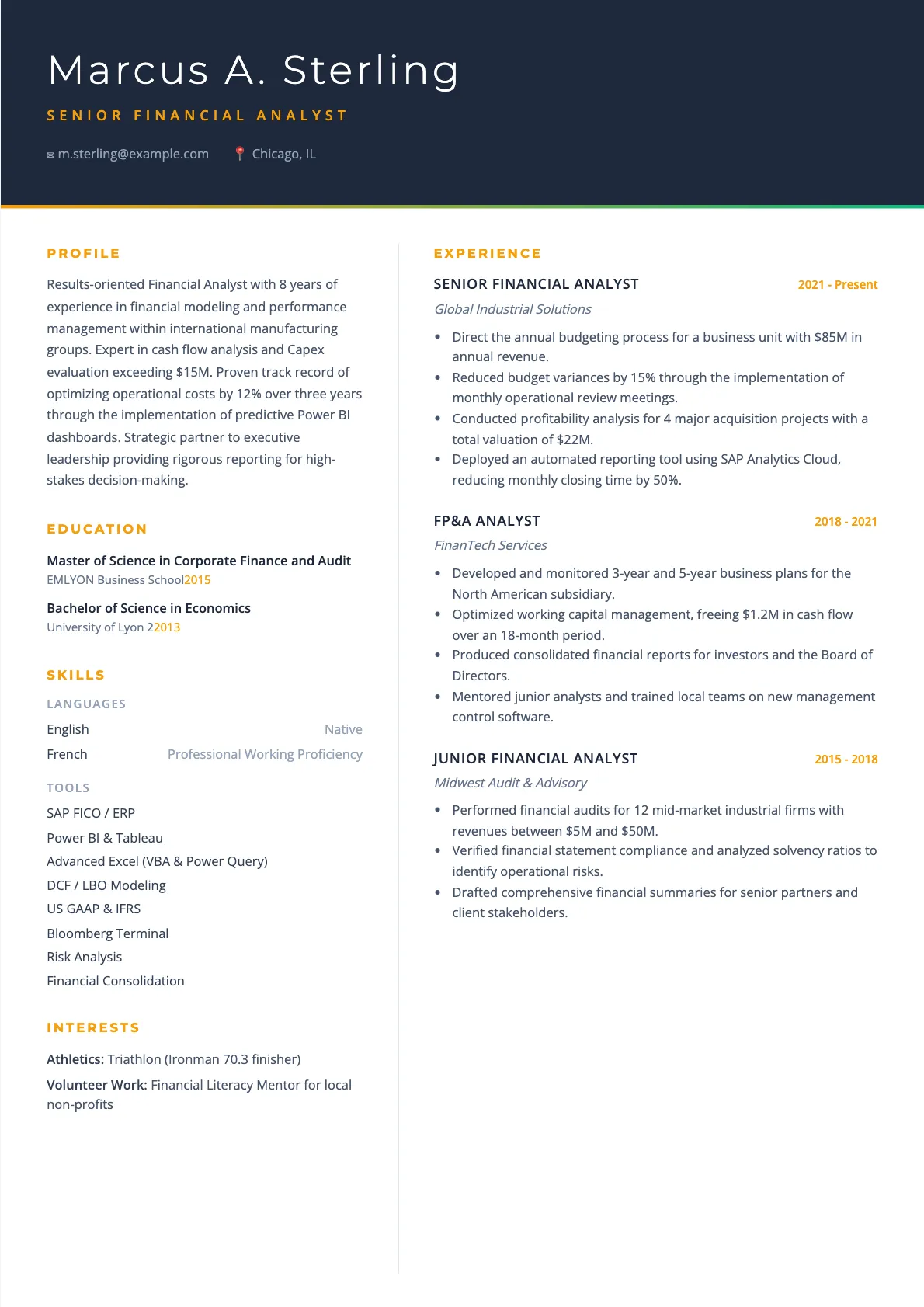
How should you format a Financial Analyst resume?
A reverse-chronological layout is the industry standard for US finance professionals to showcase career progression. This format prioritizes your most recent experience, allowing hiring managers to immediately assess your current level of responsibility and technical proficiency. You must exclude personal data such as a photo, age, gender, or marital status to comply with American labor practices and avoid immediate rejection.
Use a clean, single-column design with standard margins to ensure the document is easily parsed by Applicant Tracking Systems. For those transitioning from nursing, clearly distinguish between a Registered Nurse and a nursing assistant, as these roles carry vastly different clinical and administrative weights. Entry-level candidates should lead with their education and relevant internships, while experienced analysts must focus on their professional history.
A professional summary should replace the outdated objective statement to provide a high-level overview of your value proposition. Ensure your contact information is professional and includes a link to your LinkedIn profile. Consistency in font choice and bullet point style is essential for a polished appearance.
This structural clarity reflects the organized mindset required for high-stakes financial reporting and data management.
What skills are most valuable for finance professionals?
Technical mastery of data visualization tools and enterprise resource planning systems is non-negotiable in the current market. You should highlight specific expertise in platforms like SAP FICO, Oracle, or Microsoft Dynamics to demonstrate your ability to navigate complex corporate environments. Proficiency in advanced Excel, including Power Query and VBA, remains a foundational requirement for modeling and automation.
Beyond software, you must demonstrate a rigorous understanding of US GAAP and IFRS to ensure compliance across international reporting standards. If you are migrating to the US, retain your original qualifications like a Master of Science from EMLYON, but do not claim an American CPA license unless you have passed the US exams. Soft skills are equally critical, particularly the ability to communicate financial insights to non-finance executives.
Mentioning experience with Bloomberg Terminals or specific risk assessment methodologies can differentiate you in competitive pools. For entry-level applicants, focusing on academic projects involving DCF modeling or sensitivity analysis can bridge the experience gap. Highlighting a commitment to continuous learning through certifications like the CFA or FMVA shows professional dedication.
Ultimately, your skill set must prove you can transform raw data into strategic business intelligence.
How do you quantify achievements in finance?
Effective finance resumes use specific metrics to transform routine duties into a record of measurable impact. You should utilize the STAR method to describe how your analysis led to cost savings, revenue growth, or improved operational efficiency. For example, instead of stating you managed budgets, specify that you oversaw an $85M annual budget and reduced variances by 15% through predictive modeling.
Use dollar signs and percentages to draw the recruiter's eye to your most significant contributions. Mentioning the scale of Capex projects, such as those exceeding $15M, provides context for the level of risk you are trusted to manage. If you automated a reporting process, quantify the time saved, such as reducing the monthly closing cycle by 50%.
These figures provide concrete evidence of your ability to enhance the bottom line. Entry-level candidates can quantify their impact by mentioning the number of audits performed or the size of the datasets they analyzed during internships. Avoid vague descriptors like "assisted" or "participated" in favor of strong action verbs like "engineered," "optimized," or "negotiated."
This data-driven approach mirrors the exact work you will perform as a Financial Analyst.
What are common mistakes to avoid on a finance resume?
The most damaging error on a finance resume is a lack of attention to detail, which signals potential inaccuracy in your work. Typos, inconsistent formatting, or mathematical errors in your quantified achievements will lead to immediate disqualification. Avoid including irrelevant personal information like social security numbers or religious affiliations, as these are not part of US hiring standards.
Do not use a generic resume for every application; tailoring your bullet points to the specific job description is essential for passing ATS filters. Avoid overusing jargon that doesn't add value, and instead focus on how your skills solved specific business problems. If you are discussing a career shift, do not misrepresent a nursing assistant role as an RN, as clinical credentials are strictly regulated.
Ensure your resume does not exceed two pages, as brevity is highly valued in American corporate culture. Never list references directly on the document; instead, provide them only when requested by the recruiter. Finally, avoid using a functional resume format, as it often raises red flags regarding gaps in employment history.
A clean, honest, and meticulously proofread document is your best tool for securing an interview.
| Weak Description | Impactful Alternative |
|---|---|
| Responsible for monthly reporting. | Reduced monthly closing cycle by 50% through SAP automation. |
| Analyzed company budgets. | Managed $85M annual budget and identified 12% in operational savings. |
| Used Excel for data analysis. | Built complex DCF and LBO models using VBA and Power Query. |
Frequently asked questions
Is a CFA certification required for a Financial Analyst role?
While not always mandatory, the CFA is highly regarded in investment banking and asset management. For corporate FP&A roles, a CPA or MBA may be equally or more valuable depending on the company's focus.
How long should a Senior Financial Analyst resume be?
For a candidate with 8-10 years of experience, a two-page resume is acceptable, though a concise one-page resume is often preferred if you can fit your key achievements without sacrificing readability.
Should I include my GPA on my resume?
Only include your GPA if you are a recent graduate (less than 3 years of experience) and it is 3.5 or higher. For senior roles, your professional achievements carry far more weight than academic scores.