Resume and cover letter resources
Executive Recruiter Resume Example and Writing Guide
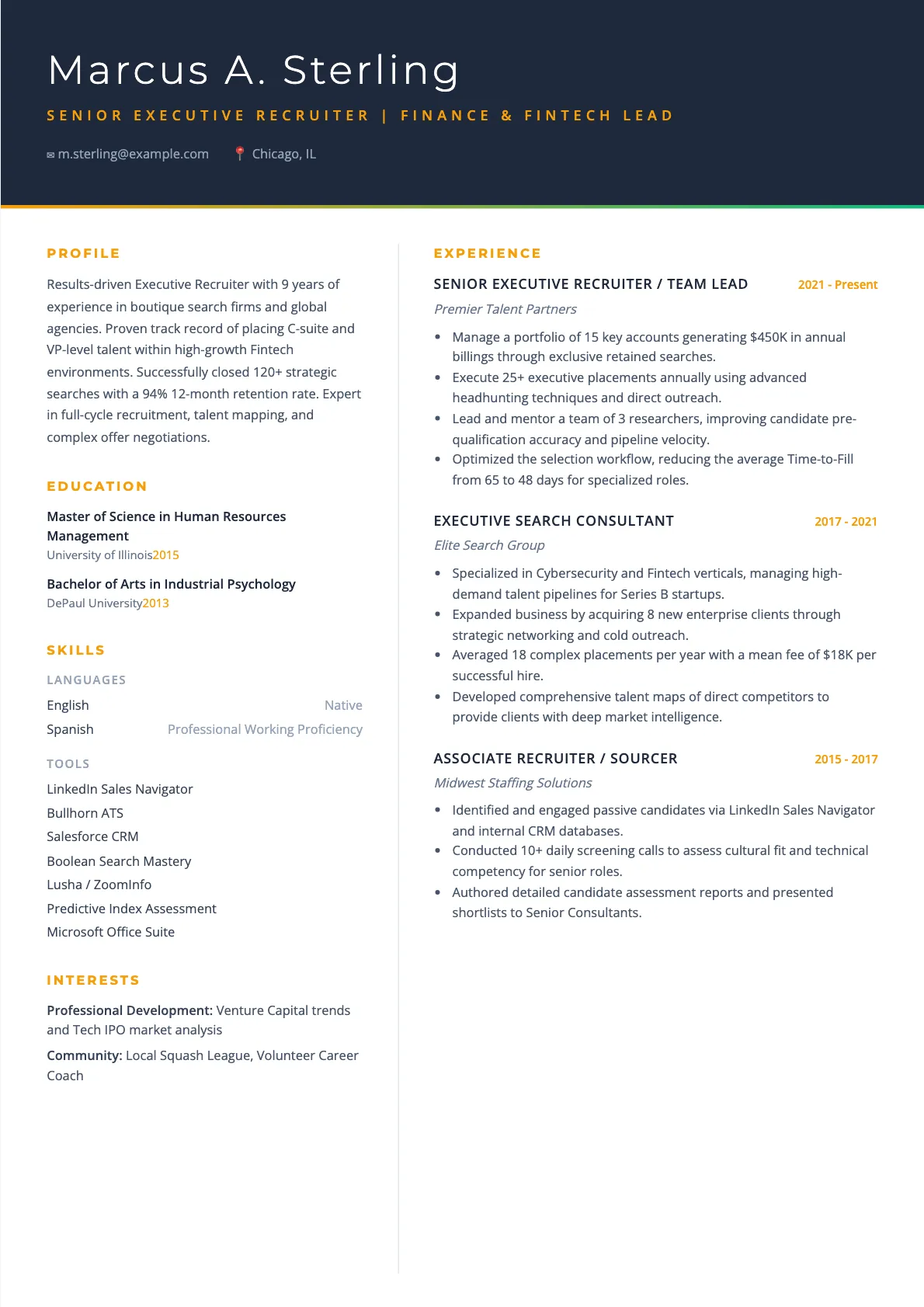
Executive recruiters, or headhunters, must demonstrate a unique blend of sales grit and psychological insight. In the American market, your resume needs to prove you can identify, engage, and close passive talent for high-stakes roles. This guide provides a fictional sample and strategic advice to highlight your billing history and network strength effectively.
Updated
How to Quantify Your Executive Recruitment Impact
Successful executive recruiters must treat their resume like a high-stakes sales report by emphasizing billings, placement volume, and long-term retention rates. In the United States market, search firms look for a specific billing history to gauge your commercial viability and market value. You should use specific dollar amounts for annual revenue generated and average fee percentages to demonstrate a deep understanding of the business side of search.
For instance, mentioning that you generated $500,000 in annual billings provides a concrete benchmark for your performance.
Beyond pure revenue, you must focus on efficiency metrics such as time-to-fill and interview-to-hire ratios to prove operational excellence. If you successfully reduced the hiring cycle by fifteen days through better pre-qualification, state this clearly as a major achievement. Mentioning a high retention rate, such as ninety-five percent of candidates staying past their first year, proves you prioritize quality over quick commissions.
This data transforms a standard list of duties into a compelling record of professional achievements. Highlighting these figures shows you are a data-driven consultant who understands the financial impact of every hire. Always ensure these numbers are accurate and reflect your direct contribution to the firm's growth.
Which Advanced Sourcing Techniques Should You Highlight?
Demonstrating mastery of direct headhunting and passive candidate engagement is significantly more valuable than simply listing job board experience. Recruiters at the executive level are expected to find elite talent that is not actively looking for new opportunities. You should explicitly mention your expertise in complex Boolean search strings, talent mapping, and using premium tools like LinkedIn Sales Navigator or ZoomInfo to uncover hidden prospects.
These tools are the industry standard for identifying high-level leaders in competitive sectors like Finance or Fintech.
Describe your specific process for cold outreach and how you successfully convert high-level prospects into active candidates. Explain how you navigate corporate gatekeepers and build rapport with C-suite executives who are frequently targeted by your competitors. Showing that you have a systematic approach to market mapping indicates you can provide clients with a total view of the available talent pool.
This level of detail proves you are not just a resume pusher but a strategic partner. For entry-level applicants, focusing on your ability to learn these tools and your persistence in candidate research is a viable alternative. Highlighting your ability to build a pipeline from scratch is a key differentiator in the American recruitment landscape.
How to Tailor Your Resume for Different Recruitment Roles
A recruiter resume must be meticulously tailored to reflect the specific industry vertical or job function the employer serves. A generalist tag often carries less weight in executive search than being a specialized Fintech Lead or a Healthcare Recruitment Expert. You should ensure your specific niche is prominent in your professional summary and throughout your work history.
If you are applying for a role in a new sector, highlight transferable skills such as negotiation and client management. Tailoring your resume shows you have done your homework on the firm's specific market position.
Distinguish clearly between roles like a Registered Nurse and a nursing assistant if you have experience in healthcare recruitment. Using precise terminology demonstrates your industry knowledge and prevents confusion during the screening process. For those moving from agency to in-house roles, emphasize your ability to manage internal stakeholders and improve employer branding.
If you are an entry-level candidate, focus on your sales aptitude and your ability to handle high-volume communication. Always adapt your fictional workplace descriptions to sound professional while retaining the integrity of your real original qualifications. This strategic alignment makes you a much more attractive candidate to specialized search firms.
Common Mistakes to Avoid on a Professional Resume
The most frequent error on a recruitment resume is failing to mention the specific ATS and CRM tools you use daily. If you do not list software like Bullhorn, Greenhouse, or Salesforce, you may appear behind the curve in a tech-driven industry. Modern recruitment relies heavily on data management and workflow automation, so these skills are non-negotiable.
Another common mistake is including personal information such as a photo, age, or marital status. In the United States, these details are excluded to comply with fair hiring practices and to maintain professional standards.
Avoid using outdated recruitment terminology or vague descriptions that do not highlight your specific achievements. Using generic phrases like 'responsible for hiring' does not tell the hiring manager anything about your actual success rate. Ensure your layout is clean and professional, avoiding distracting graphics or unconventional fonts that could hinder applicant tracking systems.
Never omit your educational background or professional certifications, as these provide the foundational credibility needed for high-level consulting. A well-structured resume should be a reflection of your ability to present information clearly and persuasively. By avoiding these pitfalls, you demonstrate the attention to detail required for executive-level search and placement.
| Weak Description | Strong Achievement-Based Alternative |
|---|---|
| Responsible for finding candidates on LinkedIn. | Sourced 85% of successful placements via direct headhunting and Boolean search. |
| Helped clients hire new employees. | Generated $350K in annual billings through 12 executive-level retained searches. |
| Managed the recruitment process. | Reduced Time-to-Hire by 25% by implementing a structured multi-stage interview framework. |
Frequently asked questions
Should I include my billing targets on my resume?
Yes, for agency roles, including your billings and how you performed against your quotas is essential. It provides a concrete measure of your productivity and commercial success.
Is it better to list my network size or my placement success?
Placement success is always superior. A large network is only valuable if it results in hires. Focus on the percentage of placements that came from your personal network versus job boards.
What is the best resume format for a senior recruiter?
A reverse-chronological format is best. It clearly shows your career progression from sourcing roles to senior consulting or management positions, which demonstrates growth and stability.