Resume and cover letter resources
DevOps Engineer Resume Example and Guide for 2026
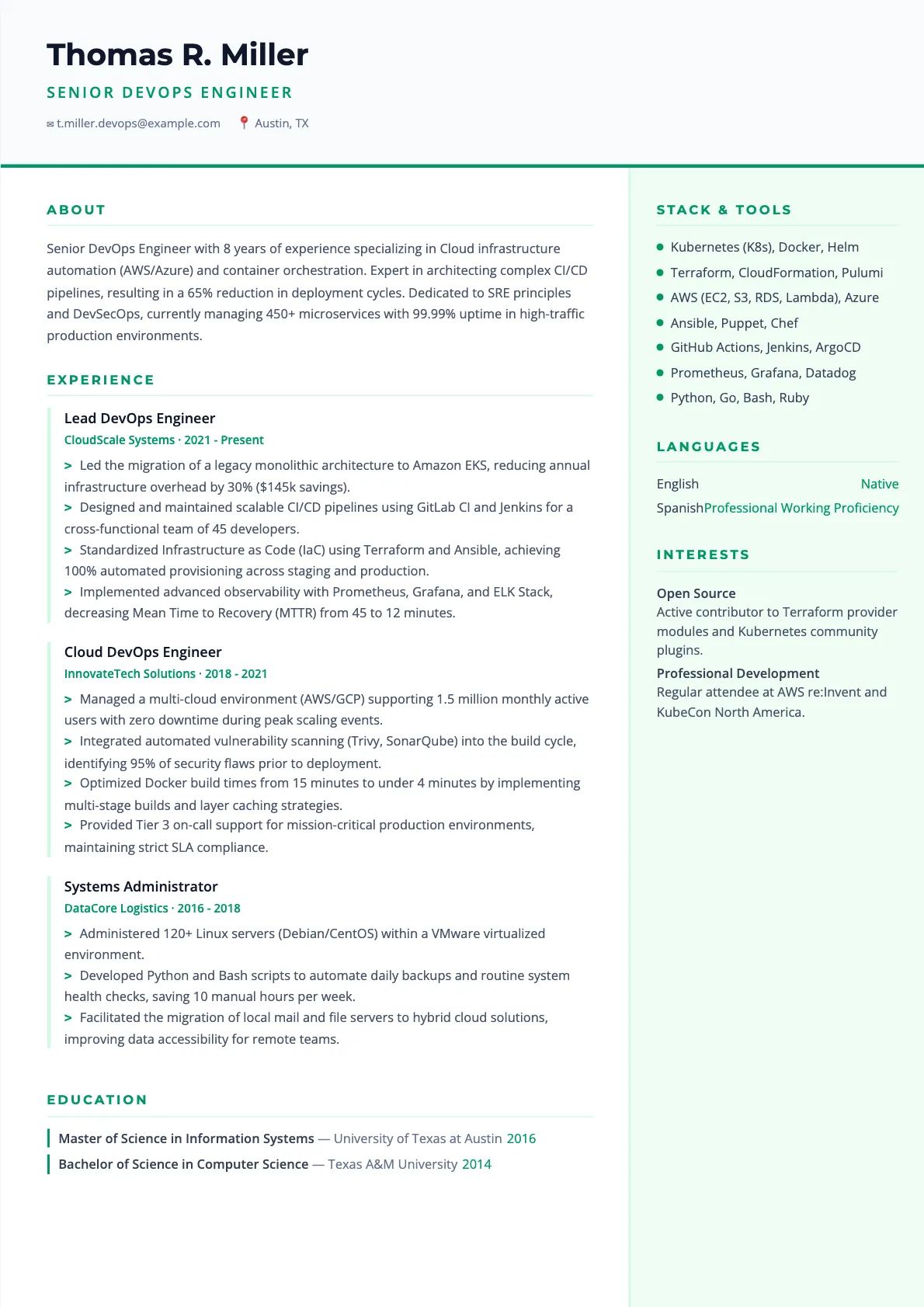
A successful DevOps Engineer resume must bridge the gap between software development and systems operations through quantifiable technical achievements. In the competitive US tech market, recruiters prioritize candidates who demonstrate measurable efficiency gains, such as reduced deployment times or infrastructure cost savings. This guide provides a fictional native example and strategic advice to help you showcase your automation and orchestration expertise effectively.
Updated
How should you structure a DevOps resume for US recruiters?
A professional DevOps resume must prioritize a clean, reverse-chronological layout that emphasizes technical stack proficiency alongside business impact. US recruiters typically spend very little time on the initial scan, so your core competencies like Kubernetes, Terraform, and AWS should be visible in a dedicated skills section or the professional summary. Avoid using photos, age, or marital status, as these are not standard in American hiring and can lead to immediate rejection for compliance reasons.
Focus your professional summary on your years of experience and your most significant architectural achievement. Instead of listing generic duties, use this space to define your specific niche, such as DevSecOps or Site Reliability Engineering. Ensure your contact information includes a LinkedIn profile and a professional email address, but omit physical street addresses to maintain privacy while indicating your general metropolitan area.
What technical evidence carries the most weight?
Concrete metrics regarding deployment frequency, system uptime, and cost reduction are the most persuasive elements of a DevOps resume. Hiring managers look for evidence that you understand the financial and operational implications of your technical choices. For example, stating that you reduced cloud spend by 20% is far more impactful than simply listing 'Cloud Cost Management' as a skill.
Use the STAR method (Situation, Task, Action, Result) to frame your bullet points.
Highlight your experience with Infrastructure as Code (IaC) and CI/CD automation as these are the pillars of modern DevOps roles. Mention specific tools like Terraform or Jenkins, but focus on the outcome, such as achieving 100% automated provisioning. If you have experience with security integration, often referred to as DevSecOps, detail how you automated vulnerability scanning within the pipeline.
This demonstrates a proactive approach to the entire software development lifecycle.
How do you handle certifications and education?
Industry-recognized certifications like AWS Certified Solutions Architect or Certified Kubernetes Administrator (CKA) should be prominently displayed to validate your expertise. While a degree in Computer Science provides a strong foundation, specialized certifications act as a shortcut for recruiters to verify your hands-on skills with specific platforms. List these in a dedicated 'Certifications' section or alongside your job title if you hold a particularly prestigious credential.
Always check the specific employer requirements as some may prioritize experience over formal certification.
When listing your education, focus on the degree earned and the institution rather than coursework, unless you are an entry-level candidate. For experienced engineers, the professional experience section should occupy the majority of the resume real estate. If you have migrated from a different technical field, emphasize the transferable skills such as scripting or systems administration.
Avoid asserting that a foreign degree is an exact equivalent to a US degree; simply list the original qualification and the institution.
What are the best practices for the cover letter?
A DevOps cover letter should tell a story of a specific technical challenge you solved and the resulting benefit to the organization. Unlike the resume, which is a factual record, the letter allows you to demonstrate your communication skills and cultural fit. Address the letter to a specific hiring manager if possible, and avoid generic greetings.
Focus on one or two major projects where your intervention directly improved developer productivity or system stability.
Keep the tone professional and solution-oriented, ensuring the letter stays between 220 and 300 words. Explain why you are interested in that specific company's infrastructure challenges, whether it is their scale, their move to serverless, or their commitment to open source. Conclude with a call to action that expresses your eagerness to discuss how your technical background aligns with their current roadmap.
This personalized approach distinguishes you from candidates who send automated applications.
| Vague Description | Quantifiable Achievement |
|---|---|
| Managed AWS infrastructure and servers. | Architected a multi-region AWS environment supporting 1M+ users with 99.9% availability. |
| Improved the deployment process. | Reduced deployment time from 2 hours to 15 minutes by implementing a blue-green strategy. |
| Worked on Kubernetes clusters. | Orchestrated 50+ microservices using Kubernetes and Helm, reducing resource waste by 25%. |