Resume and cover letter resources
Dentist Resume Example and Writing Guide
A successful Dentist resume must balance clinical precision with patient-centered care. In the United States, employers look for specific evidence of diagnostic accuracy, surgical proficiency, and the ability to manage a high-volume practice. This guide provides a fictional sample and strategic advice to help you showcase your expertise in restorative, preventative, and cosmetic dentistry effectively.
Updated
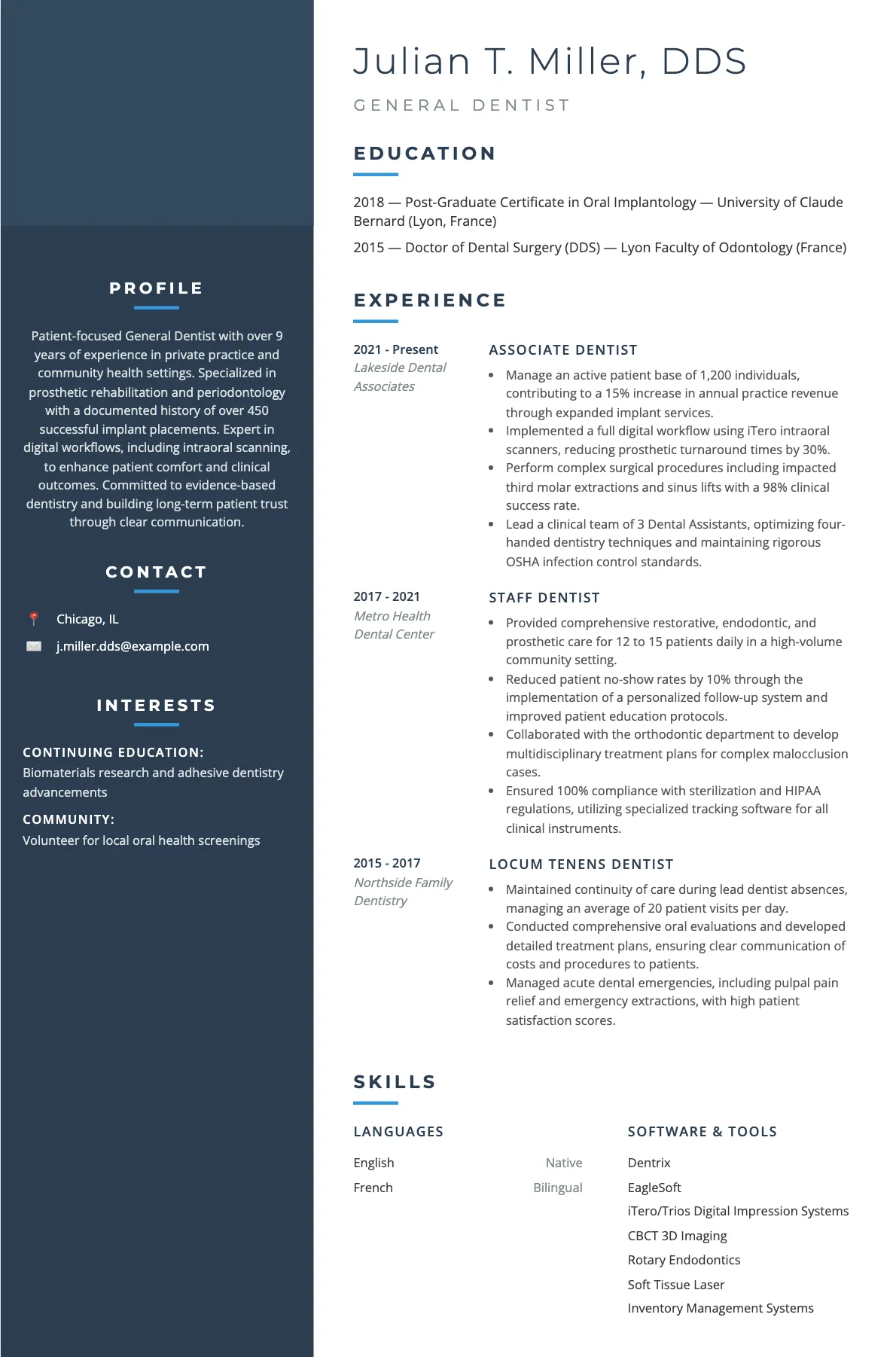
How should you format a Dentist resume for the US market?
A professional Dentist resume in the United States should follow a clean, reverse-chronological format that prioritizes clinical experience and specialized certifications. Avoid including a photo, age, or marital status, as these are not standard in American hiring and can lead to bias concerns. Focus on a clear header with your name and credentials, such as DDS or DMD, followed by a strong professional summary.
Use bullet points to describe your achievements rather than just listing duties.
Ensure your contact information is professional and up to date. Use a simple email address like name.dds@example.com and include your LinkedIn profile if it is well-maintained. While you should list your city and state, a full street address is no longer necessary.
If you are applying for a role in a different state, you might mention your licensure status for that specific jurisdiction to show you are ready to practice.
What clinical skills and technologies are most in demand?
Modern dental practices highly value proficiency in digital dentistry and advanced diagnostic tools. Mentioning specific software like Dentrix or EagleSoft is essential, but you must also highlight your hands-on experience with hardware. If you have used intraoral scanners like iTero or 3D imaging systems like CBCT, list these prominently.
These technologies demonstrate that you can improve practice efficiency and patient diagnostic accuracy.
Specialized surgical skills can significantly set a general dentist apart from other candidates. If you perform endodontics, oral surgery, or implant placements, quantify your experience. Instead of saying you do implants, state how many you have successfully placed.
This concrete evidence proves your value to a practice owner who may be looking to keep more specialized procedures in-house rather than referring them out.
How do you describe international dental qualifications?
When presenting a degree earned outside the United States, retain the original name of the qualification while providing context for its American functional equivalent. For example, if you hold a French State Diploma, list it exactly as granted but clarify that it is a doctoral-level dental degree. Never claim your foreign degree is an American DDS or DMD unless you have completed an advanced standing program at an accredited US dental school.
Transparency is vital for credential verification processes.
Focus on the scope of practice and clinical hours completed during your international training. Employers are interested in your technical proficiency and patient management skills. If you are in the process of migration, check with the specific State Board of Dentistry regarding licensure requirements, as these vary significantly by state.
Highlighting your clinical outcomes and specialized training, such as a D.U. in Implantology, shows a commitment to high standards regardless of where the training occurred.
What should be included in a Dentist cover letter?
A Dentist cover letter should bridge the gap between your technical skills and your chairside manner. Start by addressing the specific needs of the practice, such as their focus on family care or cosmetic dentistry. Explain how your background aligns with their patient demographic and practice philosophy.
Use one or two specific examples of how you solved a complex clinical case or improved a patient's experience to demonstrate your value.
Keep the tone professional yet personable to reflect your ability to build patient rapport. Mention your interest in the specific practice's reputation or their use of specific technologies. Conclude with a clear call to action, expressing your desire to discuss how your clinical expertise can contribute to their team's success.
A well-crafted letter shows that you are not just looking for any job, but that you are specifically interested in their practice environment.
| Common Mistake | Professional Alternative |
|---|---|
| Including a photo or personal details like age | Focus strictly on clinical credentials and experience |
| Listing 'General Dentistry' as a single bullet | Break down specific procedures like rotary endo or crowns |
| Vague mentions of 'using technology' | Name specific systems like iTero, CBCT, or Dentrix |
| Omitting volume or production metrics | State average daily patient load or revenue growth |
Frequently asked questions
Should I distinguish between a General Dentist and a Specialist on my resume?
Yes. If you are a General Dentist, clearly state this but highlight any 'super-GP' skills like molar endo or implants. If you are a specialist, your title should reflect your specific field, such as Periodontist or Endodontist, and your experience should focus heavily on those specialized procedures.
How do I list my Dental Assistant management experience?
Include this in your professional experience section. Mention the number of assistants you supervised and specific ways you improved workflow, such as implementing four-handed dentistry protocols or improving sterilization efficiency. This shows leadership and operational awareness.
Is it necessary to list every continuing education course?
No. List only the most significant or recent certifications that add value to the specific role you are applying for. Focus on long-term programs, surgical certifications, or training in new technologies rather than mandatory annual compliance updates.