Resume and cover letter resources
Corporate Trainer Resume Example & Writing Guide for 2026
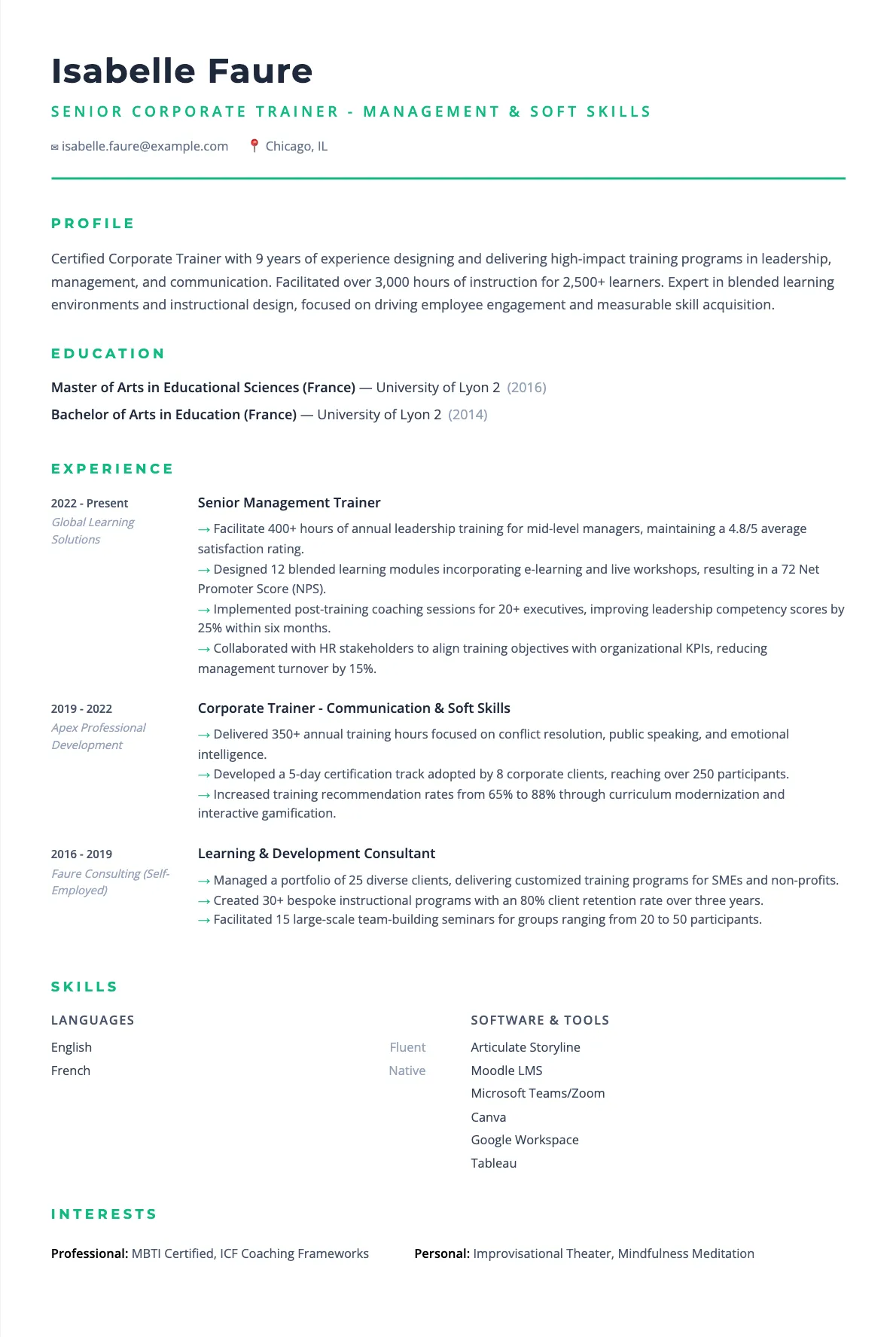
A Corporate Trainer resume must demonstrate more than just public speaking; it needs to prove measurable impact on employee performance. In the U.S. market, employers look for data-driven results such as Net Promoter Scores (NPS) and specific instructional design methodologies. This guide provides a fictional sample and strategic advice to help you highlight your pedagogical expertise and technical proficiency.
Updated
How to quantify your training impact?
Effective resumes for corporate trainers must move beyond listing daily duties to showcasing measurable outcomes through specific, data-driven metrics. Recruiters look for the volume of training delivered, such as total instructional hours or the number of participants, to gauge your stamina and experience level. You should also include quality indicators like average learner satisfaction scores or Net Promoter Scores (NPS) to prove your effectiveness in the classroom.
Quantifying these elements provides a concrete baseline for your professional capabilities. Business impact is the ultimate differentiator for senior roles in the United States market. If your training led to a reduction in safety incidents, an increase in sales, or improved employee retention, state these facts clearly.
Use percentages to show growth or improvement, such as a 20% increase in software adoption following a technical rollout. This data transforms you from a speaker into a strategic business partner who understands organizational goals. Entry-level candidates should focus on smaller-scale metrics or academic achievements.
If you lack professional data, highlight the number of workshops facilitated during internships or the size of the groups you managed. Mentioning that you improved a specific process or received high marks on peer evaluations can serve as a proxy for professional metrics. This approach demonstrates a results-oriented mindset even without a long career history.
Avoid the mistake of listing vague improvements without providing a starting point or a timeframe. Saying you improved communication is less impactful than stating you increased team efficiency scores by 15% over one fiscal year. Always provide context so the recruiter understands the scale of your success.
Clear, time-bound achievements are much more persuasive than general claims of excellence.
Which skills are essential for a Corporate Trainer?
A modern trainer needs a balance of delivery excellence and technical instructional design capabilities to remain competitive. While public speaking and facilitation are foundational, you must also demonstrate proficiency in Learning Management Systems (LMS) and authoring tools like Articulate Storyline or Adobe Captivate. Mentioning these tools by name helps your resume pass through Applicant Tracking Systems (ATS) that filter for specific technical requirements.
Mastery of these platforms shows you can handle the full lifecycle of a training project. Soft skills should be presented through the lens of pedagogical strategy rather than as simple personality traits. Instead of just listing communication, describe your ability to manage complex group dynamics or adapt content for diverse learning styles.
Highlight your expertise in adult learning principles, such as the ADDIE model or Bloom’s Taxonomy. These frameworks show that your training methods are grounded in proven educational science rather than just personal intuition. For those transitioning into training, emphasize transferable skills like project management and subject matter expertise.
If you were a high-performing sales representative, your ability to coach others on closing techniques is a vital training skill. Highlight your experience in creating documentation or onboarding new hires in previous roles. These activities are the building blocks of a professional training career.
Do not neglect the importance of virtual facilitation skills in the current job market. Proficiency in Zoom, Microsoft Teams, and interactive tools like Miro or Slido is now a standard requirement for most corporate roles. Clearly state your ability to engage remote audiences and manage digital breakout rooms.
This technical agility is often just as important as your ability to speak in front of a live audience.
How to handle international qualifications?
When presenting foreign degrees like those from France, retain the original name while providing a functional U.S. equivalent for context. For example, listing a Master in Ingénierie de Formation as a Master of Arts in Educational Sciences helps American recruiters understand the level of study. Do not claim your foreign degree is an American license; simply state the degree earned and the institution.
This maintains honesty while ensuring your education is not overlooked due to a language barrier. If you are moving to the U.S., focus on your functional experience rather than regulatory specificities of the French market. Terms like Qualiopi or BAFA have no direct equivalent and should be explained by their function, such as national quality certification or youth leadership certification.
Always check with the relevant state board or employer if a specific local certification is required for the industry you are entering. Requirements vary significantly between sectors like healthcare and corporate finance. Distinguish clearly between nursing roles if your background involves healthcare training.
In the United States, a Registered Nurse (RN) has a different scope of practice and licensing requirement than a nursing assistant or a vocational nurse. If you are discussing a French nursing qualification, describe the clinical hours and responsibilities without using protected American titles unless you have passed the NCLEX. This clarity prevents legal misunderstandings during the hiring process.
Tailor your resume by removing regionalisms that do not translate to the American corporate environment. Avoid mentioning age, marital status, or including a photo, as these are standard in some European countries but are excluded in the U.S. to prevent bias. Focus entirely on your professional merits and qualifications.
This ensures your resume aligns with American professional standards and legal expectations.
What should the professional summary include?
The professional summary should act as a high-level pitch that combines your years of experience, core specialties, and a major achievement. Avoid generic statements about being a people person or a passionate educator. Instead, define yourself by your niche, such as a Technical Sales Trainer or a Leadership Development Specialist.
This helps the recruiter immediately place you in the right category for their specific organizational needs. Include a specific hero metric in your summary to grab the recruiter's attention immediately. Mentioning that you have trained over 5,000 employees or designed a curriculum used across multiple countries sets a high bar for your candidacy.
Keep this section to three or four lines of punchy, action-oriented text. This ensures the most important information is seen within the first few seconds of the resume review. Entry-level applicants should use the summary to highlight their specialized knowledge and career objectives.
If you lack years of experience, focus on your certification in instructional design or your expertise in a specific software being taught. State clearly what you intend to bring to the company, such as a fresh perspective on digital engagement. This shifts the focus from what you lack to what you can contribute.
Avoid the mistake of using the summary to list every skill you possess. The summary is a highlight reel, not a full inventory of your capabilities. Save the detailed list of software and methodologies for the dedicated skills section.
A cluttered summary loses its impact and makes it harder for hiring managers to identify your primary value proposition.
| Common Mistake | Professional Alternative |
|---|---|
| Listing 'Public Speaking' as a primary skill | Facilitating interactive workshops for groups of 50+ |
| Focusing only on classroom delivery | Designing blended learning paths using LMS and e-learning |
| Vague descriptions like 'Improved employee skills' | Increased post-training assessment scores by 30% average |
| Including a photo or age (French style) | Focusing strictly on professional experience and contact info |
Frequently asked questions
Do I need a specific certification to be a Corporate Trainer in the U.S.?
There is no single mandatory license, but certifications from the Association for Talent Development (ATD) or the Certified Professional in Training Management (CPTM) are highly regarded. Industry-specific certifications, like those for software or safety, may be required by individual employers.
How long should a Corporate Trainer resume be?
For most professionals, a two-page resume is standard. This allows enough space to detail specific training modules you have designed and the results of those programs without overwhelming the reader.
Should I list every training topic I can teach?
No, focus on your core areas of expertise. Listing too many unrelated topics can make you look like a generalist. Group your topics into categories like Leadership, Compliance, or Technical Skills to keep the resume organized.