Resume and cover letter resources
Compliance Officer Resume Example and Writing Guide
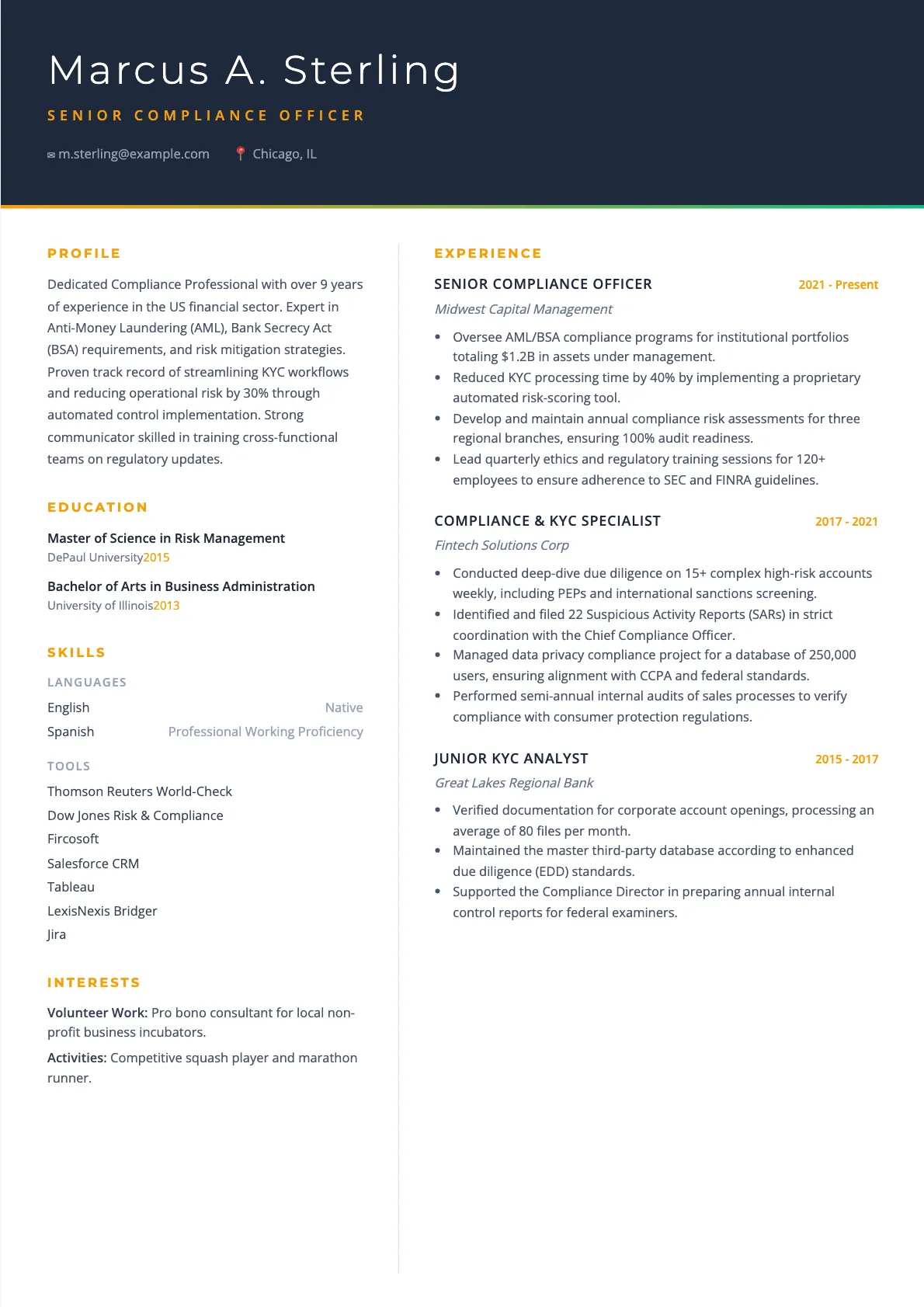
A Compliance Officer ensures a company follows all legal regulations and internal policies. In the United States, this role requires a blend of legal knowledge, risk assessment, and ethical leadership. This guide provides a fictional native resume sample and expert advice to help you showcase your regulatory expertise and operational impact to American recruiters and ATS software.
Updated
How should you structure a Compliance Officer resume?
A reverse-chronological format is the standard for compliance professionals as it highlights your career progression and recent regulatory experience. This structure allows recruiters to see your most relevant roles at the top, which is vital in a field where laws change rapidly. Ensure your contact information is clear and professional, omitting personal details like age or marital status.
A strong professional summary should follow, acting as a high-level pitch of your years of experience and core specialties.
The experience section must focus on quantifiable achievements rather than just listing daily duties. Use bullet points to describe how you mitigated risk, saved time, or improved audit scores. For compliance roles, mentioning the specific size of the portfolios or the number of accounts you managed adds necessary scale.
Finally, include a dedicated skills section for technical tools and specific regulations you have mastered.
Which keywords are essential for passing ATS filters?
Using industry-standard terminology like AML, KYC, and Due Diligence is critical for ensuring your resume passes through Applicant Tracking Systems. Recruiters search for these acronyms to find candidates who can hit the ground running. Include specific regulatory frameworks relevant to your sector, such as the Bank Secrecy Act (BSA), Dodd-Frank, or the Sarbanes-Oxley Act (SOX).
If you have experience with international standards, mention them clearly to show your versatility.
Action verbs such as Audited, Implemented, Monitored, and Mitigated help demonstrate your proactive approach to compliance. Avoid passive language that suggests you were merely a bystander in the process. Instead of saying you were responsible for reports, state that you authored or filed them.
This shift in tone shows leadership and accountability, which are highly valued traits in the compliance and legal sectors.
How do you highlight certifications and education?
List your highest degree first and include any industry-recognized certifications like CAMS or CFE prominently. In the United States, professional certifications often carry as much weight as a degree for specialized compliance roles. If you are currently pursuing a certification, list it with an expected completion date.
This shows a commitment to continuous learning and staying current with evolving financial crimes and regulations.
For candidates with international backgrounds, focus on the functional scope of your qualifications rather than direct equivalence. If you hold a French Master's in Compliance, list the degree as it was awarded but describe the skills gained in American English terms. Do not claim a US license unless you have officially passed the required exams in the states.
Focus on your ability to interpret complex legal texts and translate them into operational procedures, which is a universal skill.
What are the common mistakes to avoid in this field?
The most frequent error is failing to quantify the impact of your compliance oversight. A resume that only says you checked files does not tell the recruiter if you were efficient or thorough. Use percentages to show how you reduced errors or improved processing speeds.
Mentioning the dollar value of the assets you protected provides a sense of the stakes involved in your previous roles.
Another mistake is submitting a resume that is too long or cluttered with irrelevant personal information. Keep your document to one or two pages and avoid using photos, which are not standard in the US. Ensure there are no typos or formatting inconsistencies, as a Compliance Officer is expected to have an impeccable eye for detail.
A messy resume can lead a recruiter to believe your compliance reports will be equally disorganized.
| Weak Description | Strong Achievement |
|---|---|
| Responsible for KYC checks. | Streamlined KYC onboarding for 400+ clients, reducing turnaround time by 25%. |
| Handled AML alerts. | Investigated 50+ weekly AML alerts and successfully filed 15 high-priority SARs. |
| Updated compliance policies. | Authored and implemented a new remote-work compliance policy for 200 employees. |
Frequently asked questions
Do I need a law degree to be a Compliance Officer in the US?
While a Juris Doctor (JD) is common for senior or legal-heavy compliance roles, it is not always mandatory. Many professionals enter the field with degrees in Finance, Business, or Criminal Justice, supplemented by certifications like CAMS (Certified Anti-Money Laundering Specialist).
Should I include my photo on a US compliance resume?
No, you should never include a photo on a resume for the United States market. Including a photo can lead to concerns regarding bias and discrimination laws, and many US recruiters will automatically reject resumes that contain them.
What is the difference between a Compliance Officer and an Auditor?
A Compliance Officer works internally to ensure ongoing adherence to laws and prevent violations in real-time. An Auditor typically performs a periodic, retrospective review to verify that those compliance measures were actually followed and are effective.