Resume and cover letter resources
Communications Specialist Resume Example and Guide
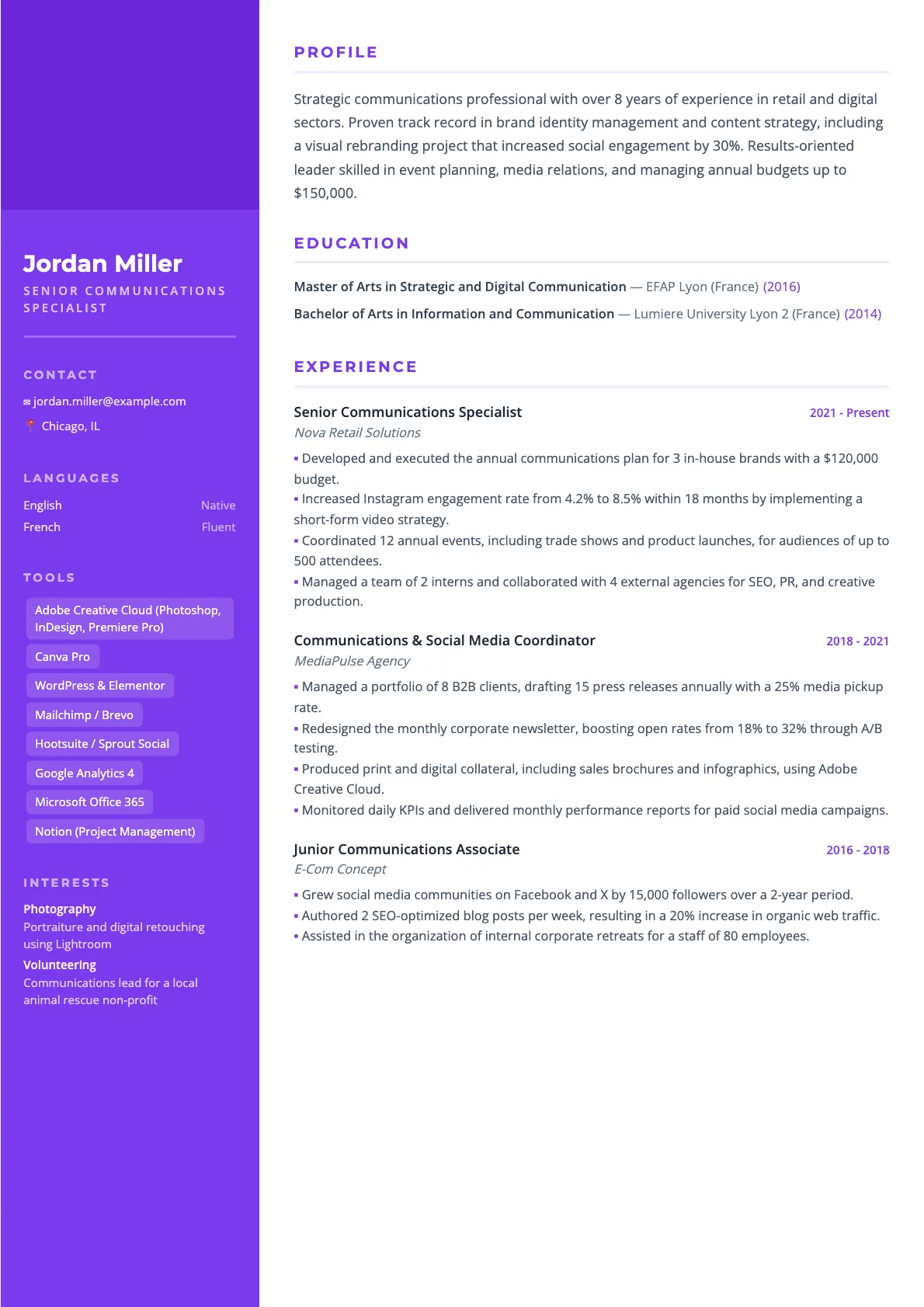
A successful Communications Specialist resume must bridge the gap between creative storytelling and data-driven results. In the competitive US job market, employers look for candidates who can demonstrate brand growth through specific KPIs and multi-channel expertise. This guide provides a fictional sample and actionable advice to help you showcase your strategic impact and technical proficiency effectively.
Updated
How should you structure a Communications Specialist resume?
A professional Communications Specialist resume should follow a reverse-chronological format to highlight career progression and recent achievements. This structure is preferred by US recruiters because it places your most senior responsibilities at the top. Start with a strong professional summary that encapsulates your years of experience and core areas of expertise, such as PR or digital strategy.
Ensure your contact information is clear and excludes personal details like age or marital status to comply with US hiring standards.
The experience section must focus on quantifiable outcomes rather than just listing daily tasks. Use bullet points to describe how your actions led to measurable growth, such as increased web traffic or higher conversion rates. For candidates with international backgrounds, keep the original names of your degrees but provide a brief context if the institution is not widely known in the US.
This maintains the integrity of your credentials while helping the hiring manager understand your educational level.
What are the essential skills for communications roles in 2026?
Modern communications roles require a blend of traditional writing excellence and advanced technical proficiency in digital analytics and AI tools. You should explicitly mention your ability to use platforms like Google Analytics 4 to track campaign success. Proficiency in the Adobe Creative Cloud remains a staple for content creation, but familiarity with AI-driven content generation is increasingly valued.
Highlighting these tools shows you are adaptable to the evolving technological landscape of the industry.
Soft skills like stakeholder management and crisis communication are equally vital for senior-level positions. Being able to navigate complex organizational structures and maintain brand reputation during a crisis is a high-value asset. Instead of just listing 'communication skills,' describe a time you managed a cross-functional project or handled a sensitive PR issue.
This provides concrete evidence of your interpersonal abilities and strategic thinking in high-pressure environments.
How do you quantify achievements on a communications resume?
Quantifying your impact involves using specific percentages, dollar amounts, and growth metrics to prove your value to a potential employer. Rather than stating you 'managed social media,' specify that you 'increased follower count by 20% and improved engagement by 15%.' These figures provide a tangible scale of your responsibilities and successes.
They help recruiters compare your performance against industry benchmarks and other candidates.
Budget management and media reach are two other critical areas where numbers make a significant difference. If you managed a $50,000 advertising budget or secured placements in national outlets with a reach of 1 million, include those details. Mentioning the size of the teams you led or the number of events you coordinated also helps define your seniority level.
Always ensure these metrics are accurate and reflect your direct contribution to the project.
Should you include a portfolio link on your resume?
Including a link to a digital portfolio or a LinkedIn profile is highly recommended for communications professionals to showcase their creative work. A resume can describe your skills, but a portfolio proves them through visual examples of campaigns, writing samples, and design projects. Place the link in your contact header for easy access.
Ensure the destination is mobile-friendly and professional, as recruiters often review these materials on various devices.
A well-curated portfolio should feature your best work rather than every project you have ever completed. Select four to six high-impact case studies that demonstrate a range of skills, from press releases to video production. For each project, briefly explain the challenge, your specific role, and the final result.
This narrative approach helps the recruiter understand your creative process and how you solve business problems through communication.
| Common Weakness | Stronger Alternative |
|---|---|
| Responsible for writing press releases. | Drafted 20+ press releases annually, securing coverage in top-tier outlets like TechCrunch. |
| Managed company social media accounts. | Grew LinkedIn community by 40% through a targeted thought-leadership content strategy. |
| Helped organize corporate events. | Directed logistics for a 500-person industry conference, staying 10% under the $100k budget. |
Frequently asked questions
What is the difference between a Communications Specialist and a PR Manager?
A Communications Specialist typically handles a broader range of internal and external tasks, including social media, content creation, and internal branding. A PR Manager focuses specifically on managing the public image and media relations of the company.
Do I need a specific license to work in communications in the US?
There is no universal mandatory license to practice communications in the US. However, some professionals pursue voluntary certifications like the Accreditation in Public Relations (APR). Always check specific employer requirements.
How long should a Senior Communications Specialist resume be?
For a professional with 8+ years of experience, a two-page resume is acceptable and often necessary to detail significant achievements. However, ensure every line adds value and avoid fluff.