Resume and cover letter resources
Clinical Psychologist Resume Example and Writing Guide
A Clinical Psychologist resume must bridge the gap between academic rigor and practical therapeutic outcomes. In the United States, employers look for specific evidence of patient caseload management, diagnostic proficiency, and multidisciplinary collaboration. This guide provides a native American English template and strategic advice to help you document your clinical impact and specialized treatment modalities effectively.
Updated
How should you present clinical experience on a resume?
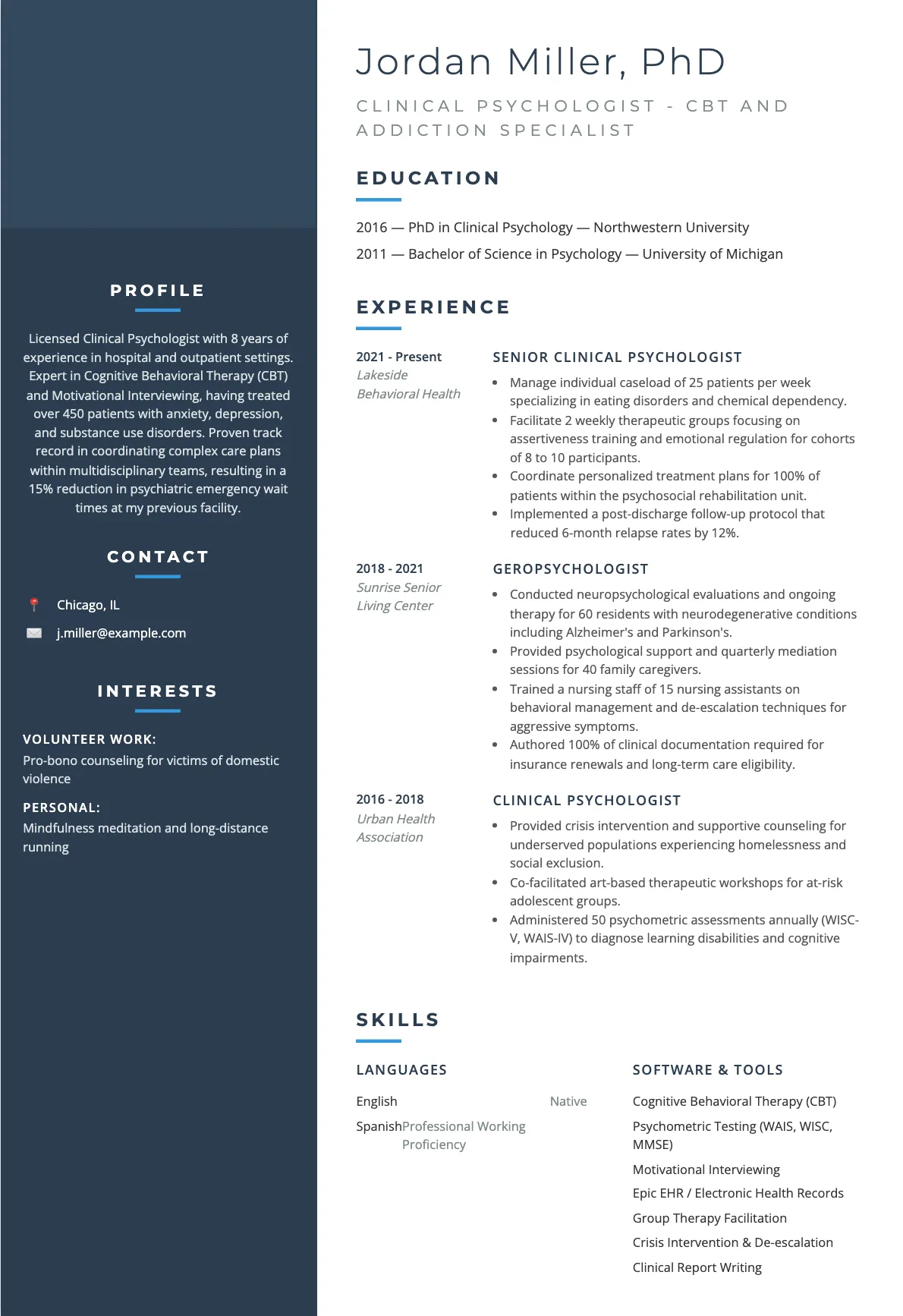
Focus on quantifiable patient outcomes and specific therapeutic modalities rather than just listing daily duties. Recruiters in the United States healthcare sector need to see the scale of your practice, such as weekly caseload numbers or the specific populations you serve. This fictional example demonstrates how to link interventions to results, like reducing relapse rates or improving staff efficiency.
Clearly distinguish between different levels of care and institutional settings. Whether you worked in an inpatient psychiatric ward or a private outpatient clinic, the context dictates the skills required. Use active verbs like facilitated, administered, or coordinated to show leadership within a care team.
Avoid vague descriptions of helping patients and instead describe the evidence-based protocols you utilized. Mentioning specific tools like the WISC-V or MMSE provides concrete evidence of your technical proficiency. Tailor your experience to the specific needs of the facility, whether it is a geropsychology center or a trauma-informed clinic.
Which certifications and licenses are essential to list?
Always place your state licensure and highest degree prominently at the top of the resume near your name. In the United States, the title Psychologist is legally protected and typically requires a doctoral degree and state-specific licensing. If you are a foreign-trained professional, you must list your original qualifications exactly as they were awarded.
Do not claim a US license unless you have successfully completed the state board requirements and hold a valid license number. Mention specialized certifications that add value to your specific niche. Certifications in EMDR, Board Certified Behavior Analyst (BCBA) credentials, or specialized addiction counseling certifications can set you apart.
Ensure you check the specific requirements of the state where you intend to practice, as regulations vary significantly across the country. For entry-level candidates, listing your supervised internship hours and the specific settings where they occurred is vital. Include your NPI number if applicable to demonstrate you are ready for immediate billing and clinical practice.
How do you handle the distinction between healthcare roles?
Ensure you correctly identify the nursing staff you collaborated with by using standard US terminology like RN or Nursing Assistant. In the US, a Registered Nurse (RN) has a different scope of practice than a Certified Nursing Assistant (CNA). If your experience involved training staff in behavioral management, specifying the role shows you understand the clinical hierarchy.
This clarity is vital for multidisciplinary team environments where roles are strictly defined by scope of practice. Avoid using foreign acronyms for support staff that do not exist in the American system. For example, if you worked with French AESH or ATSEM, describe their functional role as Educational Support Assistant or Paraprofessional rather than using the acronym.
This ensures the hiring manager understands your experience in supervising or collaborating with support personnel. Distinguishing between these roles demonstrates your familiarity with the American healthcare infrastructure. It also highlights your ability to communicate effectively across different levels of medical and support staff.
What are the common mistakes to avoid on a US resume?
Leave out age, gender, marital status and photographs so the resume focuses on your professional qualifications. Use that space to identify your clinical setting, patient populations and relevant experience. A clean, professional layout that focuses entirely on your qualifications and work history is the standard.
Use a standard font and avoid overly complex graphics that might interfere with Applicant Tracking Systems. Select a length that lets you explain relevant clinical experience clearly, and follow any document instructions in the posting.
Ensure your contact information is current and professional, using a standard email address. Avoid using jargon that is specific to a single institution and instead use industry-standard terminology. Proofread carefully to ensure there are no spelling errors, particularly with medical and psychological terminology.
| Weak Description | Stronger Clinical Alternative |
|---|---|
| Saw patients for therapy sessions. | Managed a weekly caseload of 25+ adult patients using CBT for mood disorders. |
| Helped nurses with difficult patients. | Trained 15 nursing assistants in de-escalation techniques for geriatric care. |
| Did psychological testing. | Administered and interpreted 50+ annual psychometric batteries (WAIS-IV, MMPI-2). |
Frequently asked questions
Should I include my clinical internships on my resume?
Include relevant supervised placements and postdoctoral experience, especially early in your career. Label training roles accurately and distinguish them from independent practice or later employment. As your experience grows, shorten older placements while retaining information that helps the employer understand your clinical background.
How do I list a foreign psychology degree for a US job?
List the degree exactly as it was issued by the original institution. You may include a brief parenthetical explanation of the US equivalent if you have had a formal credential evaluation, but never rename the degree itself to a US title.
When should I include a cover letter with a psychologist application?
Follow the document requirements in the job posting. When a letter is requested or welcomed, explain why your experience fits the setting and patient population, using one relevant example. Keep confidential patient information out of both the letter and the resume.